Microsoft 365 Copilot Adoption: The Metrics Leaders Must Track
Enterprises now race to prove Microsoft 365 Copilot adoption delivers real business value. However, many leaders still rely on vanity numbers. Prompt counts and license tallies sound impressive, yet they rarely sway CFOs. Consequently, funding stalls and pilots fade. This article shows how to capture outcome-driven metrics that unlock scale.
Drawing on Adoptify.ai field work, Microsoft telemetry updates, and analyst ROI models, we outline a compact measurement blueprint. HR, L&D, IT, and digital transformation teams can use it to secure investment, manage risk, and accelerate productivity across functions.
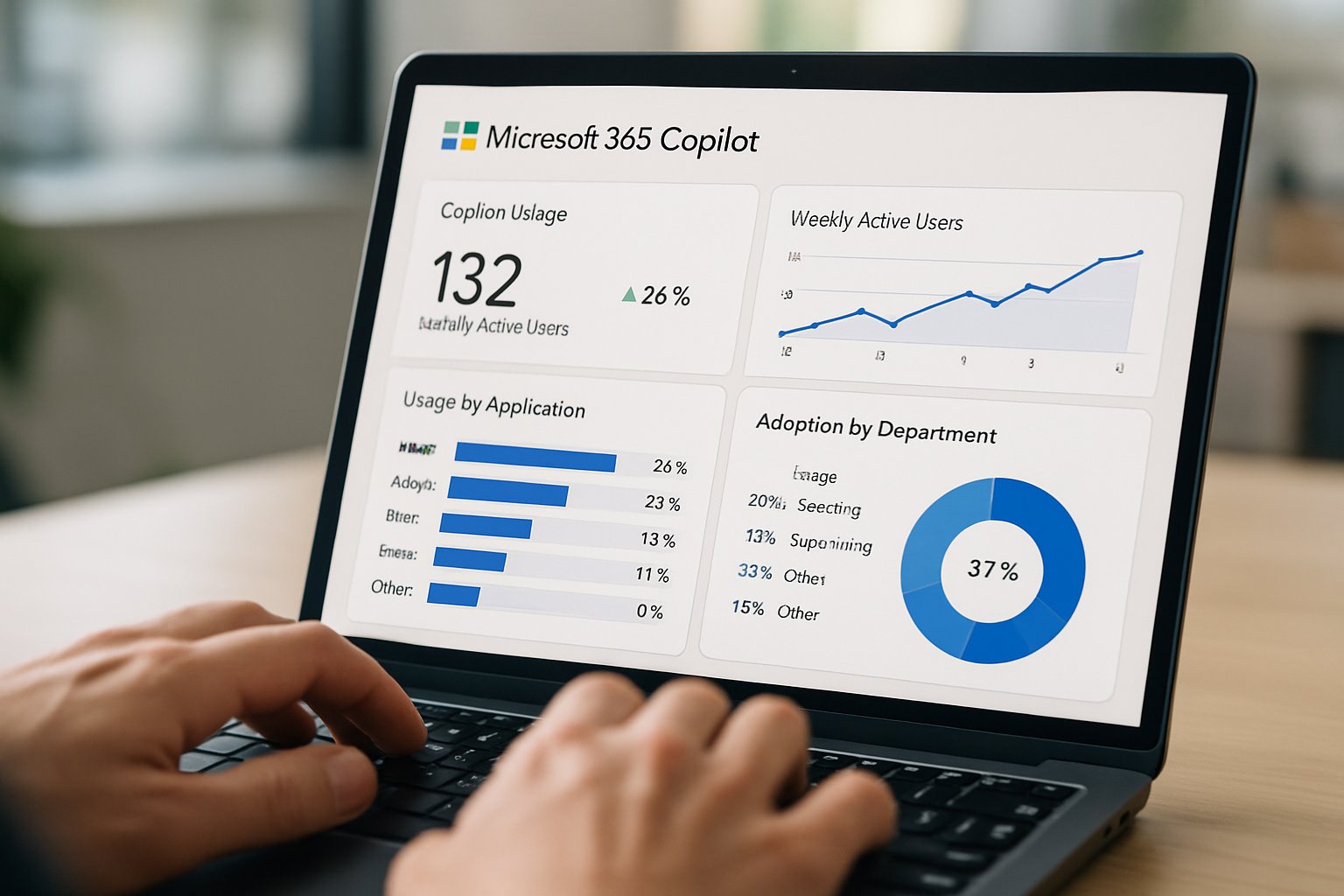
Why Metrics Matter
McKinsey reveals 88% of firms now use AI somewhere. Nevertheless, only a minority achieve EBIT impact. The gap lies in measurement rigor. Without clear Copilot adoption metrics, executives cannot link effort to outcomes. Funding dries up before value compounds.
Furthermore, governance teams need proof that security controls hold under load. Telemetry validates DLP rules and supports compliance audits. Meanwhile, line managers crave insight to coach lagging cohorts.
Adoptify.ai’s AdaptOps model tackles those needs. Real-time dashboards convert raw signals into minutes saved, error reductions, and revenue deltas. Therefore, sponsors gain confidence to expand licenses.
Key takeaway: Metrics translate experimentation into enterprise programs. Second takeaway: Quality metrics calm governance fears. Next, we explore the metric framework.
Three Layer KPI Model
Successful Microsoft Copilot adoption programs follow a three-layer structure. Adoption measures breadth, intensity gauges depth, and outcome indicators prove impact. Microsoft’s new Viva Insights exports now make each layer feasible.
Layer one shows if people start using Copilot. Layer two tracks how well sessions run. And, Layer three quantifies financial returns. This stack aligns with Forrester TEI guidance and Adoptify’s ROI dashboards.
Importantly, Microsoft 365 Copilot metrics must remain lightweight. Flooding leaders with thirty charts dilutes focus. Instead, select two or three KPIs per layer and review them in QBRs.
Key takeaway: Use a tiered model to avoid noise. Second takeaway: Fewer KPIs drive sharper action. Next comes the first layer—adoption.
Adoption Layer Core Signals
The adoption layer answers, “Are people even trying Copilot?” Critical signals include:
- License utilization percentage
- Weekly active users
- Time-to-first-value (TTV)
- Cohort retention at 30/60/90 days
Adoptify pilots target 80% activation within four weeks. They achieve that by embedding in-app guidance and role-based nudges. Moreover, HR teams can correlate training completions with activation spikes.
Tracking these Copilot adoption metrics lets managers spot stalled groups early. Consequently, support arrives before frustration spreads. Remember to anonymize data at the team level to maintain trust.
Key takeaway: High activation underpins later ROI. Second takeaway: Privacy-safe cohort views increase acceptance. Next, we deepen measurement with intensity and quality.
Intensity Quality Indicators Guide
Raw usage is not enough. Leaders must know whether sessions succeed. Microsoft now highlights Successful Session Rate (SSR) as a prime metric. SSR measures how often Copilot reaches the user’s goal without rework.
Other depth KPIs include prompts per session, active days, and hallucination rates. Together, they reveal user stickiness and model reliability. Adoptify dashboards flag departments where SSR falls below 70%, triggering targeted coaching.
When Microsoft 365 Copilot metrics show intense yet low-quality use, fix training or governance before scaling. Conversely, high SSR indicates readiness for broader rollout.
Key takeaway: Quality metrics protect brand trust. Second takeaway: SSR is the early-warning system. Next, we translate depth into business impact.
Outcome And Business Impact
Outcome KPIs clinch the funding debate. Adoptify field pilots report 60–75 minutes saved per user daily in focused scenarios. Finance leaders care because minutes saved convert into lower cycle times and cost per case.
Common impact metrics include FTE-equivalent capacity, revenue uplift, and error reduction. Forrester TEI studies show ROI ranging from 125% to 468% over three years when those outcomes materialize. Therefore, tie each Copilot scenario to a clear baseline and delta.
Link training completions to outcome shifts. Trained cohorts often post higher minutes saved and fewer governance incidents. That correlation strengthens Microsoft 365 Copilot adoption narratives for the board.
Key takeaway: Business KPIs unlock capital. Second takeaway: Baselines turn anecdotes into proof. Next, we secure the program with governance.
Governance And Privacy Guardrails
No enterprise will scale AI without airtight controls. Adoptify packages Purview DLP templates, Entra Conditional Access policies, and insider-risk alerts. Administrators gain visibility into data exposure events per 1,000 sessions.
Tracking compliance incidents sits alongside Microsoft Copilot adoption numbers. If DLP hits spike, AdaptOps playbooks pause rollout until mitigations land. Consequently, risk stays within tolerance.
Moreover, privacy rules require de-identified reporting. Adoptify exports strip personal identifiers yet keep team trends intact. This approach balances insight with ethics.
Key takeaway: Governance metrics accelerate security approval. Second takeaway: Privacy-first design sustains trust. Next, we discuss funding conversations.
Turning Data Into Funding
Metrics only matter when they influence budgets. Finance chiefs want payback periods and multi-scenario ROI. Adoptify dashboards blend Viva data with cost models to produce executive-ready views.
Use TEI methodology to present low, medium, and high cases. Include training, governance, and operational costs. When Copilot adoption metrics show quick payback, funding usually follows.
Finally, benchmark against GitHub Copilot developer seat utilization to illustrate achievable saturation rates. Demonstrated performance eases resistance and justifies additional licenses.
Key takeaway: Clear ROI unlocks capital. Second takeaway: Scenario planning builds credibility. We now wrap up the journey.
Conclusion And Next Steps
Microsoft 365 Copilot adoption succeeds when leaders track activation, quality, and outcome metrics in one coherent stack. SSR, minutes saved, and license utilization form the core scorecard. Governance signals keep security aligned, while ROI models convert data into budget.
Why Adoptify 365? Adoptify 365 couples AI-powered digital adoption, interactive in-app guidance, intelligent user analytics, and automated workflow support. Consequently, organizations achieve faster onboarding, higher productivity, and resilient scale with enterprise-grade security. Experience streamlined Microsoft 365 Copilot adoption and sustained impact by partnering with Adoptify 365. Explore the platform today.
Frequently Asked Questions
- How does Adoptify 365 optimize Microsoft 365 Copilot adoption?
Adoptify 365 optimizes Copilot adoption by integrating in-app guidance, role-based nudges, and intelligent user analytics. Our dashboards track key metrics like license utilization, successful session rate, and time-to-first-value to drive actionable insights and ensure rapid onboarding. - What key metrics should enterprises monitor for successful Copilot adoption?
Enterprises should monitor metrics including license utilization, weekly active users, successful session rate, and outcome indicators like minutes saved per user. These KPIs ensure effective digital adoption and ROI, helping to secure continued funding. - How does in-app guidance from Adoptify 365 enhance user engagement?
Our in-app guidance delivers just-in-time support and role-based nudges that enhance user engagement. By streamlining onboarding and providing actionable insights, Adoptify 365 increases activation rates and sustains Copilot adoption. - How does Adoptify 365 maintain privacy and security during digital adoption?
Adoptify 365 incorporates robust governance by integrating Purview DLP templates and de-identified reporting to ensure security and privacy. Our approach supports compliance audits while delivering actionable user analytics for continuous workflow improvements.

FEATURED
Scaling Retail Operations Through Corporate AI Adoption
February 27, 2026
FEATURED
How Corporate AI Adoption Reduced Operational Costs by 40%
February 27, 2026
FEATURED
Boutique Enterprise AI Adoption vs Big Four Consulting
February 25, 2026
FEATURED
Security Audit for Corporate AI Adoption
February 25, 2026
FEATURED
What is the Average Investment for Enterprise AI Adoption
February 20, 2026