Copilot vs ChatGPT Enterprise: Picking Your Enterprise AI
Enterprises face a pivotal choice today: Copilot vs ChatGPT Enterprise. Both assistants promise radical productivity gains, yet their strengths differ. Choosing the right path influences security posture, workflow speed, and cultural change. This article delivers an expert, data-driven AI Assistant Comparison to guide HR, IT, and transformation leaders.
We ground every insight in measurable adoption metrics, not vendor hype. Moreover, we weave in Adoptify AI’s AdaptOps frameworks so you can translate pilot success into lasting value.
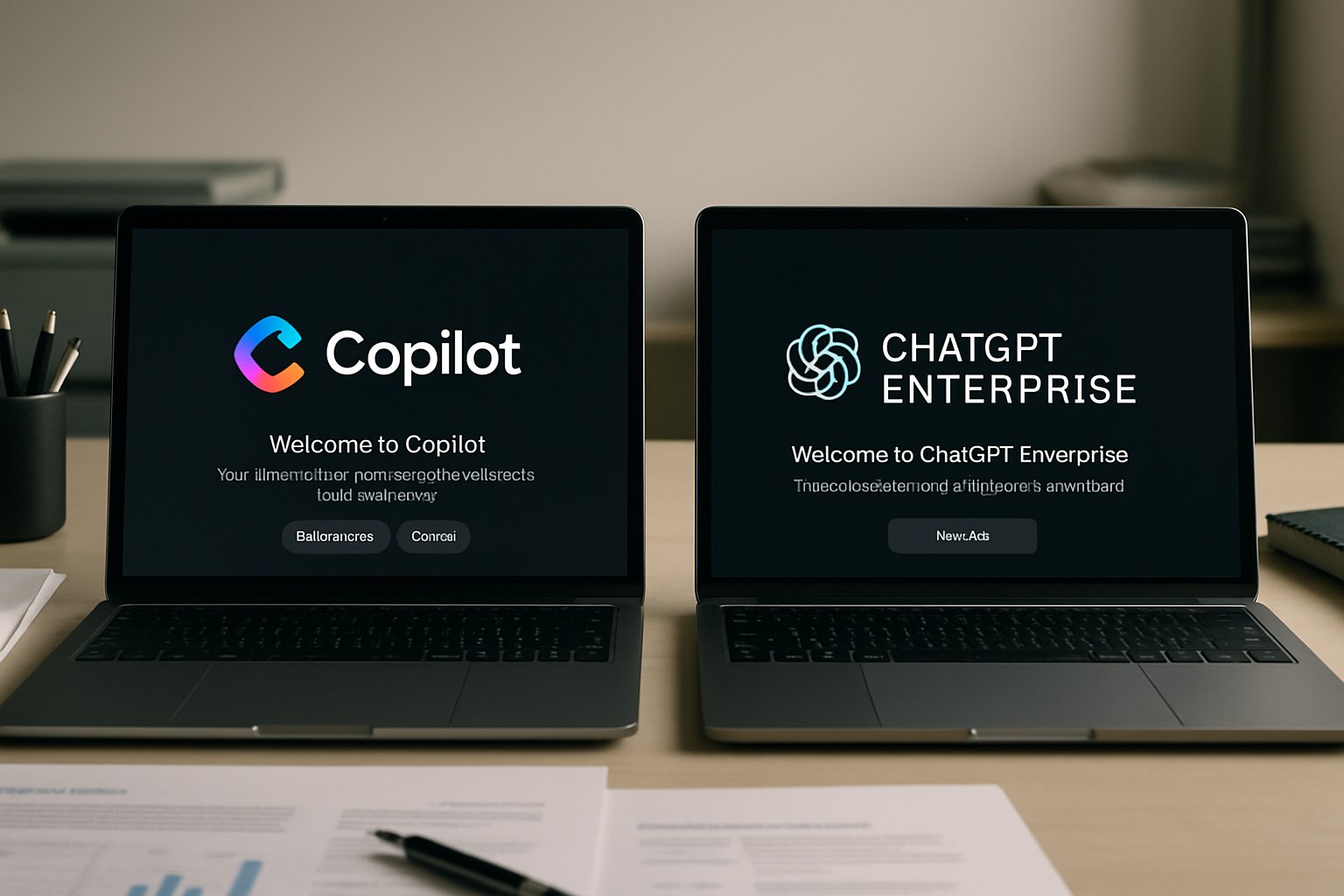
Copilot vs ChatGPT Enterprise
This section frames the headline rivalry. Microsoft 365 Copilot lives inside Word, Excel, Teams, and Outlook. Consequently, users engage without leaving familiar screens. ChatGPT Enterprise operates as a platform-agnostic chatbot with APIs for custom agents and integrations.
According to McKinsey, generative AI could add up to $4.4 trillion in annual value. Horizontal copilots already dominate spending, so your selection matters. An AI Assistant Comparison therefore hinges on five factors: workload fit, integration effort, security, cost, and operational readiness.
Key takeaway: match the assistant to the job, not marketing buzz. Next, we explore why comparisons now matter.
Why Comparisons Matter Now
Budgets tighten while AI expectations soar. Gartner warns that pilot purgatory threatens 60% of enterprises without clear adoption plans. Meanwhile, microsoft copilot adoption rates surge where governance exists.
OpenAI counters with rapid feature releases, including regional data residency and expanded context windows. Consequently, leaders must weigh a Copilot vs ChatGPT Enterprise comparison before committing long-term capital.
Summary: Competitive pressures require a structured decision. Let’s transition to workflow integration.
Integration And Workflow Fit
Microsoft Copilot enterprise productivity thrives because it plugs into Microsoft Graph. Permissions follow Entra ID, so data lineage remains intact. Users create summaries, drafts, and meeting minutes inside the flow of work.
Conversely, ChatGPT Enterprise shines for cross-platform scenarios. Developers build custom pipelines, fine-tune models, and embed assistants via API. Such flexibility benefits product teams crafting unique Copilot vs ChatGPT workflows.
Adoptify AI’s telemetry shows a 40% task-time reduction when Copilot is embedded where work happens. However, labs using ChatGPT’s APIs achieved deeper knowledge synthesis for specialized research teams.
- Copilot Strengths: native UI, minimal context switching, automatic compliance labels.
- ChatGPT Strengths: large context window, code interpreter, flexible embedding.
Summary: pick Copilot for mainstream productivity, choose ChatGPT for bespoke builds. Next, security enters the spotlight.
Security And Compliance Lens
Regulators demand proof of control. Microsoft integrates Copilot with Purview DLP, eDiscovery, and tenant isolation. Therefore, Copilot vs ChatGPT security debates often tip toward Microsoft in Microsoft-centric environments.
OpenAI has responded. ChatGPT Enterprise now offers SOC 2 compliance, SSO, SCIM, and European data residency. Admins receive audit logs and usage analytics, narrowing the gap.
Adoptify AI recommends a risk-first pilot. Test sensitive workflows under both platforms, then benchmark incident rates. This evidence beats assumptions.
Summary: Both vendors improved controls, yet integration depth differs. Our next stop is cost.
Total Cost Ownership Realities
Copilot pricing arrives as a per-user Microsoft add-on. Organizations already licensed for Microsoft 365 E3/E5 can forecast spend easily. Moreover, ECIF funding often offsets pilot costs during microsoft copilot adoption.
ChatGPT Enterprise uses negotiated pricing. Costs hinge on model usage, token volume, and API calls. High-volume data projects can trigger credit overruns if unsupervised.
The true Copilot vs ChatGPT Enterprise comparison therefore extends beyond license fees. Include training, governance tooling, connector upkeep, and model credits in the calculation.
Summary: Transparent licensing favors Copilot; flexible consumption favors ChatGPT. We now review scale tactics.
Pilot To Scale Playbook
Adoptify AI’s AdaptOps model runs short, governed pilots. Leaders select one high-value workflow, apply baseline metrics, and test both tools in parallel. Dashboards track adoption, accuracy, and time saved.
After 90 days, teams gate expansion on KPIs. If Copilot shows higher Microsoft Copilot enterprise productivity, scale within Office apps. If ChatGPT API workflows outperform, allocate connectors and credits with guardrails.
This data-driven approach prevents shadow AI, aligns with Copilot vs ChatGPT workflows, and speeds decision cycles.
Summary: Prove value fast, then scale responsibly. We conclude with a decision framework.
Decision Framework Summary Guide
The table below condenses our findings.
| Dimension | Microsoft Copilot | ChatGPT Enterprise |
|---|---|---|
| Workflow Fit | Embedded Microsoft apps | Custom multi-app agents |
| Security Controls | Purview, Entra ID native | Enterprise audit, residency |
| Licensing Model | Per-user add-on | Usage-based, negotiated |
| Governance Ease | Tenant-aware defaults | Requires policy scripting |
| Time To Value | Fast for Office users | Fast for dev teams |
Therefore, leaders should score each assistant against workload priorities. Adoptify AI dashboards automate this scoring.
Summary: A structured rubric clarifies the choice. We now wrap up.
Conclusion
Copilot vs ChatGPT Enterprise decisions should rely on measurable pilots, security posture, and total cost views. Microsoft excels in embedded productivity, while OpenAI wins on customization. Adoptify AI bridges the gap with AI-powered digital adoption, interactive in-app guidance, intelligent user analytics, and automated workflow support. Consequently, teams onboard faster and reach higher productivity without sacrificing enterprise scalability or security.
Ready to elevate workflows? Discover how Adoptify AI drives governed Copilot vs ChatGPT Enterprise rollout success at Adoptify.ai.
Frequently Asked Questions
- What factors should be considered when comparing Copilot and ChatGPT Enterprise?
Consider workflow fit, security controls, licensing models, and integration complexity. Adoptify AI enhances digital adoption with in-app guidance and automated support to streamline your pilot-to-scale process. - How does digital adoption impact AI assistant selection?
Digital adoption ensures seamless integration within existing workflows. A well-chosen assistant, supported by interactive in-app guidance and real-time user analytics, boosts productivity and streamlines enterprise operations. - How does workflow intelligence enhance enterprise productivity?
Workflow intelligence optimizes task execution and reduces inefficiencies. With tools like Adoptify AI providing intelligent user analytics and automated support, enterprises achieve measurable productivity gains. - What role do user analytics play in refining AI assistant adoption?
User analytics offer insights into adoption patterns and performance metrics. They help tailor in-app guidance and support, ensuring that AI assistants like Copilot or ChatGPT Enterprise meet your workflow and digital adoption goals.
FEATURED
Artificial intelligence adoption: Inbox zero with Copilot
February 3, 2026
FEATURED
Artificial intelligence adoption: myths leaders must crush
February 3, 2026
FEATURED
Establishing Ethical Artificial Intelligence Adoption Guidelines
February 3, 2026
FEATURED
Artificial Intelligence Adoption: Models, Skills, ROI
February 3, 2026
FEATURED
20-Point Artificial Intelligence Adoption Readiness Checklist
February 3, 2026