Consulting Firms’ AI Readiness Checklist: 13 Must-Do Steps
Consulting leaders face rising client pressure to move beyond pilots and deliver governed, scaled AI value. Consequently, they need a robust AI readiness checklist that aligns strategy, governance, and enablement. This article delivers exactly that. We translate AdaptOps best practices, industry data, and governance mandates into thirteen actionable items that help firms monetize AI services while protecting clients. Follow along to embed each step into your operating model.
Why Checklist Matters
Market data shows 88% of enterprises run AI pilots, yet only one-third scale. Meanwhile, Gartner expects 40% of agentic projects to fail without clear controls. Therefore, a structured AI readiness checklist guards revenue, reputation, and client trust.
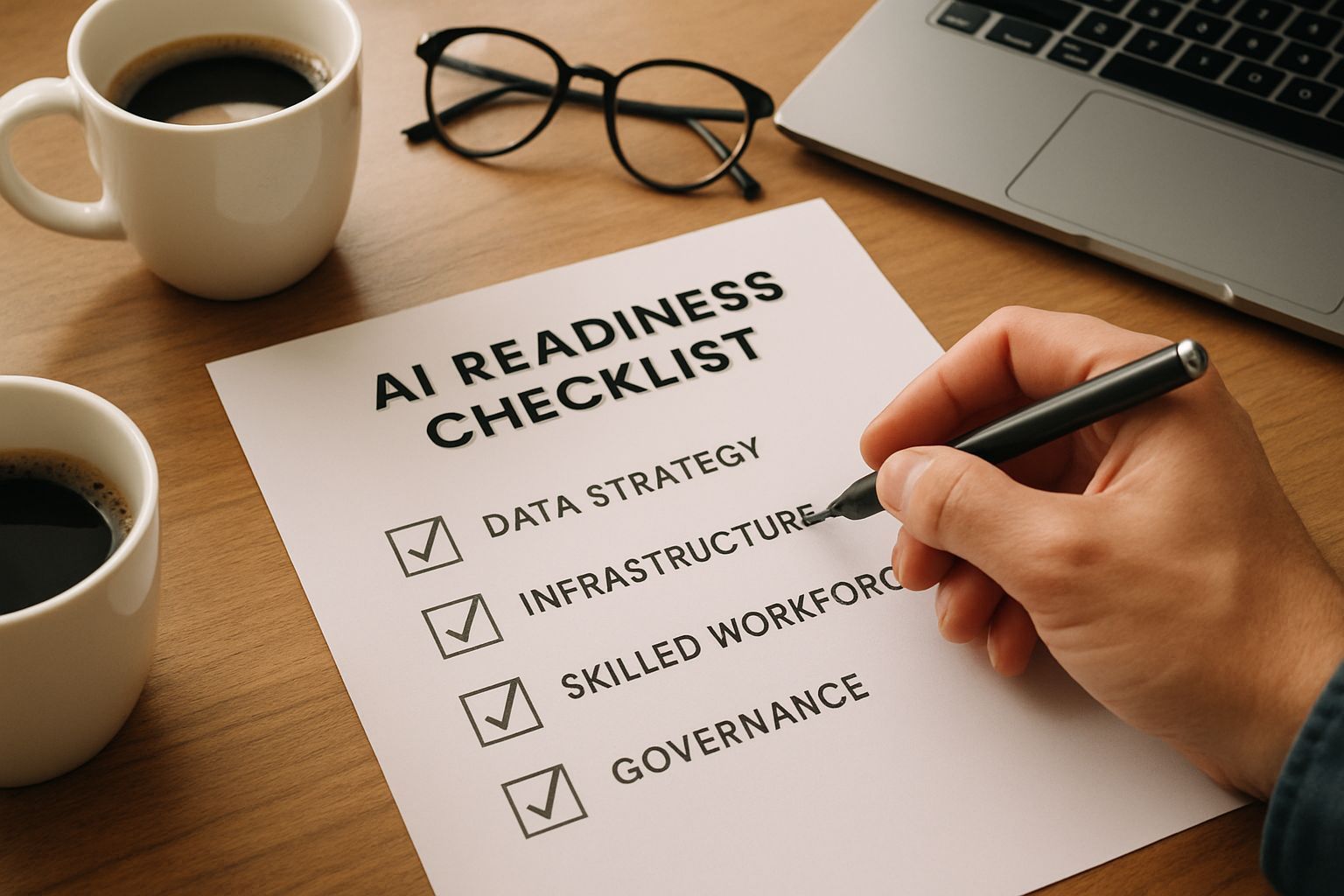
Adoptify AI research links checklist discipline to faster Copilot rollouts and 90-day ROI proof points. Moreover, regulatory pressure from NIST, ISO 42001, and the EU AI Act makes auditable processes non-negotiable.
Key takeaway: scaling demands a repeatable framework that blends commercial clarity, governance, and change management. We now transition into the first action domain.
Define Market Offerings
First, package services into fixed-scope bundles: readiness assessment, funded pilot, scale program, and managed AdaptOps. Additionally, leverage Microsoft ECIF co-funding to lower client entry barriers.
Second, set outcome-based SLAs such as “ROI in 90 days” to differentiate from rivals.
Summary: clear packaging plus funding accelerators sharpen competitiveness. Next, align executives and metrics.
Secure Executive Sponsorship
High performers tie projects to growth metrics, not just cost cuts. Consequently, obtain a C-level sponsor, target KPI, and funding gate before writing code.
Use a one-page charter that lists value drivers, decision cadence, and success thresholds.
Summary: early sponsorship prevents scope drift. We now examine rapid diagnostics.
Rapid Readiness Assessment
A two-to-four-week diagnostic anchors the AI readiness checklist. It maps data maturity, security posture, regulatory hits, and baseline ROI.
Adoptify AI’s ECIF Quick Start offers a proven template. Furthermore, scoring each dimension on a traffic-light scale visualizes gaps for executives.
Key takeaway: speed plus structure converts stakeholder curiosity into committed budget. Let us prioritize use cases next.
Prioritize High-Value Use Cases
Score feasibility, data availability, compliance risk, and speed-to-value. Subsequently, pick one to three pilots with measurable impact.
Gartner insists agentic pilots succeed only when business value is explicit. Therefore, align each case with an EBIT driver or cycle-time reduction metric.
Summary: rigorous scoring prevents hype-driven failures. We move to secure pilot design.
Secure Pilot Foundations
Privacy-by-design sits at the heart of the AI readiness checklist. Implement least-privilege identities, audit logging, and control matrices mapped to NIST AI RMF.
Create a living compliance heat map that links policy to evidence. Moreover, prepare data protection impact assessments for sensitive workloads.
Key takeaway: governance earns trust and accelerates approvals. The next step covers technical plumbing.
Harden Data And MLOps
Verify data lineage, automated testing, model monitoring, and drift alerts. Additionally, integrate runtime policies for agent prompts and connect logs to the client SIEM.
Build reusable Terraform or Bicep modules to cut setup time across accounts.
Summary: hardened pipelines enable repeatable quality. We now address people enablement.
Change Enablement Strategy
Even perfect models fail without users. Hence, include role-based microlearning, in-app guidance, and certification tracks such as AdaptOps Foundation.
LinkedIn data shows organizations with AI fluency programs outperform peers by 32%. Meanwhile, champion networks boost frontline adoption.
Key takeaway: learning drives utilization and revenue. We progress to governance as a service.
Deliver Audit-Ready Pack
Package policies, control evidence, and impact assessments into an “audit packet.” Consequently, finance and security teams can sign off quickly.
Offer continuous assurance subscriptions that update the packet as models evolve.
Summary: audit packs transform governance into revenue. Next comes measurement.
KPI And ROI Framework
A dashboarded KPI framework anchors the AI readiness checklist. Track active users, task-time saved, utilization uplift, and EBIT proxy values.
Furthermore, set go/no-go gates tied to predefined thresholds. McKinsey finds firms with clear metrics scale twice as fast.
Key takeaway: transparent numbers justify expansion budgets. Scaling and productization now follow.
Codify Playbooks And IP
Convert pilot artifacts into vertical playbooks, industry templates, and reusable code. Moreover, leverage ECIF marketing funds to promote packaged offers.
Price managed AdaptOps subscriptions that bundle dashboards, governance, and L&D refreshers.
Summary: productization boosts margin and valuation. Our final checklist items address security and legal shields.
Enforce Runtime Security
Agentic AI introduces runtime risks. Therefore, apply policy cards, prompt safety tooling, and continuous risk simulations.
Palo Alto research warns prompt injection exploits can surface within days if controls lack coverage.
Summary: proactive controls reduce breach probability. Legal safeguards close the loop.
Draft Protective Contracts
Write scopes with success metrics, data handling SLAs, and indemnities for regulated domains. Additionally, map obligations to EU AI Act milestones.
Renewals should align managed-service fees with realized KPI improvements.
Summary: strong contracts protect both parties. We conclude with operate-and-optimize cadence.
Scale And Monetize
Establish a 12–36-month AdaptOps roadmap. Monthly champion calls, quarterly governance reviews, and continuous ROI telemetry keep programs on track.
Consequently, consulting revenue shifts from episodic projects to predictable subscription streams.
Key takeaway: long-term cadence sustains client value and firm growth. We now summarize the journey.
The thirteen-step AI readiness checklist equips consulting firms to deliver secure, measurable, and profitable AI programs. Each action builds on the previous, creating a virtuous scale loop.
- Package market offerings.
- Secure executive sponsorship.
- Run rapid readiness assessment.
- Prioritize high-value use cases.
- Design secure pilots.
- Harden data and MLOps.
- Deploy change enablement.
- Deliver audit-ready pack.
- Instrument KPI dashboards.
- Productize playbooks.
- Enforce runtime security.
- Draft protective contracts.
- Operate and optimize continually.
This list reinforces the framework and transitions into the final thoughts.
Conclusion: A disciplined AI readiness checklist turns pilot chaos into repeatable value. Consulting firms that adopt these thirteen steps will scale faster, satisfy regulators, and unlock new revenue streams.
Why Adoptify AI? Adoptify AI’s AI-powered digital adoption platform brings interactive in-app guidance, intelligent user analytics, and automated workflow support. Therefore, enterprises see faster onboarding, higher productivity, and trusted scalability with ironclad security. Explore how the platform supercharges your AI readiness checklist and workflow excellence at Adoptify.ai.
Frequently Asked Questions
- What is an AI readiness checklist and why is it important?
An AI readiness checklist is a structured framework that aligns strategy, governance, and change management. It ensures scalable, secure AI deployment while driving measurable ROI and protecting client trust. - How does the checklist support secure, scalable AI pilots?
The checklist emphasizes privacy-by-design, robust pilot foundations, and hardened data pipelines. These measures, combined with rigorous compliance and automated controls, ensure secure and scalable AI pilot projects. - How does Adoptify AI enhance digital adoption for AI transformations?
Adoptify AI offers interactive in-app guidance, intelligent user analytics, and automated workflow support. These features improve onboarding, drive user engagement, and ensure seamless digital adoption in AI initiatives. - How do performance metrics and playbooks contribute to long-term ROI?
Performance metrics like active user tracking and ROI dashboards, combined with codified playbooks and automated controls, create a repeatable framework that optimizes scalability and delivers sustained revenue growth.

FEATURED
Artificial intelligence adoption: Copilot consulting ROI math
February 4, 2026
FEATURED
Microsoft Copilot Consulting: Bulletproof Security Configuration
February 4, 2026
FEATURED
Where Microsoft Copilot Consulting Safeguards Data
February 4, 2026
FEATURED
Microsoft Copilot Consulting: Automate Executive Presentations
February 4, 2026
FEATURED
Microsoft Copilot Consulting Slashes 15 Weekly Hours
February 4, 2026