Build an AI Adoption Cost Estimator That Finance Trusts
Budgets tighten even as GenAI excitement soars. Consequently, leaders now demand clear numbers before signing purchase orders. An AI adoption cost estimator answers that call by translating pilots into finance-grade forecasts. This article shows HR, IT, and SaaS teams how to build, validate, and optimise those numbers using AdaptOps telemetry and modern cost benchmarks.
Budget Pressure Reality Check
CFO surveys reveal cautious optimism. Nevertheless, 76% require measurable ROI before expanding GenAI spend. Rising monthly AI bills, now a median US$85.5K, intensify scrutiny. Hidden costs—training cycles, governance audits, idle licences—often derail forecasts. However, disciplined modelling converts uncertainty into confident plans.
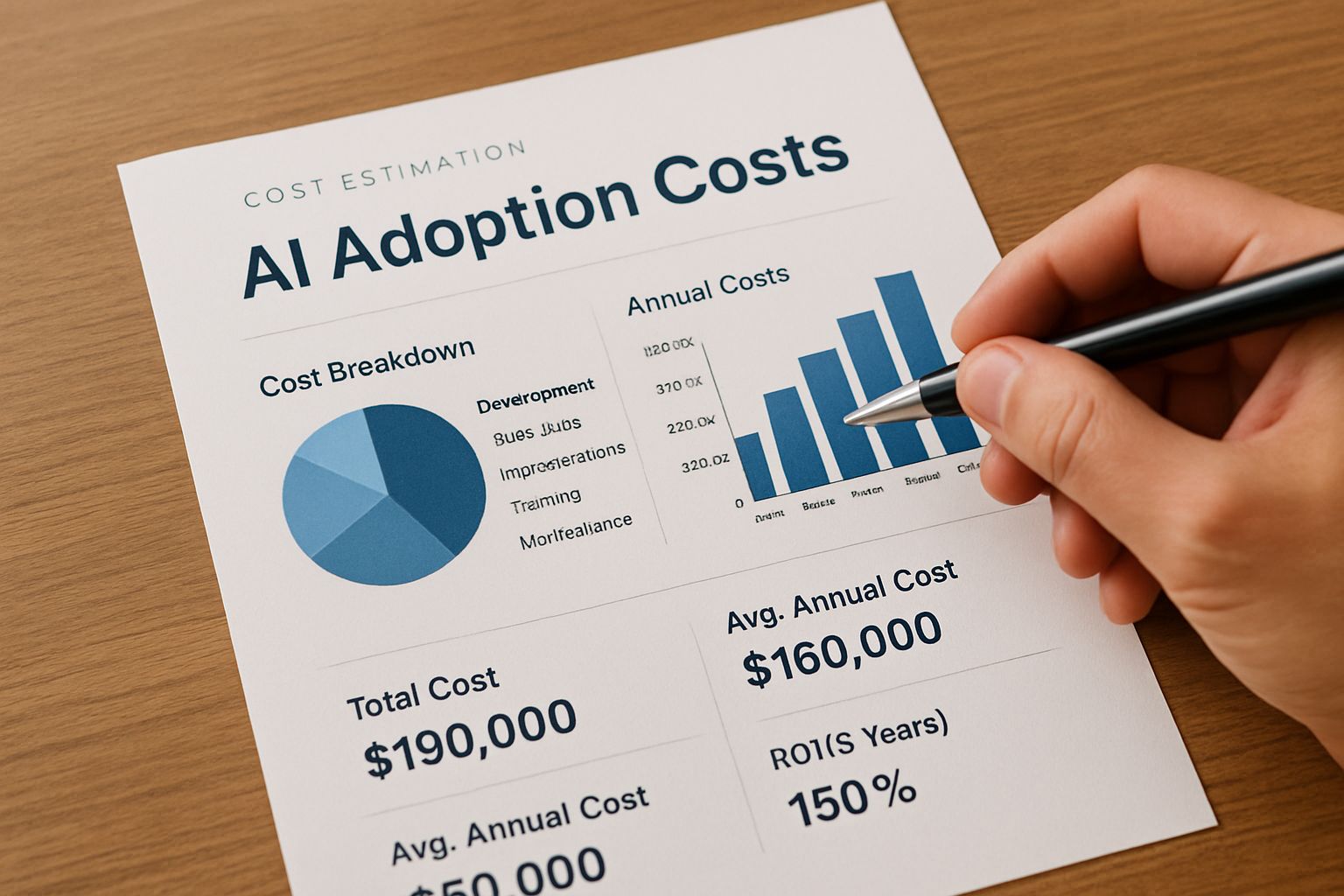
Key takeaway: Finance wants transparency and guardrails. Next, we explore the tool that delivers both.
AI Adoption Cost Estimator
The AI adoption cost estimator aligns people, processes, and platforms. Moreover, it links AdaptOps checkpoints with granular spend data. Use three linked modules:
- Pilot validation (0–3 months)
- Scale forecast (3–24 months)
- Steady-state TCO (24+ months)
Each module captures cost lines and value offsets, ensuring end-to-end visibility.
Key takeaway: Structured modules simplify complex forecasts. Subsequently, we detail the pilot stage.
Pilot Module Cost Inputs
Start small. Therefore, use ECIF-funded pilots starting around US$15K. Baseline metrics include:
- Active users and licence price per seat.
- Minutes saved per user daily—Adoptify pilots cite 26 minutes.
- Token counts, prompt volumes, and support overhead.
Measure weekly. Consequently, week-six data informs the go/no-go decision.
Key takeaway: Early telemetry creates credible assumptions. Meanwhile, scaling looms next.
Scaling Stage Forecast Model
Adoption Curve Assumptions
Feed pilot telemetry into adoption curves. Furthermore, segment users into cohorts and project monthly growth. Blend per-token prices with licence ramp to model cash flow.
Include incremental staffing—fractional MLOps, security, and training roles. Additionally, add governance tools like Purview checks every quarter.
Key takeaway: Dynamic curves prevent budget shocks. Consequently, long-term costs demand fresh focus.
Steady State TCO Guardrails
Inference costs keep falling, yet variability persists. Therefore, model best, average, and worst token rates. Add GPU amortisation if self-hosting.
Include 15–20% contingency, reflecting survey-quantified execution risk. Moreover, schedule retraining every six months and certification renewals annually.
Key takeaway: Guardrails protect against volatility. Next, unlock optimisation levers.
Optimisation Levers And Scenarios
License Reclamation Savings Plan
Adoptify’s Copilot License Audit often reclaims 10–25% idle seats. Consequently, budgets shrink instantly. Multi-model routing can cut inference spend up to 70%. Furthermore, smaller context windows reduce token burn.
Compare API versus GPU break-even. Subsequently, reroute low-value queries to cheaper models.
Key takeaway: Tactical levers stretch funds further. Governance integration finalises the estimator.
Governance Finance Integration Points
Contingency Reserve Strategy Blueprint
Expose ARR, payback months, and NPV in CFO-friendly dashboards. Moreover, tie funding releases to AdaptOps gates.
Embed policy templates and DLP simulation cadence as recurring cost lines. Therefore, compliance never surprises finance.
Key takeaway: Governance seals trust and accelerates approvals. The journey now concludes.
Conclusion
An AI adoption cost estimator transforms vague enthusiasm into disciplined investment. By combining pilot telemetry, staged forecasts, optimisation levers, and governance hooks, enterprises gain clarity and speed.
Why Adoptify AI? Adoptify AI couples AI-powered digital adoption, interactive in-app guidance, intelligent user analytics, and automated workflow support. Consequently, organisations achieve faster onboarding, higher productivity, and governed scale. Ready to act? Explore Adoptify AI at Adoptify.ai and start building your AI adoption cost estimator today.
Frequently Asked Questions
- What is an AI adoption cost estimator?
An AI adoption cost estimator converts early pilot telemetry, scaling forecasts, and TCO projections into clear ROI metrics, ensuring disciplined digital adoption with finance-grade transparency and guided checkpoints. - How does pilot module validation support budget management?
The pilot stage captures real-time data like active users and time saved, enabling precise cost modelling and go/no-go decisions while integrating interactive in-app guidance for optimal budget control. - How does Adoptify AI ensure digital adoption success?
Adoptify AI enhances digital adoption using interactive in-app guidance, intelligent user analytics, and automated workflow support, accelerating onboarding and delivering clear, measurable ROI for AI investments. - What optimisation levers help reduce AI operational costs?
Adoptify AI leverages license reclamation, multi-model routing, and cost guardrails to minimize idle spend and token burn, ensuring predictable budgeting and efficient AI adoption.

FEATURED
Artificial intelligence adoption: Copilot consulting ROI math
February 4, 2026
FEATURED
Microsoft Copilot Consulting: Bulletproof Security Configuration
February 4, 2026
FEATURED
Where Microsoft Copilot Consulting Safeguards Data
February 4, 2026
FEATURED
Microsoft Copilot Consulting: Automate Executive Presentations
February 4, 2026
FEATURED
Microsoft Copilot Consulting Slashes 15 Weekly Hours
February 4, 2026