AI Readiness Assessment Tool: Scale Enterprise AI Fast
Executives feel the pressure to move pilots into production fast. Yet scaling remains rare despite record AI spending. An AI Readiness Assessment can break the stalemate by exposing hidden blockers. Moreover, an interactive tool converts those insights into a shareable, data-driven roadmap. This article outlines the architecture, scoring logic, and governance needed to launch such a capability.
We combine Adoptify-curated best practices with analyst research from Gartner, McKinsey, and Cisco. The focus stays on enterprise buyers, HR leaders, SaaS teams, and transformation offices. Prepare to see why an Interactive Enterprise AI Readiness Assessment Tool is now central to modern AI programs. Consequently, readers will leave with a concrete blueprint they can adapt today. Let’s dive in.
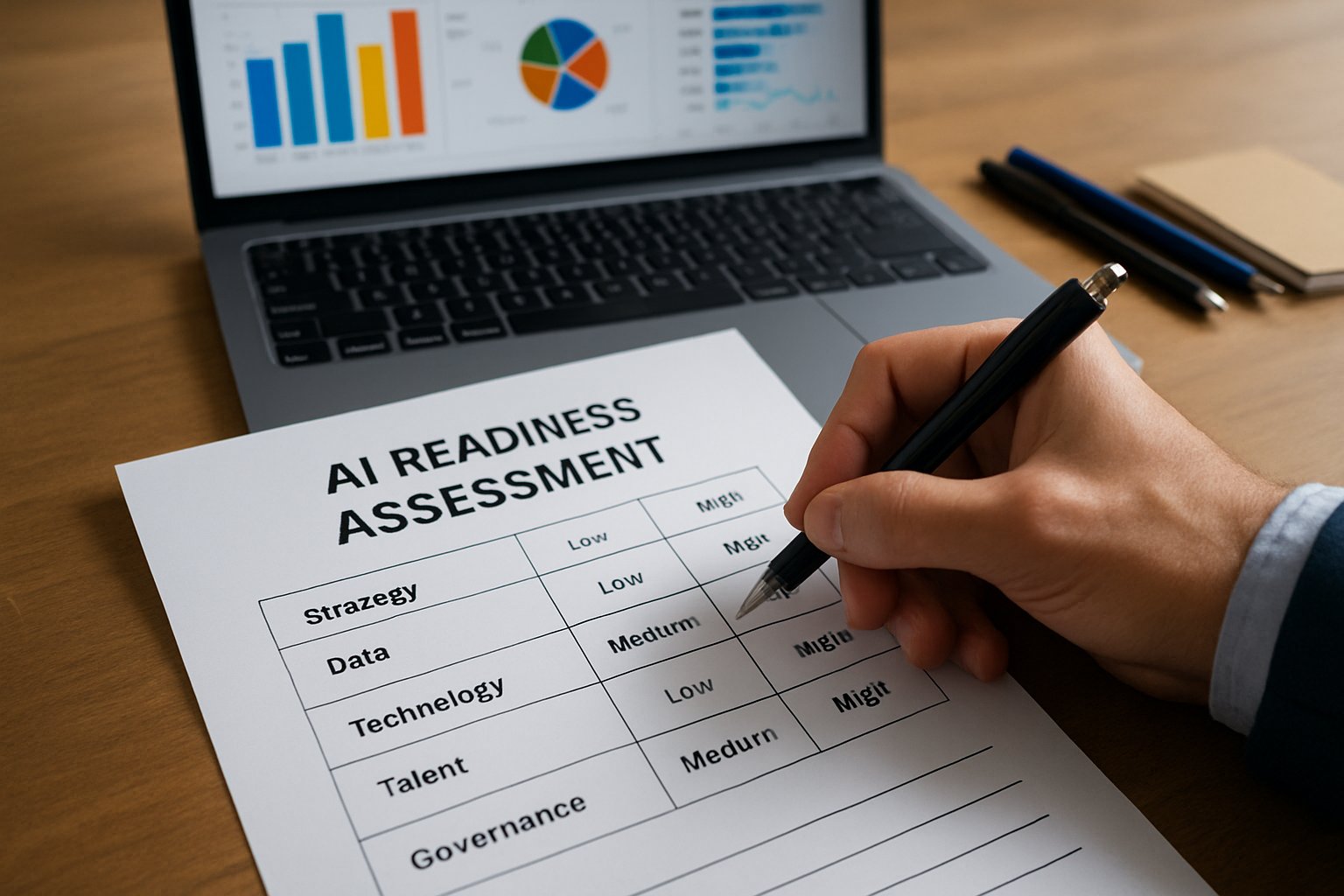
Enterprise AI Readiness Assessment
Every assessment should target both technical and organizational levers. Therefore, Adoptify recommends a hybrid questionnaire that captures executive vision and frontline realities. The AI Readiness Assessment begins with a 15-minute executive survey that frames strategy, governance, and expected value. Subsequently, deeper modules probe data lineage, security posture, and skill gaps.
Importantly, each question maps to clear evidence requests, reducing optimism bias. Uploaded artifacts, cloud telemetry, and policy links support scoring transparency. Consequently, leaders gain defensible scores and audit-ready documentation.
This phase grounds the entire tool in verifiable facts. Next, we explore why scaling still stalls even with such clarity.
AI Scaling Gap Reality
McKinsey shows only a minority of firms translate pilots into EBIT uplift. Meanwhile, BCG labels just five percent as “future-built” AI winners. These statistics confirm that readiness alone is useless without prioritization and funding.
However, the AI Readiness Assessment generates benchmark bands similar to Cisco’s index. Enterprises see whether they rank as Pacesetter, Chaser, Follower, or Laggard. Moreover, each band carries recommended investment ranges and timeframes.
Benchmark visibility sparks executive urgency. Consequently, organizations request a deeper multi-pillar breakdown.
Multi-Pillar Scoring Model Guide
Gartner and Microsoft both organize maturity around seven pillars. Adoptify merges those frameworks with AdaptOps principles. The resulting model weighs strategy, data, governance, infrastructure, culture, use-case fit, and model operations.
Specifically, the tool assigns each pillar a weight based on risk impact:
- Strategy and leadership – 20%
- Data foundations – 20%
- Governance and security – 15%
- Infrastructure readiness – 10%
- Workforce skills – 15%
- Use-case portfolio – 10%
- Model operations – 10%
Weights adjust easily for regulated industries needing stronger governance controls. Moreover, the AI Readiness Assessment recalculates benchmarks in real time when weights change.
The weighted model pinpoints bottlenecks with surgical accuracy. Next, we dive into the heaviest weighted pillar: data.
Critical Data Foundations Priority
Precisely’s 2025 launch cited data quality as the top AI failure cause. Therefore, the assessment demands evidence for lineage, catalog coverage, and privacy controls. Automated hooks into Azure Purview or similar catalogs cut manual inspection time.
If gaps exceed threshold, the tool recommends phased remediation with ownership assignments. Furthermore, ROI calculators quantify the cost of poor data versus fix investments.
Data scores often move companies between maturity bands. With data addressed, attention shifts to people.
Workforce Skills Engine Blueprint
Even perfect models fail when users lack skills. Hence, Adoptify links specialty microlearning paths directly to skill gaps revealed. The AI Readiness Assessment schedules content automatically and tracks completion through in-app telemetry.
Additionally, certification milestones gate production rollout, ensuring sustainable adoption. Progress dashboards let HR quantify savings from reduced support tickets.
Upskilling keeps momentum after technical blockers are cleared. Governance makes sure that momentum stays compliant.
Governance And Risk Gates
Regulators now expect proactive AI risk management. Consequently, the tool embeds responsible-AI checklists aligned to ISO and NIST. Policy templates auto-populate based on assessment answers.
Moreover, gating rules tie pilot exit criteria to governance scores. If risk remains high, the system blocks production tagging and surfaces remediation playbooks.
Governance gates protect value and reputation. With compliance secured, leaders want fast execution.
AdaptOps Continuous Readiness Loop
Static assessments age quickly as teams evolve. Therefore, Adoptify’s AdaptOps model recommends quarterly reassessment using the same AI Readiness Assessment framework. Telemetry feeds score shifts back into dashboards, creating a virtuous improvement cycle.
Additionally, ECIF-funded pilots kick off automatically when scores cross predefined gates. Consequently, progress remains measurable, funded, and visible to executives.
Continuous loops transform readiness into ongoing operational excellence. Finally, we summarise key points and introduce the Adoptify solution.
Enterprises struggle to scale AI because gaps hide inside strategy, data, skills, and governance. An interactive AI Readiness Assessment lights up those blind spots and prescribes funded, measurable next steps. When combined with continuous AdaptOps cadence, the tool accelerates time-to-value and reduces rework.
Why Adoptify AI? Our AI-powered digital adoption platform layers interactive in-app guidance, intelligent user analytics, and automated workflow support onto your existing stack. Consequently, teams onboard faster, stay productive, and scale securely. Visit Adoptify AI to see how we transform readiness insights into lasting enterprise impact.
Frequently Asked Questions
- What is an AI Readiness Assessment and how does it benefit enterprises?
An AI Readiness Assessment evaluates organizational readiness by mapping executive vision, technical capability, and data quality with clear benchmarks. It drives digital adoption by identifying gaps and recommending improvements through a data-driven roadmap. - How does the multi-pillar scoring model enhance AI maturity?
The multi-pillar scoring model assesses strategy, data, governance, and workforce skills, providing insights into bottlenecks. It supports digital adoption by prioritizing investments with in-app guidance, intelligent user analytics, and automated workflow support. - Why is data quality crucial for scaling AI initiatives?
Data quality is foundational as it impacts risk assessments and maturity band shifts. Proper data management minimizes AI failures, supports digital transformation, and ensures effective in-app guidance and automated support for continuous improvement. - How does Adoptify AI integrate digital adoption and workflow intelligence?
Adoptify AI combines interactive in-app guidance with intelligent user analytics and automated workflow support. This integration accelerates onboarding and scaling, ensuring continuous digital adoption and streamlined AI readiness monitoring.

FEATURED
Artificial intelligence adoption: Copilot consulting ROI math
February 4, 2026
FEATURED
Microsoft Copilot Consulting: Bulletproof Security Configuration
February 4, 2026
FEATURED
Where Microsoft Copilot Consulting Safeguards Data
February 4, 2026
FEATURED
Microsoft Copilot Consulting: Automate Executive Presentations
February 4, 2026
FEATURED
Microsoft Copilot Consulting Slashes 15 Weekly Hours
February 4, 2026