AI Adoption Playbook: Worker Safety on the Factory Floor
Industrial leaders love AI yet fear accidents. During rapid rollouts, worker safety often faces hidden threats. Cobots, vision systems, and predictive models all introduce new failure modes.
However, disciplined governance converts that risk into competitive reward. This article presents a practical framework for protecting factory teams while scaling intelligent automation. We will show why worker safety must anchor every AI decision, from pilot to plant deployment.
Statistics from IFR and NIOSH confirm that exposure rises as robots move closer to humans. Fortunately, proven controls, targeted training, and Adoptify’s AdaptOps lifecycle create a safer, smarter shop floor. Moreover, forward-looking manufacturers now integrate cyber resilience, compliance, and EHS metrics into one safety-plus-security dashboard. Consequently, executives gain real-time insight and faster response when anomalies threaten people or production. Read on for concrete steps, market data, and playbooks your HR, OT, and L&D teams can use. Meanwhile, we highlight quick wins like predictive maintenance that cut downtime and reduce unsafe emergency fixes. Ultimately, every stakeholder—from finance to line operators—benefits when safety becomes the north star.
Governance in Worker Safety
AI deployments fail when responsibility stays vague. Governance assigns clear owners and audited checkpoints before code reaches the line. Therefore, Adoptify’s AdaptOps framework inserts four gates: Discover, Pilot, Scale, and Embed.
Each gate demands documented risk tiers, model cards, and EHS sign-offs. Moreover, no-training-without-consent controls protect sensitive process data from accidental leaks. Consequently, supervisors see exactly who approved every change and why.
These artifacts mirror ISO/TS 15066 requirements for documented risk assessments. In contrast, ad-hoc integrations often skip this step and invite unseen hazards.
AdaptOps Lifecycle Safety Gates
AdaptOps documents ownership using a RACI matrix that links each gate to named leaders. Moreover, automatic reminders push tasks to stakeholders, ensuring gate reviews never stall.
Effective governance prevents blind spots and builds trust across IT, OT, and EHS. Next, we explore the mandatory standards your program must satisfy.
Standards And Regulations Basics
Manufacturers must start with ISO 10218, ISO/TS 15066, and relevant ANSI/RIA guides. These documents outline speed and separation monitoring, power and force limits, and protective stops.
OSHA already expects documented risk assessments before any collaborative operation begins. Furthermore, NIOSH research shows 41 robot-related fatalities between 1992 and 2017. That history underscores why worker safety regulations demand continuous verification, not one-time checks.
Adoptify’s governance gates store safety test logs and incident playbooks for easy audits. Therefore, compliance teams can present digital evidence within minutes.
NIOSH and OSHA collaborations now produce accessible online training and free assessment tools. Organizations should bookmark these resources and fold them into internal knowledge bases.
Following standards removes ambiguity and accelerates approvals. However, human competence remains vital, as the next section explains.
Human-Centric Training Strategies
Robots may be safe by design, yet people create most incidents through misuse or fatigue. Consequently, role-based upskilling trumps generic classroom sessions.
Adoptify provides micro-lessons inside daily workflows, plus simulated sandboxes for frontline operators. Supervisors can require certification before anyone overrides motion parameters. Moreover, in-app nudges remind crews of proximity limits during live shifts.
Studies link targeted competence programs to a 30% drop in near-miss events. That decrease directly enhances worker safety on fast-moving lines.
Additionally, job-rotation schedules can reduce repetitive strain and cognitive fatigue during high-variance tasks. Therefore, safety managers should coordinate with HR to align rotation with workload peaks.
Structured training embeds safe habits instead of memorized rules. Technology controls then reinforce these behaviors, as we explore next.
Technology Safety Controls Layer
Safety starts with certified functions like speed monitoring and power limiting. However, AI vision now adds dynamic risk scoring and virtual fencing. When sensors detect unsafe proximity, policies trigger protective stops or slow motions instantly.
Adoptify connects these signals to drift monitors and rollback triggers. Therefore, unexpected behavior rolls back before it reaches humans.
- Speed and Separation Monitoring (SSM)
- Power and Force Limiting (PFL)
- Protective stop overrides
- Hand guiding verification
Sensor diversity matters because single-point failures create blind spots. Combining lidar, depth cameras, and proprioceptive data yields robust detection even in dusty environments.
Cyber resilience matters as much as mechanics. Integrated safety-plus-security dashboards expose OT anomalies that could transform into physical hazards.
Technical safeguards act as the last defense after governance and training. Yet programs prove value only when metrics show improvement.
Pilot Metrics That Matter
Smart pilots establish success criteria before installation begins. Leading indicators include near-miss counts, override frequency, and training completion rates. Lagging indicators track injuries, unplanned downtime, and repair incidents.
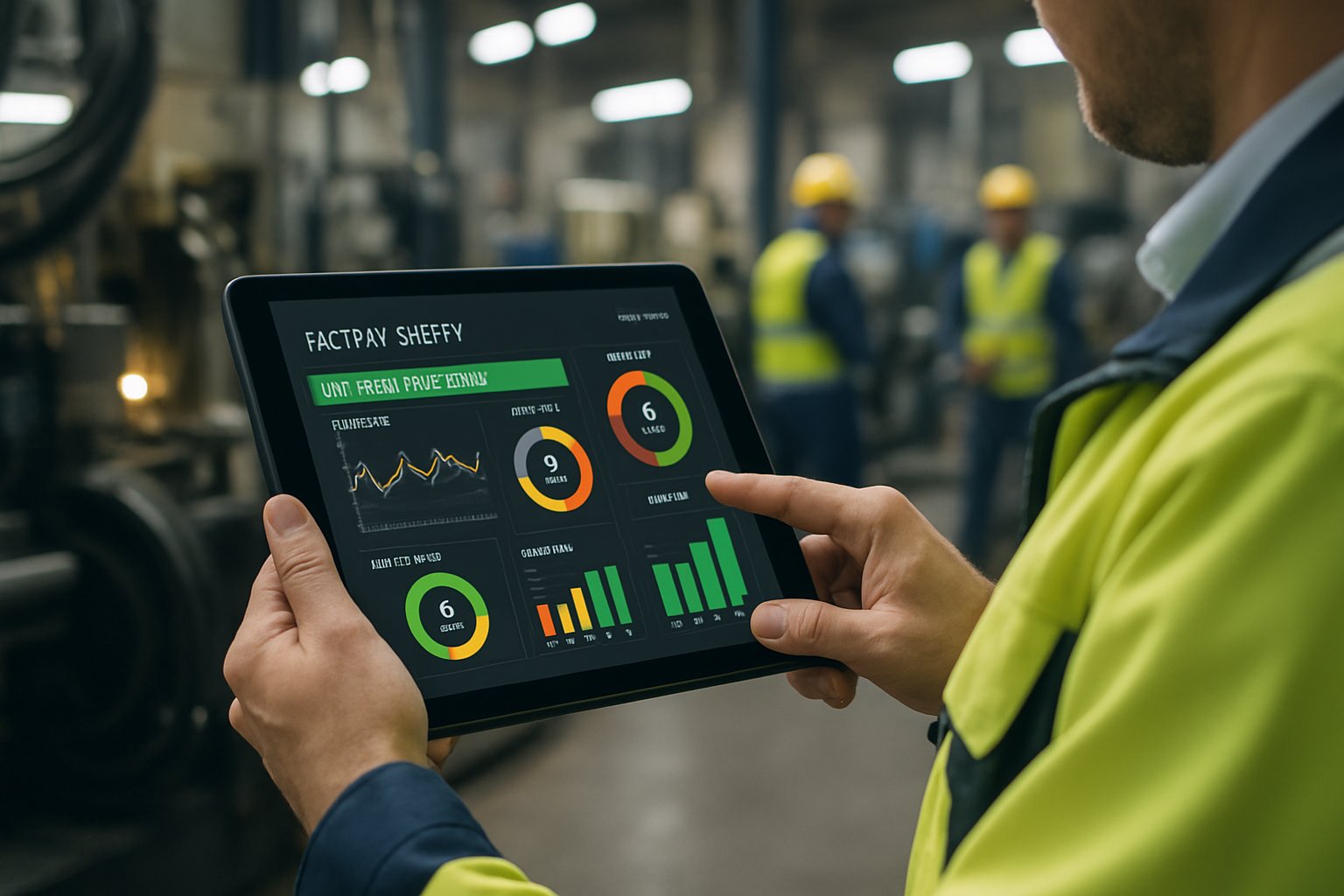
Adoptify dashboards aggregate these signals and display ROI alongside safety data. Consequently, executives see that worker safety improvements boost throughput, not slow production.
- Near-miss frequency per 1,000 hours
- Average override response time
- Training completion within 30 days
- EHS incident severity index
Pilot reviews happen quarterly during the AdaptOps Scale gate. Teams refresh risk tiers and retire outdated controls.
Leading plants publish anonymized KPI dashboards to vendors and union representatives. This transparency strengthens trust and accelerates consensus during upgrades.
Measurement turns abstract safety goals into fundable business results. The final section explains how risks increasingly converge.
Risk Convergence In Practice
Cyber, quality, and physical hazards now intersect. Meanwhile, boards expect unified reporting across all domains. Manufacturers therefore adopt joint incident playbooks linking IT, OT, and EHS.
Adoptify orchestrates tabletop drills, secure deployment templates, and shared SLAs. In contrast, siloed teams respond slower and threaten compliance commitments.
By merging dashboards, leaders gain holistic situational awareness and faster response. That alignment completes the loop, delivering sustainable worker safety at enterprise scale.
Meanwhile, insurers increasingly price premiums based on integrated risk scores. Consequently, converged programs can unlock financial upside beyond compliance.
Integrated risk management future-proofs AI programs. Finally, we recap the journey and outline next steps.
Future Trends Shaping Safety
Robot shipments dipped in 2024 yet rebound forecasts suggest steep growth after 2025. Consequently, human-robot interaction research accelerates.
Academic teams now validate dynamic risk assessment models that adjust safety zones in real time. Moreover, sensor costs continue to fall, allowing smaller firms to adopt advanced protection.
Public agencies invest in open training resources and digital twins for safety simulation. Additionally, insurers explore parametric policies tied to live telemetry.
Therefore, early adopters who build governance muscle today will scale faster tomorrow. Continuous improvement remains the ultimate competitive moat.
Governance, standards, training, controls, metrics, and convergence form a complete safety spine for smart factories. Follow these steps and you will protect budgets, brand, and most importantly, worker safety.
Why Adoptify AI? The platform unites AI-powered digital adoption, interactive in-app guidance, intelligent analytics, and automated workflow support. Consequently, teams experience faster onboarding and higher productivity without sacrificing scale or security. Explore how Adoptify AI elevates your workforce and workflows today. Visit Adoptify.ai to schedule a pilot.
Frequently Asked Questions
- How does AI enhance worker safety on the shop floor?
AI integrates real-time sensor data and dynamic risk scoring to trigger protective stops and avoid hazards. Adoptify’s solutions embed safety controls within workflows, ensuring worker safety while accelerating digital adoption. - What is the AdaptOps framework and how does it improve safety governance?
The AdaptOps framework features four safety gates—Discover, Pilot, Scale, and Embed—that enforce risk assessments and documented change approvals. Its automated reminders and in-app guidance streamline digital adoption and boost worker safety. - How does Adoptify AI support digital adoption and workflow intelligence?
Adoptify AI leverages AI-powered digital adoption, interactive in-app guidance, intelligent analytics, and automated workflow support. This platform enhances onboarding, improves productivity, and securely scales digital transformation across industrial operations. - What measures ensure compliance with safety standards in smart factories?
Companies comply with ISO, ANSI, and OSHA standards by implementing documented risk assessments, structured training, and real-time monitoring. Adoptify’s safety-plus-security dashboards and audit trails deliver transparent, integrated compliance for modern industrial environments.

FEATURED
Artificial intelligence adoption: Copilot consulting ROI math
February 4, 2026
FEATURED
Microsoft Copilot Consulting: Bulletproof Security Configuration
February 4, 2026
FEATURED
Where Microsoft Copilot Consulting Safeguards Data
February 4, 2026
FEATURED
Microsoft Copilot Consulting: Automate Executive Presentations
February 4, 2026
FEATURED
Microsoft Copilot Consulting Slashes 15 Weekly Hours
February 4, 2026