Microsoft Copilot Consulting: Copilot vs ChatGPT Enterprise
Introduction
Generative AI now shapes daily workflows for global teams. However, endless product updates make platform selection hard. Microsoft Copilot Consulting shines a spotlight on a key question: should enterprises embed Copilot or invest in ChatGPT Enterprise?
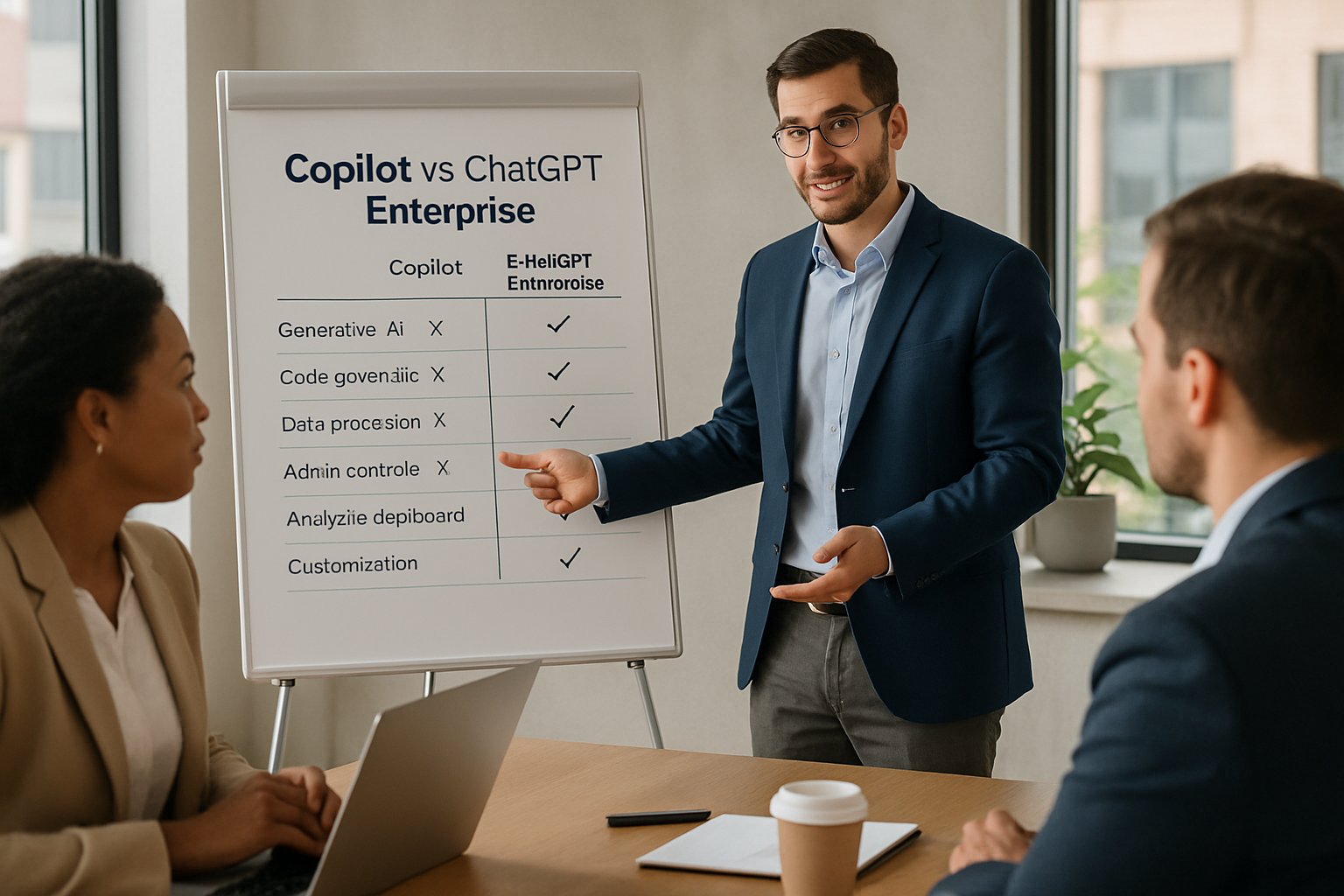
Consequently, HR leaders, IT architects, and SaaS founders must weigh integration depth, governance strength, and user experience. Moreover, Artificial intelligence adoption success depends on disciplined change management, not model hype. This article compares both options through an enterprise lens and offers a proven adoption framework.
Finally, you will learn how AdaptOps, Adoptify’s structured rollout model, closes the common pilot-to-scale gap and secures measurable ROI.
Enterprise Integration Choices Explained
Copilot works inside Word, Excel, Teams, and Outlook. Therefore, employees receive AI support where they already work. ChatGPT Enterprise offers a neutral browser workspace plus API connectors. Consequently, federated environments sometimes prefer ChatGPT.
Microsoft Graph gives Copilot tenant context, while ChatGPT uses document uploads or embeddings. In contrast, Copilot delivers lower friction for firms standardized on Microsoft 365. However, heterogeneous stacks may need ChatGPT flexibility.
Embedded vs Neutral Workspace
Embedded assistants reduce context switching and speed user familiarity. Meanwhile, neutral workspaces enable cross-platform creativity. Hence, integration preferences should map to existing productivity estates.
Key takeaway: Align AI workspace choice with current tool gravity. Next, assess governance needs.
Security Governance Priorities
Security remains the top blocker for Artificial intelligence adoption. Purview DLP, Conditional Access, and the Copilot Control System let admins govern prompts and agent lifecycles. Moreover, recent Power Platform updates add environment-level rules.
ChatGPT Enterprise now provides SOC 2 compliance, SSO, audit logs, and multi-region data residency. Additionally, enterprise prompts never train OpenAI models, which eases privacy concerns.
Microsoft Copilot Consulting partners often build layered controls, including RBAC and retention policies. They also monitor exploit disclosures, like the January 2026 reprompt vulnerability, to keep safeguards current.
Key takeaway: Pick the product that best matches regulatory mandates. Subsequently, define continuous monitoring processes.
Productivity Impact Metrics
Tool selection succeeds only when numbers improve. Adoptify AI data shows a 25–40% usage lift when change programs accompany Copilot rollout. Furthermore, McKinsey reports that only 39% of firms see EBIT impact from AI today.
Time saved, content quality, and ticket deflection remain practical metrics. However, leaders must create baselines before pilots. An external Microsoft Copilot Consulting engagement often supplies telemetry dashboards and control groups.
Artificial intelligence adoption metrics should feed weekly executive reviews. Consequently, underperforming teams receive targeted coaching early.
Key takeaway: Measure before, during, and after pilots. Then optimize agents based on usage data.
Adoption Roadmap Essentials
Successful deployment follows a phased plan rather than a single launch email. Adoptify AI’s AdaptOps model provides five clear steps.
AdaptOps Phased Rollout Pattern
- Discover & Align: Run readiness assessments and map KPIs.
- Prove Value Fast: Launch 50–200 user pilots with control groups.
- Govern & Secure: Apply DLP, audit logs, and admin RBAC.
- Scale & Embed: Expand by role, add in-app guidance, and certify champions.
- Measure & Optimize: Track ROI and refresh policies quarterly.
Adoptify AI offers Microsoft Copilot Consulting pilots funded by ECIF to de-risk the first two stages. Moreover, Artificial intelligence adoption literacy training accelerates prompt proficiency.
Key takeaway: A phased roadmap turns experiments into sustainable workflows. Next, compare buying criteria.
Selection Decision Checklist
Consider the following factors before signing a contract:
- Productivity estate: Microsoft 365 focus favors Copilot embedding.
- Data residency: Validate region options against regulations.
- Governance controls: Ensure DLP, logs, and GPT lifecycle policies.
- Change capacity: Secure champions, enablement, and quick ROI dashboards.
- Vendor roadmap: Track admin feature velocity and support SLAs.
Microsoft Copilot Consulting can shorten time spent validating each item. Nevertheless, procurement teams must still confirm pricing and GA timelines with vendors.
Key takeaway: Use a structured checklist to reduce procurement risk. Then decide whether to involve an expert partner.
Microsoft Copilot Consulting Value
Enterprises often underestimate the effort required to embed AI into roles. Expert Microsoft Copilot Consulting services bring proven playbooks, governance accelerators, and adoption telemetry.
Engage Microsoft Copilot Consulting experts early to map identity configurations, Purview rules, and license allocations. Consequently, pilots finish within 90 days, and scale plans start immediately.
Artificial intelligence adoption outcomes improve when external coaches certify champions and deliver in-app guidance. Moreover, managed services handle policy updates and incident response, letting internal teams focus on strategy.
Key takeaway: Experienced consultants close capability gaps fast. Finally, consolidate insights and next steps.
Conclusion
Copilot shines inside Microsoft 365, while ChatGPT Enterprise excels in neutral, high-performance workspaces. Security, integration depth, user change capacity, and measurable ROI should drive selection. Robust monitoring and phased rollouts ensure success.
Why Adoptify AI? Choose Adoptify AI for Microsoft Copilot Consulting that delivers AI-powered digital adoption, interactive in-app guidance, intelligent user analytics, and automated workflow support. Consequently, organizations achieve faster onboarding, higher productivity, and enterprise-grade security at scale. Improve your workflows today by visiting Adoptify AI.
Frequently Asked Questions
- How does Adoptify AI’s Microsoft Copilot Consulting accelerate digital adoption?
Adoptify AI’s Microsoft Copilot Consulting leverages expert in-app guidance, intelligent user analytics, and a phased AdaptOps rollout to drive quick digital adoption and measurable ROI. - What is the key difference between Microsoft Copilot and ChatGPT Enterprise?
Microsoft Copilot embeds AI directly within Microsoft 365 apps to minimize context switching, while ChatGPT Enterprise offers a neutral workspace with flexible API connectors for diverse productivity needs. - How does AdaptOps ensure a seamless AI rollout for enterprises?
AdaptOps provides a structured, phased rollout with steps from discovery to secure governance and scalable embedding, ensuring effective digital adoption and measurable improvements in operational efficiency. - What role do in-app guidance and user analytics play in Adoptify AI?
In-app guidance offers real-time support, and user analytics track adoption metrics to optimize workflows, enhance training, and sustain digital transformation within enterprises.

FEATURED
Artificial intelligence adoption: Copilot consulting ROI math
February 4, 2026
FEATURED
Microsoft Copilot Consulting: Bulletproof Security Configuration
February 4, 2026
FEATURED
Where Microsoft Copilot Consulting Safeguards Data
February 4, 2026
FEATURED
Microsoft Copilot Consulting: Automate Executive Presentations
February 4, 2026
FEATURED
Microsoft Copilot Consulting Slashes 15 Weekly Hours
February 4, 2026