AI Workforce Displacement is reshaping the global technology sector as major corporations redirect capital from human resource expansion toward large scale computing infrastructure. The latest strategic pivots by Amazon and Microsoft illustrate how automation, artificial intelligence, and cloud expansion now influence workforce planning across enterprise ecosystems.
Technology companies increasingly view computational power as the foundation of future competitive advantage. Investments in AI driven services, data center expansion, and autonomous enterprise tools require enormous capital allocation. These priorities are forcing companies to reassess payroll structures, management layers, and operational models. This article explores how infrastructure investments are driving workforce transformation, examines corporate restructuring trends, and analyzes how enterprises are adapting to a new compute driven economy.
Compute Economics Is Redefining Corporate Priorities
AI Workforce Displacement is closely linked to the rapid shift toward compute intensive operations across the technology sector. Companies now allocate significant portions of capital budgets toward advanced processors, large scale data centers, and AI training clusters.
The demand for real time data processing and generative AI capabilities requires massive computing resources. Organizations must maintain high performance GPU clusters to support AI driven services. This shift forces executives to compare payroll growth with infrastructure scalability. Companies increasingly choose infrastructure investment because it produces long term operational efficiency.
Corporate leadership views computational infrastructure as a revenue multiplier. When enterprises scale AI services, they can serve millions of customers simultaneously without proportional workforce expansion.
In the next section, we examine how Amazon is restructuring operations to support automation focused growth.
Amazon Layoffs Reflect Strategic Automation Realignment
Amazon’s workforce restructuring highlights how AI Workforce Displacement influences corporate decision making. The company has aggressively expanded automation across logistics, customer service, and supply chain management.
Automation systems now handle warehouse inventory, predictive demand forecasting, and fulfillment optimization. These technologies reduce reliance on manual operational roles. Amazon is simultaneously investing in advanced data centers to support AI enhanced cloud services.
Executives emphasize that automation improves delivery accuracy, reduces operational latency, and increases customer experience efficiency. The company’s infrastructure investments allow cloud customers to deploy AI applications faster while reducing operational cost structures.
Amazon leadership is also redesigning workforce roles to focus on AI governance, infrastructure management, and system monitoring rather than traditional operational supervision.
In the next section, we explore how Microsoft is expanding its global data center footprint.
Microsoft Data Centers Accelerate AI Infrastructure Expansion
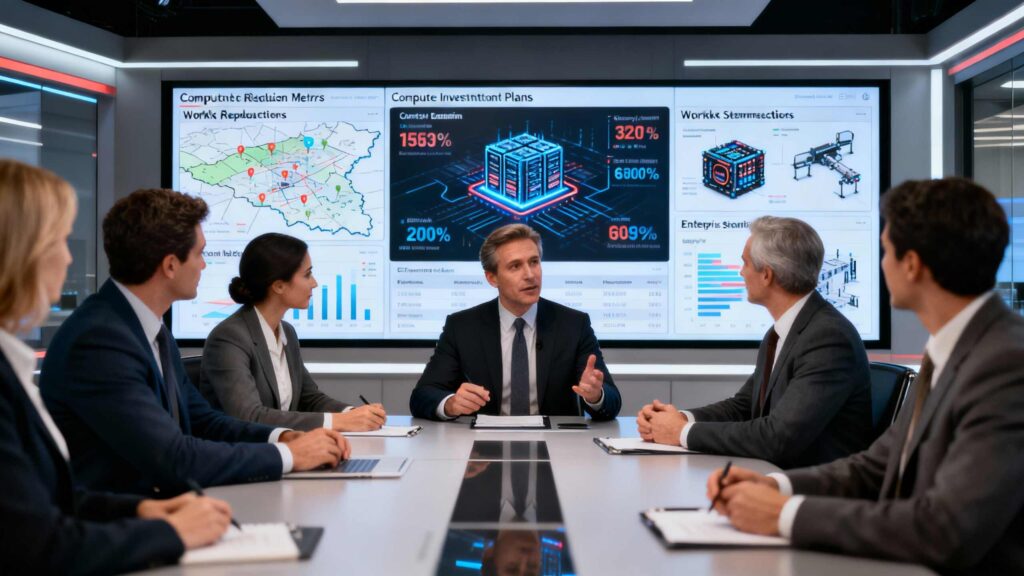
Executives evaluate automation strategies as AI Workforce Displacement drives infrastructure focused corporate planning.
Microsoft’s cloud strategy demonstrates how AI Workforce Displacement aligns with global infrastructure development. The company is rapidly building data centers designed to support AI model training, enterprise analytics platforms, and autonomous enterprise applications.
The expansion of Microsoft Data Centers supports increasing enterprise demand for AI workloads. These facilities host high density computing clusters designed for generative AI processing and real time analytics deployment.
Microsoft prioritizes infrastructure because enterprise customers require scalable AI environments to deploy automation solutions. Cloud based AI services allow organizations to accelerate digital transformation while reducing operational complexity.
Companies adopting centralized AI platforms such as Adoptify ai are using automation frameworks to manage workforce productivity alongside infrastructure growth.
In the next section, we analyze how management restructuring supports infrastructure focused growth models.
Middle Management Streamlining Supports Automation Models
AI Workforce Displacement is particularly visible in management restructuring initiatives across technology firms. Companies are reducing middle management layers to create faster decision making structures and reduce operational overhead.
Automation tools and AI analytics platforms provide real time performance insights, reducing reliance on manual reporting structures. Executives can now monitor enterprise performance through AI dashboards that deliver predictive analytics and operational intelligence.
Organizations report that streamlined management improves decision velocity and reduces communication bottlenecks. AI driven enterprise systems enable companies to implement data backed decision making at scale.
The transformation of management roles reflects a broader shift toward technology assisted leadership models where AI platforms support workforce coordination and strategic planning.
In the next section, we examine how Intel’s workforce restructuring reflects industry wide transformation.
Intel Workforce Cuts Signal Ecosystem Transformation
The semiconductor industry also reflects AI Workforce Displacement as chip manufacturers adjust production strategies to meet AI hardware demand. Intel’s workforce reduction demonstrates how companies are redirecting resources toward AI chip design and advanced manufacturing infrastructure.
The growing demand for high performance processors requires companies to prioritize research and fabrication investment. Semiconductor firms must accelerate innovation cycles to support global AI adoption trends.
Chip manufacturing organizations are restructuring workforce roles to focus on engineering innovation, supply chain automation, and advanced production technology. This transformation supports the increasing demand for processors powering enterprise AI systems.
In the next section, we explore how the compute to payroll ratio is shaping corporate financial strategies.
Compute to Payroll Ratio Becomes a Strategic Metric
The compute to payroll ratio is emerging as a major factor influencing AI Workforce Displacement across enterprise technology organizations. Companies measure how infrastructure investment compares with workforce spending to determine operational efficiency.
Executives increasingly view computing power as a scalable asset capable of delivering long term cost efficiency. Infrastructure investments allow organizations to expand digital services without proportional workforce expansion.
Several enterprise trends are driving the shift toward infrastructure dominated budgets:
-
Expansion of GPU clusters supporting generative AI
-
Increased enterprise reliance on automated customer service systems
-
Growth of AI powered supply chain optimization platforms
-
Rising enterprise demand for real time analytics infrastructure
-
Automation of business process management systems
These trends demonstrate how infrastructure investments are reshaping corporate resource allocation models.
In the next section, we examine how enterprises are adapting workforce strategies to align with AI expansion.
Enterprise Workforce Strategy Evolves with Automation Growth
AI Workforce Displacement is encouraging enterprises to redesign workforce training and talent development strategies. Companies now prioritize hiring professionals skilled in AI operations, data science, and automation governance.
Organizations are investing in workforce reskilling initiatives to prepare employees for AI integrated operational environments. These training programs focus on system monitoring, algorithm oversight, and ethical AI governance.
Enterprises deploying AI management platforms such as Adoptify ai are creating hybrid operational models where employees collaborate with automation systems. These strategies help organizations maintain productivity while preparing teams for technology driven transformation.
Corporate leaders emphasize that workforce evolution is essential to maintaining innovation momentum while managing operational risk.
In the next section, we examine how workforce transformation influences long term industry competition.
Workforce Transformation Is Redefining Industry Competition
AI Workforce Displacement is reshaping how technology companies compete in global markets. Organizations with advanced infrastructure capabilities can deploy AI driven services faster and scale operations more efficiently.
Companies that fail to invest in computational infrastructure risk falling behind competitors that leverage automation to improve product delivery and customer engagement. Infrastructure focused strategies allow enterprises to experiment with AI applications across multiple business units simultaneously.
Global competition increasingly depends on how efficiently companies integrate infrastructure investment with workforce transformation. Technology leaders now view AI infrastructure as a strategic asset that drives innovation speed and operational resilience.
Conclusion
AI Workforce Displacement reflects a structural transformation across the technology sector as corporations prioritize infrastructure investment over traditional workforce expansion. Amazon and Microsoft demonstrate how automation, data center expansion, and AI driven services are redefining corporate strategy. The growing emphasis on computational scalability, automation governance, and workforce reskilling signals a long term shift in enterprise operational design.
Organizations must balance infrastructure investment with talent transformation to maintain competitive advantage. AI Workforce Displacement will continue to influence corporate decision making as companies pursue automation driven efficiency and scalable service delivery.
For deeper insight into how autonomous systems are reshaping enterprise risk and governance, readers can explore our previous article analyzing emerging enterprise AI security challenges.