Practical AI governance framework for risk-ready enterprise use
The race to deploy generative models is relentless. However, every executive now asks a sharper question: How do we scale safely? A practical AI governance framework offers the answer. Without one, regulatory deadlines loom, reputational risks escalate, and scattered pilots stall expansion.
Meanwhile, EU AI Act obligations begin in 2025. Board members demand inventory, evidence, and business impact. Consequently, HR, IT, and L&D leaders must align people, processes, and platforms fast. This article shows how to build a governance program that satisfies auditors and boosts productivity.
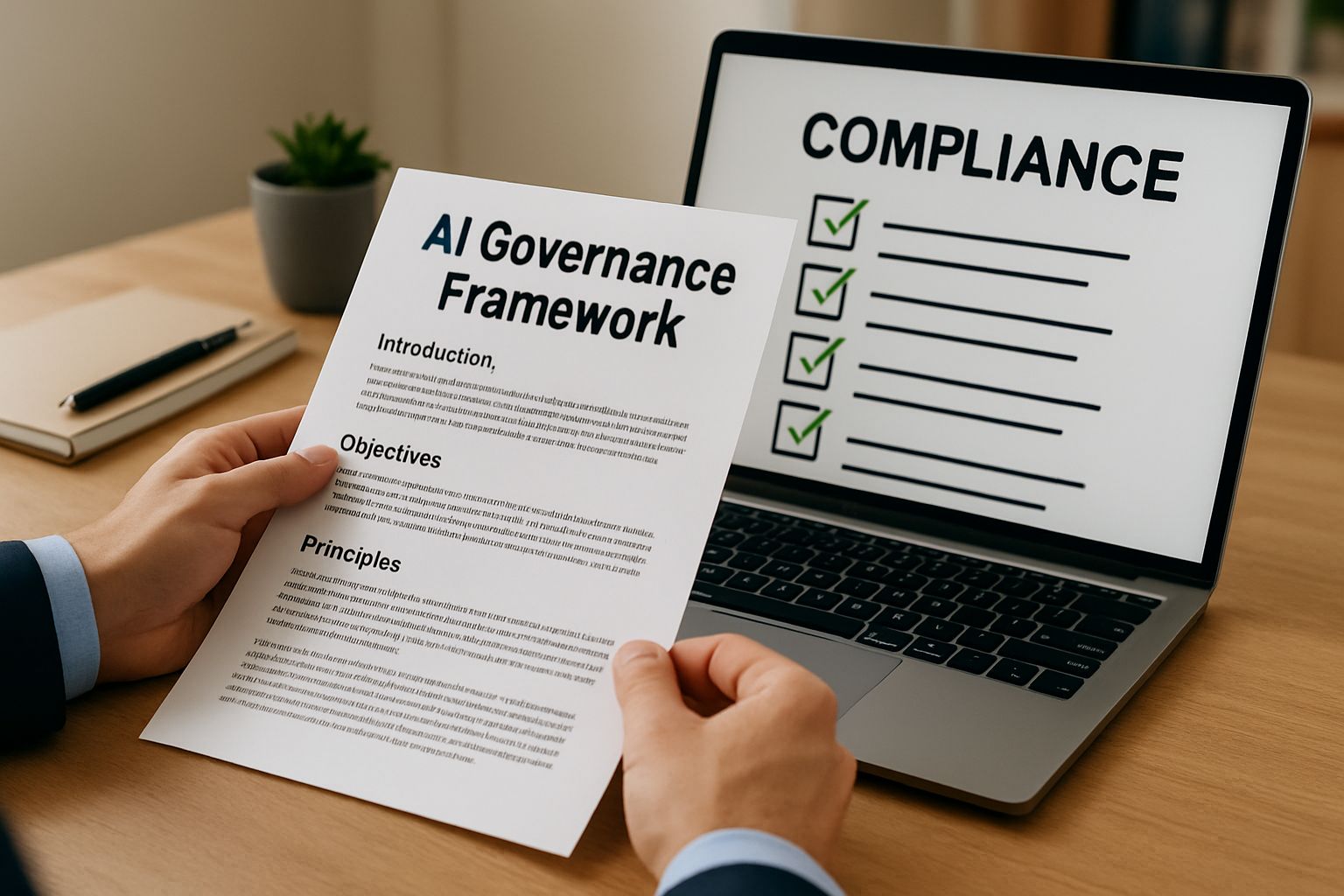
We draw on Adoptify.ai’s AdaptOps model, NIST AI RMF, ISO 42001, and fresh market data. Readers will learn clear steps, real performance benchmarks, and a repeatable playbook for risk-ready scale.
Practical AI Governance Framework
High performers treat governance as an operating system. They knit together policy templates, lifecycle controls, and measurable KPIs. Therefore, they achieve enterprise EBITDA gains three times faster than peers.
Adoptify.ai’s AdaptOps flow mirrors NIST’s Govern-Map-Measure-Manage loop. It embeds a living AI governance framework into every pilot and expansion sprint. As a result, compliance never lags innovation.
Key takeaway: Embed governance from day one. Transitioning early avoids rework later.
Next, explore why regulation makes delay dangerous.
Regulatory Pressures Escalate Governance
Regulators now move briskly. The EU AI Act phases high-risk rules by August 2026. Colorado and multiple agencies already follow NIST AI RMF guidance.
Moreover, ISO 42001 introduces auditable management systems for AI. Boards expect readiness reports aligned with that standard. Gartner warns that firms without an AI governance framework will face costlier remediation and lost deals.
Transition words: Meanwhile, research reveals only 25% run mature programs. Consequently, legal exposure widens.
Key takeaway: Timelines are fixed. Late adopters will scramble for documentation. Next, review foundational steps.
Adopt Risk-Ready Governance Foundations
A sound start blends policy, roles, and funding. Adoptify.ai offers governance starter kits that cover acceptable use, bias, privacy, and incident playbooks. These kits map directly to ISO clauses.
Furthermore, a robust AI compliance strategy assigns ownership. Executive sponsors, CAIOs, and product leads each hold clear KPIs. Quarterly reviews tie guardrails to ROI dashboards, ensuring balanced decisions.
Finally, invest early in governance tooling. Analyst reports forecast the platform market to grow above 30% CAGR. Centralized inventories and automated risk scoring replace brittle spreadsheets.
Key takeaway: Foundations set culture and controls. Transitioning now builds momentum for mapping assets.
Map Inventory And Risk
Governance fails without visibility. Start by cataloging models, datasets, SaaS vendors, and shadow AI scripts. Classify each item by business impact, data sensitivity, and decision criticality.
Below is a rapid mapping checklist:
- Build a unified asset register.
- Tag each asset with risk tiers.
- Link controls to tier thresholds.
- Maintain vendor attestations and model cards.
- Schedule re-assessments every quarter.
This inventory feeds your AI compliance strategy and provides evidence for regulators. Adoptify.ai readiness assessments deliver this step within the first 30 days of a 90-day pilot.
Key takeaway: Visibility precedes control. The next section shows how to measure outcomes and threats.
Measure Value And Risk
Metrics resolve the speed-versus-safety debate. McKinsey reports that organizations tracking both ROI and risk outperform laggards by 40% on EBIT impact.
Therefore, define quantitative KPIs before launch. Blend productivity baselines, accuracy scores, drift indicators, and user adoption rates. Adoptify.ai dashboards pull these feeds into a single view.
Importantly, tie metrics back to your AI governance framework. Evidence logs support audits while informing product improvements. Regular assessments also strengthen the broader AI compliance strategy.
Key takeaway: Measurement fuels trust and funding. Next, see how runtime controls keep systems aligned.
Manage Controls At Runtime
Pilots graduate to production only when controls automate enforcement. Consequently, implement drift detectors, bias scans, and role-based access gates.
Gartner’s 2025 survey shows automated checks triple GenAI value likelihood. Adoptify.ai’s managed adoption services monitor models continuously and trigger alerts when anomalies surface.
Additionally, runtime logs auto-generate audit artifacts. This feature satisfies ISO 42001’s “Check” activities and the EU AI Act’s traceability needs.
Key takeaway: Continuous enforcement sustains compliance. The final puzzle is people.
Align People And Culture
Technology alone cannot guarantee trustworthy AI. Employees must understand policies and master new skills. Role-based training and AI CERTs close that gap.
Moreover, champions programs foster peer support, boosting adoption rates by 25%. A mature AI compliance strategy ties certification completion to deployment approvals.
Adoptify.ai embeds these levers within its AI governance framework, creating accountability loops that outlive individual projects.
Key takeaway: Skilled people operationalize policies. Now, consolidate the journey and act.
Conclusion Drives Action Forward
A disciplined AI governance framework unites regulation, risk mapping, measurement, controls, and culture. When paired with a proactive AI compliance strategy, it accelerates safe scale and unlocks lasting value.
Why Adoptify AI? The platform layers an enterprise-grade AI governance framework over AI-powered digital adoption. Interactive in-app guidance, intelligent analytics, and automated workflow support slash onboarding time and lift productivity. Moreover, cloud-native scalability and zero-trust security fit strict enterprise standards. Experience faster, safer AI transformation today. Explore Adoptify AI and modernize your workflows now.
Frequently Asked Questions
- How does an AI governance framework enable safer scaling of generative models?
An AI governance framework enables safe scaling by integrating policy templates, risk mapping, and continuous control measures. It meets regulatory demands, ensuring AI compliance and unlocking faster enterprise adoption. - What are the key steps to implement a robust AI governance framework?
Establish clear policies, conduct risk inventories, set measurable KPIs, and automate controls. Adoptify AI integrates in-app guidance, user analytics, and automated support to streamline implementation and boost compliance. - How does Adoptify AI accelerate digital adoption with its AI governance approach?
Adoptify AI layers an enterprise-grade AI governance framework over digital adoption processes. Its in-app guidance, intelligent analytics, and automated workflows simplify onboarding and enhance compliance for safer, faster AI transformation. - Why is measuring AI risks and value crucial for enterprise adoption?
Measuring AI risks identifies potential compliance gaps while quantifiable KPIs validate ROI. This balanced approach, paired with real-time analytics, drives informed decisions and secures regulatory confidence.
FEATURED
The Complete Guide to Building an AI Adoption Framework for 2026
March 2, 2026
FEATURED
Who Owns the Intellectual Property in Enterprise AI Adoption
March 2, 2026
FEATURED
7 Reasons To Embrace AI-Native Architecture
March 2, 2026
FEATURED
Hybrid AI FAQ: Strategy, Governance, and ROI
March 2, 2026
FEATURED
Agentic AI Integration Playbook for Enterprises
March 2, 2026