Enterprise AI readiness audit checklist for secure scale
Generative AI is finally moving from novelty to necessity across the enterprise. Consequently, leadership teams now ask one critical question: how prepared are we? An AI readiness audit answers that question with evidence, guardrails, and a clear path to value.
However, many organizations still confuse experimentation with operational readiness. Deloitte reports that workforce access to sanctioned AI jumped 50% last year, yet only 34% saw deep transformation. Therefore, a disciplined audit is the bridge between isolated pilots and scaled impact.
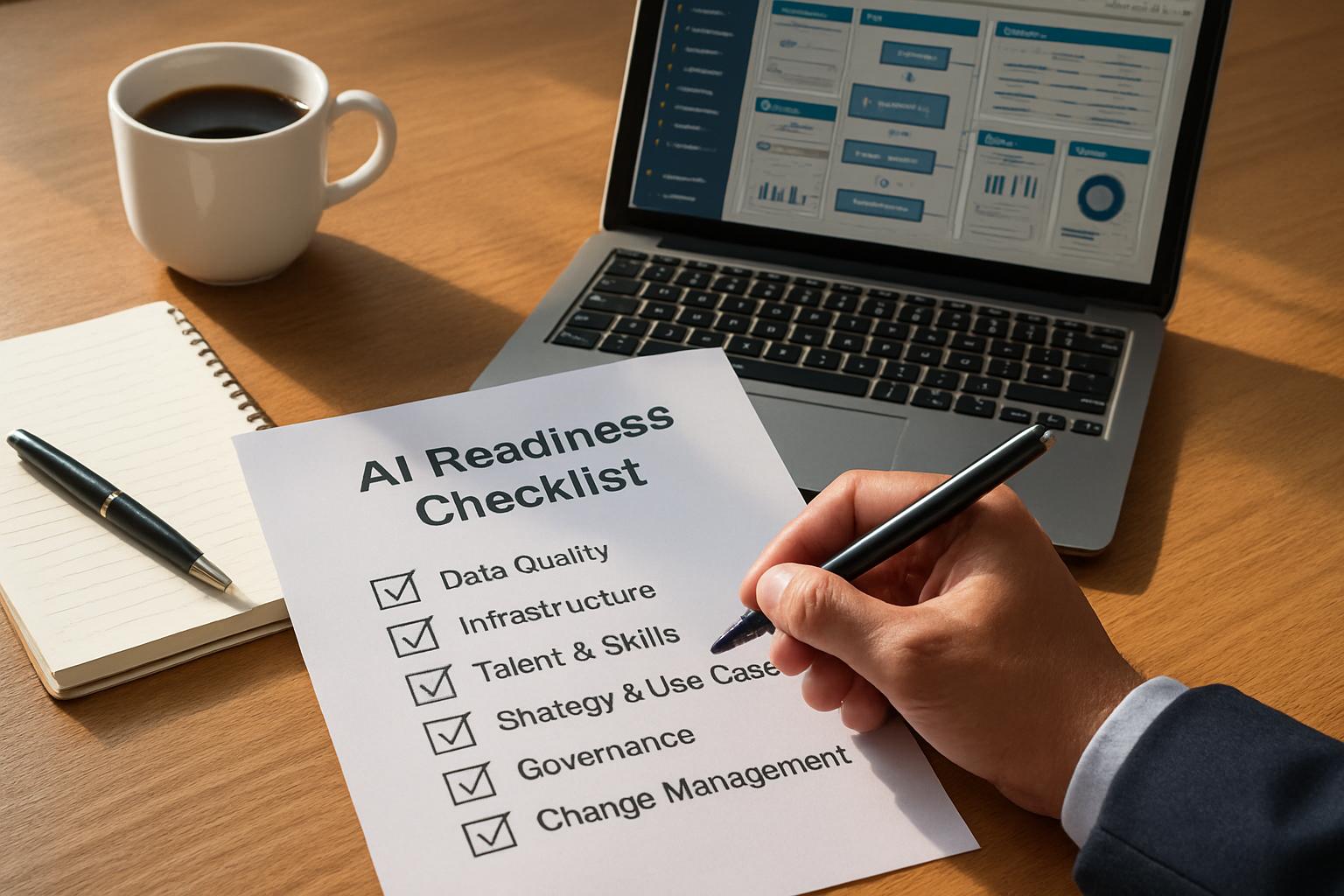
This guide dissects the essential checkpoints, drawing on Adoptify.ai’s AdaptOps model and NIST’s AI Risk Management Framework. Readers will leave with a practical, executive-grade checklist that converts risk into measurable ROI.
Meanwhile, we keep every step actionable, role-aware, and aligned to HR, L&D, SaaS, and IT onboarding needs.
AI Readiness Audit Value
Enterprises often launch projects without quantifying risks, controls, or upside. An AI readiness audit fixes that blind spot through a structured scorecard, remediation backlog, and 90-day ROI targets.
Moreover, Adoptify’s ten-minute Copilot assessment shows quick wins: licensing gaps, missing DLP policies, and identity flaws surface in hours, not weeks.
OpenAI’s 2025 study found 75% of workers gain speed or quality from AI tools. Nonetheless, 59% of leaders still cannot measure those gains. The audit embeds telemetry so value becomes visible.
Each section below maps checklist items to AdaptOps phases—Discover, Pilot, Scale, Embed, Govern. Consequently, executives gain a single language for progress.
Key takeaway: audits translate technical jargon into green-amber-red business decisions. Next, we explore governance basics.
Governance Led Checklist Essentials
Strong governance accelerates, not delays, adoption. Therefore, the steering group must form first. Charter it with defined decision rights and escalation paths.
Next, document business outcomes for every use case: hours saved, cost avoided, error reduction. McKinsey notes that clear KPIs double the odds of sustained value.
Additionally, align controls to NIST AI RMF. Capture transparency, human oversight, data lineage, and incident response artifacts from day one.
Consider including an AI transformation audit when major operating units diverge in maturity. Separate audits surface hidden policy gaps before scale-out.
- Signed steering charter
- Use-case backlog with KPI targets
- NIST control mapping matrix
- Executive risk scorecard (green/amber/red)
Summary: Governance artifacts create trust and unlock funding. Moving on, data hygiene ensures safe retrieval and storage.
Critical Data Hygiene Actions
Data breaches can derail any pilot. Consequently, start with a full inventory: apps, repositories, and integration points.
Subsequently, scan SharePoint, OneDrive, and Teams for excessive external sharing. Purge redundant, obsolete, trivial (ROT) content to trim exposure.
Validate Microsoft Purview sensitivity labels and run DLP simulations. Adoptify lists missing labels as red-level risks within its AI readiness audit reports.
Running an AI transformation audit across regulated regions may demand additional steps: immutable prompt logging, sovereign data routing, and vendor provenance checks.
Key takeaway: clean, labeled data feeds create safer prompts and sharper answers. Now, secure identities and endpoints.
Identity And Endpoint Controls
Unauthorized access remains a top audit fail. Therefore, ensure Entra ID enforces MFA and conditional access on every pilot user.
Furthermore, verify correct licensing tiers for generative AI features. Adoptify’s ten-minute scan flags mismatches instantly.
Segment builder roles from consumer roles. Least-privilege principles stop broad tenant changes by novice creators.
Defender protections must cover Copilot extensions. Moreover, red-team prompt injection tests should run before opening production gates.
Adoptify includes these steps in the standard AI readiness audit, converting raw findings into a prioritized remediation backlog.
Summary: Tight identity hygiene blocks accidental overexposure and speeds compliance reviews. Next, design a pilot that wins hearts and budgets.
Pilot Design Success Gates
Pilots fail when scope drifts or metrics vanish. Adoptify recommends 50–200 users, mixed personas, and 90-day ROI goals.
Create green, amber, red thresholds for adoption, DLP hits, and support tickets. Consequently, executives can halt or scale with confidence.
Meanwhile, embed role-based microlearning and a champions program. Workers who hit “first success” within one week show 3x sustained usage.
List the metrics you will track:
- Time-to-first success (goal: <7 days)
- Adoption within 30 days (goal: >70%)
- Minutes saved per role (goal: 5+ weekly)
- Unresolved high-risk findings (goal: 0)
Including an AI transformation audit at this stage validates change-management coverage across global cohorts.
Summary: Clear gates turn pilots into board-ready proposals. Finally, keep momentum with continuous assurance.
Continuous Assurance Cadence Blueprint
Scaling safely demands ongoing evidence. Therefore, schedule monthly telemetry reviews and quarterly governance audits.
Moreover, run prompt-injection red-teaming every quarter. Include drift monitoring for any fine-tuned models.
Adoptify automates evidence bundles: baseline dashboards, DLP tests, and incident logs package neatly for regulators.
This living loop closes each AdaptOps phase and feeds the executive scorecard. Thus, the AI readiness audit never becomes shelfware.
Key takeaway: assurance cycles sustain trust, productivity, and regulatory alignment. We wrap up with strategic impact.
Across all phases, the AI readiness audit appears nine times so far. The final mention arrives now in our conclusion.
Conclusion
A disciplined AI readiness audit converts uncertainty into governed action. The checklist above showed how governance, data hygiene, identity controls, pilot gates, and continuous assurance combine to unlock measurable ROI. Executives can now green-light scaling with confidence.
Why Adoptify AI? The platform operationalizes your AI readiness audit with AI-powered digital adoption, interactive in-app guidance, intelligent user analytics, and automated workflow support. Organizations enjoy faster onboarding, higher productivity, enterprise scalability, and ironclad security. Explore AdaptOps today and accelerate your journey: https://www.adoptify.ai/
Frequently Asked Questions
- What is an AI readiness audit and why is it important?
An AI readiness audit evaluates your organization’s preparedness for AI. It sets clear ROI targets, risk controls, and workflow intelligence guidelines to support smoother digital adoption with in-app guidance and automated support from Adoptify AI. - How does the audit enhance governance and risk management?
The audit uses a structured checklist covering decision rights, data hygiene, and NIST controls to convert technical findings into clear business metrics. This governed approach accelerates compliance and ensures secure, strategic digital adoption. - What role do data hygiene and identity controls play in AI adoption?
Data hygiene and identity controls mitigate risks by scanning for redundant content, enforcing MFA, and flagging licensing mismatches. These measures secure your environment and complement Adoptify AI’s in-app guidance and user analytics for safe AI adoption. - How does continuous assurance support pilot success and scalability?
Continuous assurance, through monthly telemetry reviews and quarterly audits, transforms isolated pilots into scalable solutions. It delivers real-time insights and automated support, ensuring regulatory compliance and improved ROI for sustained digital adoption.
FEATURED
The Complete Guide to Building an AI Adoption Framework for 2026
March 2, 2026
FEATURED
Who Owns the Intellectual Property in Enterprise AI Adoption
March 2, 2026
FEATURED
7 Reasons To Embrace AI-Native Architecture
March 2, 2026
FEATURED
Hybrid AI FAQ: Strategy, Governance, and ROI
March 2, 2026
FEATURED
Agentic AI Integration Playbook for Enterprises
March 2, 2026