AI Roadmap Development: Proven Guide To Scale Enterprise AI
Every enterprise now races to unlock GenAI value. However, many lose momentum after flashy pilots. McKinsey reports 88% already use AI somewhere, yet only one-third scale successfully. This gap hurts EBIT and frustrates boards. Therefore, leaders need disciplined AI roadmap development to convert proofs into production wins. The guide below offers a proven, AdaptOps-driven path designed for HR, IT, and SaaS teams. We combine fresh market data, governance best practices, and quick-start pilot templates. Consequently, you can craft a board-ready plan that secures budget, reduces risk, and accelerates adoption.
Current Market Reality Check
Recent surveys paint a clear picture. Moreover, 88% of firms use AI in at least one function. Nevertheless, only 33% report enterprise scaling success. Investment has jumped to $37B, yet ROI remains elusive.
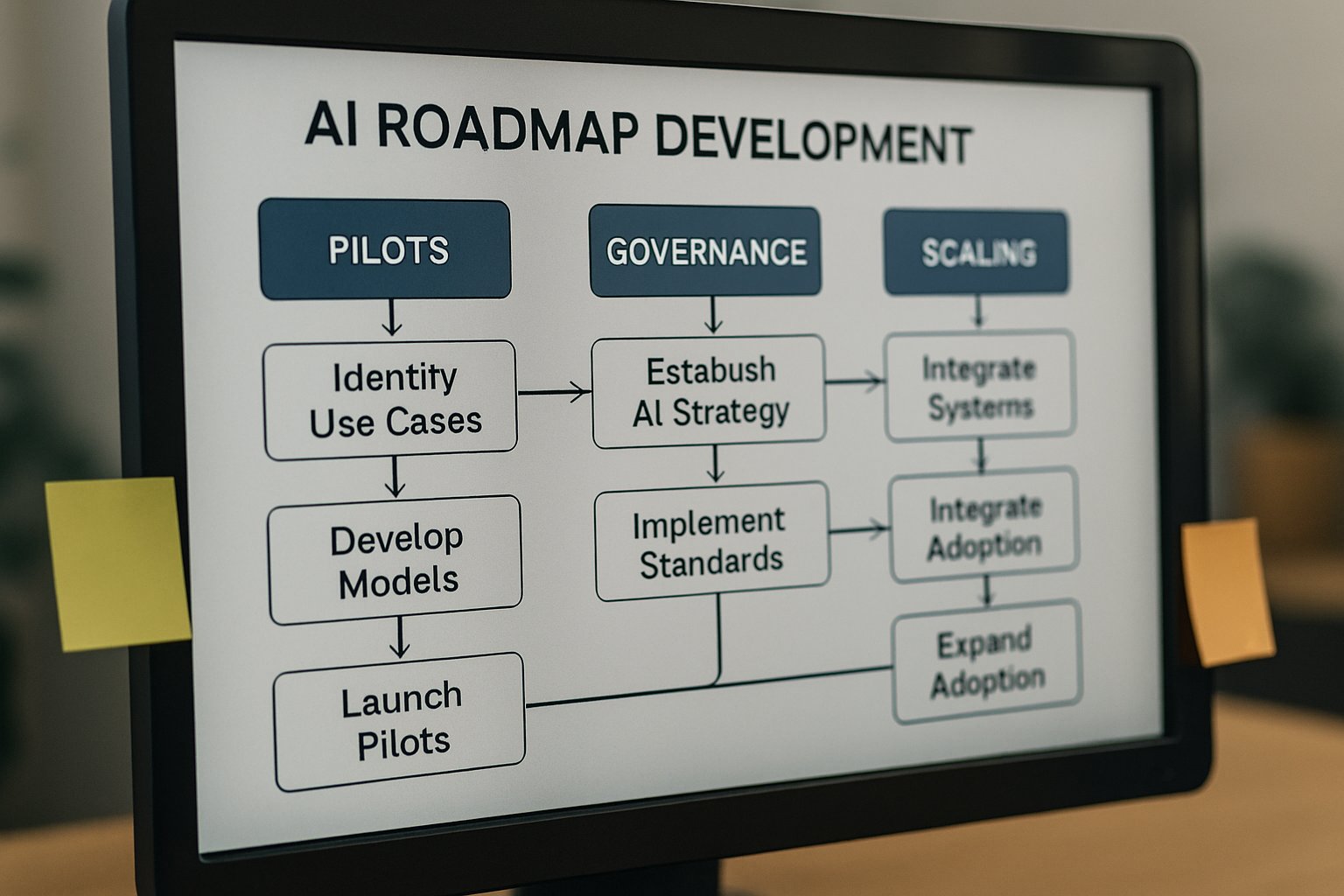
Consequently, boards now demand evidence before approving further funds. Enterprises must shift from hype to operational discipline quickly. Many leaders still lack an AI transformation roadmap that links pilots to enterprise goals.
Key takeaway: market saturation demands structured execution. Next, we map those execution gates. Let us explore the precise gates required.
AI Roadmap Development Gates
Adoptify’s AdaptOps model segments the journey into five gates. Each gate represents a stop-go decision driven by data. Firstly, Discover surfaces use cases through readiness assessments and stakeholder interviews. Secondly, Pilot/Prove validates value with 50-200 users and live KPIs. Thirdly, Scale expands across departments once compliance and ROI targets clear thresholds. Fourth, Embed hardwires AI into workflows using in-app guidance and champion networks. Finally, Govern maintains security, ethics, and performance with automated policy gates.
- Discover – Idea funnel and prioritization.
- Pilot/Prove – Quick 6-8 week validation.
- Scale – Cross-unit rollout with templates.
- Embed – Change management and enablement.
- Govern – Continuous monitoring and audits.
Together, these gates prevent pilot purgatory and align projects with executive expectations.
Gated governance drives confident decisions. Next, we align gates with time horizons.
Three Horizon Roadmap Structure
Leaders often visualize planned work across three horizons. This structure clarifies sequencing and funding.
Horizon Zero spans up to three months. Activities include assessments, security mapping, and Quick-Start pilots. Horizon One covers three to twelve months, adding larger pilots, ROI dashboards, and governance automation. Horizon Two, twelve to twenty-four months, focuses on enterprise scaling, MLOps, and continuous improvement.
Successful AI roadmap development ties deliverables in each horizon to measurable OKRs. Consequently, executives see value earlier while foundational work continues in parallel.
Three horizons balance speed and safety. Our next section deep dives into governance.
Governance Comes First Always
Governance failure stalls many programs. Therefore, embed controls from day one.
Teams should run DLP simulations, apply SOC-2 templates, and enforce No-Training-Without-Consent policies during pilots. Agentic systems require even stricter oversight using least-privilege identities, audit logs, and rollback plans.
By including governance in AI roadmap development, CISOs become allies rather than blockers. Moreover, quarterly value reviews keep leadership informed and accountable.
Governance gates reduce security friction. Next, we address workforce readiness.
Talent And Change Enablement
Statistics reveal persistent skill gaps across enterprise staff. Adoptify suggests mapping job tasks to AI-enabled workflows, then launching role-based microlearning quickly.
Champions receive sandboxed prompt labs and AI CERTs, building credibility across business units. Embedding these activities into AI roadmap development secures adoption and cultural shift.
Consequently, productivity gains become visible within weeks instead of months.
People power sustained momentum. Measurement then validates that momentum.
Measurement And Scale Discipline
Only 59% of companies can measure AI productivity gains today. Therefore, instrument telemetry and ROI dashboards during the very first pilot.
Define metrics such as minutes saved, error reduction, or revenue uplift before coding starts. Continual metric tracking strengthens AI roadmap development by giving executives transparent progress reports.
Additionally, scale decisions use evidence rather than gut feel, shortening approval cycles.
Rigorous measurement de-risks scaling. Finally, let’s consolidate everything.
Executing The Full Roadmap
With gates, horizons, governance, talent, and metrics aligned, execution accelerates. Start with an ECIF Quick-Start funded pilot lasting two to four weeks.
Subsequently, advance to a six-week Pilot phase, requiring 15% productivity improvement before expansion. Document decisions in AdaptOps templates to keep stakeholders synchronized.
This disciplined AI roadmap development approach shortens time to value and builds organizational trust. AdaptOps templates keep the AI transformation roadmap visible to executives and auditors.
Methodical execution wins support. We close with key reminders.
In summary, you now hold a practical playbook for enterprise AI roadmap development. Follow the gates, three horizons, governance overlay, talent tracks, and continuous measurement. Doing so keeps pilots focused, risks transparent, and scale predictable.
Why Adoptify AI? The platform supercharges every stage. It delivers AI-powered digital adoption capabilities that embed interactive in-app guidance. Intelligent user analytics surface friction instantly. Automated workflow support removes manual drudgery. Consequently, onboarding finishes faster and productivity climbs higher. Enterprise scalability and security come baked in, backed by AdaptOps templates and policy gates. Discover how Adoptify AI transforms your AI journey by visiting Adoptify.ai today.
Frequently Asked Questions
- What is AI roadmap development and why is it important?
AI roadmap development is a structured strategy linking pilots to enterprise goals. It uses disciplined gates and timelines to reduce risk, accelerate digital adoption, and ensure smooth workflow intelligence. - How does Adoptify AI accelerate AI adoption?
Adoptify AI supercharges AI adoption with interactive in-app guidance, intelligent user analytics, and automated workflow support. This approach not only accelerates digital adoption but also streamlines AI roadmap development. - What are the key gates in the AdaptOps framework?
The AdaptOps framework features five gates: Discover, Pilot/Prove, Scale, Embed, and Govern. Each stage validates use cases, ensures compliance, and establishes a secure digital adoption path. - How does continuous measurement enhance AI deployment?
Continuous measurement with ROI dashboards and user analytics validates progress, de-risks scaling, and builds executive trust. This transparent approach supports efficient digital adoption and sustainable AI transformation.
FEATURED
The Complete Guide to Building an AI Adoption Framework for 2026
March 2, 2026
FEATURED
Who Owns the Intellectual Property in Enterprise AI Adoption
March 2, 2026
FEATURED
7 Reasons To Embrace AI-Native Architecture
March 2, 2026
FEATURED
Hybrid AI FAQ: Strategy, Governance, and ROI
March 2, 2026
FEATURED
Agentic AI Integration Playbook for Enterprises
March 2, 2026