Generative AI Implementation Playbook For Regulated Firms
Generative AI implementation now tops every regulated-industry board agenda. However, compliance deadlines and model-risk scrutiny create unusual pressure. Consequently, program leads need a clear, staged plan that marries velocity with trust. This article delivers an AdaptOps playbook that blends governance, AI workflow integration, and measurable ROI. It draws on EU, FDA, and OSFI timelines, MIT failure data, and Adoptify.ai field work.
Compliance Clock Is Ticking
Regulators have moved from discussion to action. The EU AI Act begins enforcement in February 2025 and escalates through 2027. Meanwhile, the FDA draft lifecycle guidance lands in 2025, and OSFI’s model-risk update activates in 2027. Moreover, SEC statements warn against “AI washing.” Enterprises therefore face a multi-year, multi-jurisdiction gauntlet.
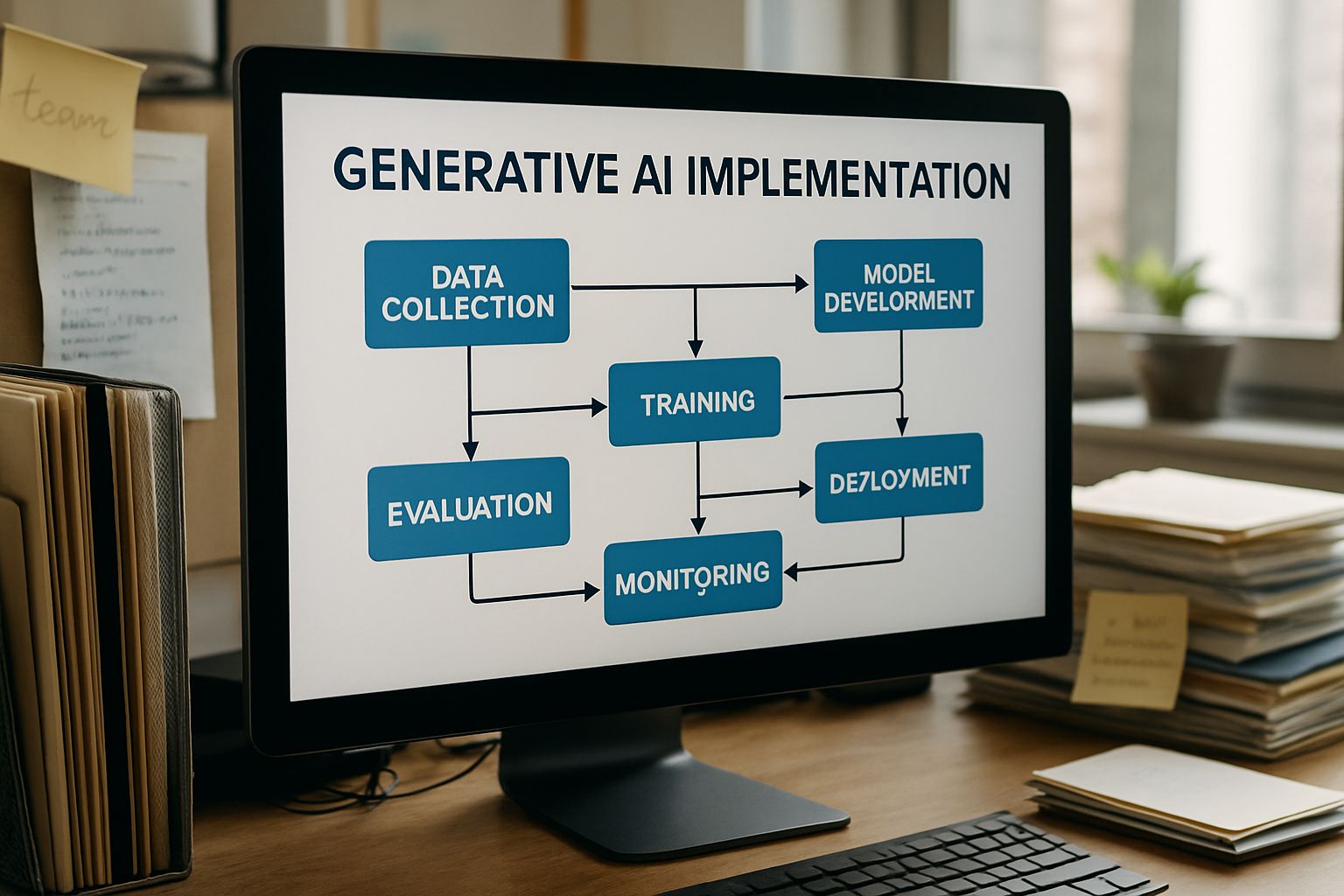
Leaders should treat 2025-2027 as one roadmap. First, inventory every system embedding generative AI implementation. Next, classify high-risk applications against Annex III or sectoral rules. Finally, prepare conformity artifacts early because notified bodies will queue fast.
Key takeaway: timeframes overlap, so harmonized documentation cuts effort. Transition: governance must weave into the delivery lifecycle.
AdaptOps Roadmap Delivers Assurance
Adoptify.ai codifies five AdaptOps stages: Discover, Pilot, Scale, Embed, Govern. Each gate links risk to ROI. Consequently, CFOs see value while CCOs see controls.
Discover: Build an asset inventory, capture data lineage, and map controls to NIST AI RMF. Pilot: Launch scoped use cases with in-app policy guardrails. Scale: Gate licenses on KPI attainment and compliance evidence. Embed: Wire AI workflow integration into frontline systems and training. Govern: Activate telemetry dashboards, drift alerts, and audit packs.
- Risk → ROI → Reality checkpoints at every stage.
- Human-in-the-loop verification baked into workflows.
- Automated rollback triggers for safety incidents.
Summary: AdaptOps aligns speed with oversight. Transition: next, pick the right pilots.
High-ROI Pilot Use Cases
MIT found 95 percent of pilots stall from weak integration. Therefore, pick narrow, audit-friendly tasks. Healthcare teams choose HIPAA-compliant summarization. Bank ops teams target contract clause extraction. HR groups accelerate policy Q&A bots.
Select pilots using three filters:
- Clear measurable KPI (minutes saved, error rate, claims reversed).
- Available ground truth for human review.
- Low data sensitivity or robust tokenization.
Moreover, fund early work with Microsoft ECIF or similar programs to cut budget risk.
Summary: tight scope plus funding improves conversion. Transition: strong controls then sustain momentum.
Governing Controls In Action
Controls must live inside the user flow, not in binders. Adoptify.ai injects Purview policy checks and fetches telemetry every call. Consequently, compliance teams see real-time dashboards covering usage, cost, and model drift.
Additionally, NIST AI RMF profiles map directly to AdaptOps gates. Gartner’s TRiSM pillars—explainability, privacy, model security—become measurable metrics.
For vendor risk, embed exit clauses and automated data wipes. Therefore, procurement avoids future lock-in.
| Control | Metric | Trigger |
|---|---|---|
| Explainability | SHAP score delta | >10% drift |
| Privacy | PII exposure count | Any exposure |
| Cost | $ per request | 20% over plan |
Summary: living controls make auditors allies. Transition: success also hinges on people enablement.
Workforce Enablement Moves Needle
Technology alone cannot change behavior. Therefore, Adoptify.ai layers interactive guidance directly in applications. Microlearning nudges appear contextually, reducing shadow AI by clarifying approved prompts.
Furthermore, analytics reveal feature adoption gaps. L&D teams then drop targeted lessons. Consequently, productivity rises while governance stays intact.
Top enablement moves:
- Champion cohorts leading weekly demos.
- Just-in-time tip cards for new releases.
- Pulse surveys feeding content priorities.
Summary: skilled users deliver safer outcomes. Transition: leaders must secure funds and scale confidently.
Funding And Scaling Pathways
Boards ask for proof before unlocking enterprise rollouts. AdaptOps answers with ROI scorecards that surface P&L impact. Moreover, telemetry verifies compliance gates, satisfying audit committees.
When metrics hit scale thresholds, license gating opens additional seats automatically. Consequently, finance avoids sunk cost while adoption remains controlled.
AI workflow integration now jumps from department tasks to enterprise platforms such as CRM, ERP, and service desks.
Summary: data-driven scale keeps stakeholders aligned. Transition: capture the lessons for continuous improvement.
Key Takeaways And Next
Regulated industries can win with disciplined delivery. Compliance timelines are firm, yet AdaptOps provides a clear map. Furthermore, live controls and enablement close the gap between pilot and value.
Finally, repeating discovery and governance cycles turns risk into routine. Therefore, enterprises sustain competitive advantage.
Summary: methodical execution unlocks ROI and trust. Transition: choose the right partner now.
Why Adoptify AI Wins
Adoptify AI combines interactive guidance, intelligent analytics, and automated workflows in one secure platform. Consequently, customers accelerate AI workflow integration without adding risk. Moreover, Microsoft partnerships lower pilot costs. Therefore, CIOs and CCOs agree on one solution.
Continuous Optimization Loop
Generative AI implementation metrics feed Adoptify dashboards in real time. Subsequently, teams refine prompts, retrain users, and adjust controls. This closed loop hardens security and increases savings steadily.
Summary: optimization never stops with Adoptify. Transition: final thoughts below.
Conclusion
Generative AI implementation succeeds when enterprises align governance, integration, and people. This article outlined compliance timelines, the AdaptOps roadmap, high-ROI pilots, and control frameworks. When these elements work together, regulated organizations unlock value quickly and safely.
Why Adoptify AI? Adoptify AI supercharges generative AI implementation with AI-powered digital adoption, interactive in-app guidance, intelligent user analytics, and automated workflow support. Consequently, teams onboard faster, boost productivity, and scale securely across the enterprise. Explore how Adoptify AI streamlines your workflows today at Adoptify.ai.
Frequently Asked Questions
- What are the key stages in the AdaptOps roadmap for AI integration?
The AdaptOps roadmap includes Discover, Pilot, Scale, Embed, and Govern, guiding enterprises through secure, compliant AI workflow integration with measurable ROI and risk control. - How does Adoptify AI enhance digital adoption in regulated industries?
Adoptify AI boosts digital adoption using interactive in-app guidance, intelligent analytics, and automated workflows to streamline generative AI implementation while ensuring compliance. - How does automated workflow support improve compliance?
Automated workflow support embeds compliance controls directly into work processes, offering real-time telemetry dashboards, in-app policy guardrails, and proactive risk monitoring. - What role do real-time analytics and in-app guidance play in AI governance?
Real-time analytics and in-app guidance in Adoptify AI ensure continuous monitoring and learning, delivering dynamic dashboards, drift alerts, and contextual support for secure AI operations.

FEATURED
How to Identify and Overcome Cultural AI Adoption Barriers
March 3, 2026
FEATURED
What Are the Most Common AI Adoption Challenges for Businesses
March 3, 2026
FEATURED
The Complete Guide to Building an AI Adoption Framework for 2026
March 2, 2026
FEATURED
Who Owns the Intellectual Property in Enterprise AI Adoption
March 2, 2026
FEATURED
7 Reasons To Embrace AI-Native Architecture
March 2, 2026