Conquering AI Adoption Resistance in Modern Enterprises
AI adoption resistance now threatens even ambitious digital leaders across industries. Executives approve budgets, yet pilots often stall before reaching production scale. Meanwhile, employees experiment alone, creating risky shadow AI footprints.
Consequently, the promised productivity uplift fails to appear on financial statements. Multiple surveys show up to 95% of generative pilots deliver no measurable ROI. However, root causes live mostly in people, process, and governance rather than code.
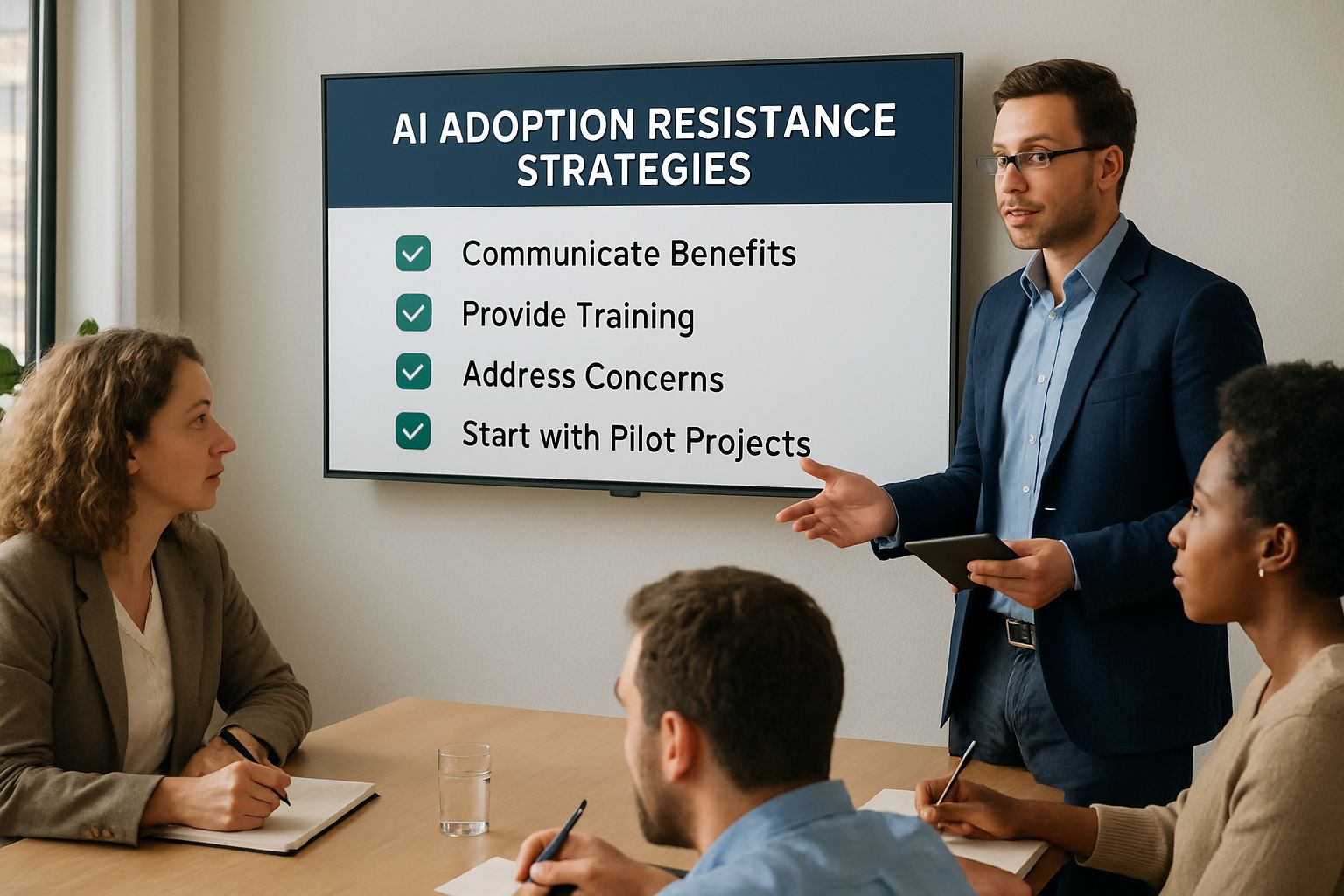
Adoptify AI research confirms fear, unclear ownership, and skill gaps dominate the AI transformation challenges list. Therefore, leaders must pair technology investments with structured enablement, transparent policies, and continuous measurement. This article delivers a practical roadmap grounded in field data and AdaptOps best practices.
Readers will gain actionable steps to move from isolated prototypes to enterprise impact. Each section closes with concise takeaways to simplify execution for HR, IT, and transformation teams.
Core Resistance Causes Explained
First, data confirm a stubborn pilot-to-production gap. MIT Project NANDA found only five percent of generative pilots drove P&L impact. Similarly, Deloitte reports just twenty percent of firms see revenue growth despite broad efficiency gains. These statistics highlight the AI transformation challenges facing large enterprises.
Fear of job loss intensifies the gap. Surveyed workers cite career uncertainty as their top concern when AI appears. However, transparent role forecasts and reskilling plans cut anxiety quickly.
Second, training deficits hinder confidence. Nearly half of employees blame inadequate instruction for stalled usage. Manager support doubles daily AI engagement, yet many managers lack coaching resources.
Finally, governance opacity breeds mistrust. Without clear policies, staff default to unsanctioned tools or avoid AI completely. Consequently, leaders face both compliance risk and wasted investment.
In short, fear, skill gaps, and invisible governance drive early pushback. Addressing each root cause lays the foundation for confident adoption. Next, we examine practical moves for tackling AI adoption resistance.
Tackling AI Adoption Resistance
Effective programs start with a clear operating rhythm. Adoptify’s AdaptOps loop—Discover, Pilot, Scale, Embed, Govern—turns big objectives into digestible milestones. Consequently, teams see progress every 90 days, which sustains morale. These tactics directly confront AI adoption resistance by turning abstract change into observable benefits.
Define explicit exit criteria for each pilot stage. Moreover, instrument telemetry from day one to show time saved, errors avoided, and revenue lifted. Visible data reduces skepticism and funds next waves.
Managers carry the message locally. Therefore, certify them early and provide playbooks aligned with AdaptOps gates. Gallup shows this single action doubles frequent AI usage.
Structured cadence, measurable wins, and empowered managers neutralize early resistance. This combination converts uncertainty into confident momentum. We now dive deeper into the manager role.
Manager Enablement Matters Most
Managers translate strategy into daily habits. However, many feel unprepared to answer team questions. Provide microlearning modules, office hours, and community channels focused on quick wins.
Adoptify’s manager certification flow embeds short scenario-based assessments into Teams or Slack. Scorecards gamify progress and highlight leading managers. Consequently, positive peer pressure amplifies success.
When managers model responsible prompting, AI adoption resistance drops across the department. Their example normalizes experimentation across roles.
- Certify managers early.
- Give them prompt libraries.
- Publish usage leaderboards weekly.
Empowered managers convert curiosity into consistent usage. This shift tackles motivation and support in one move. Next, we explore continuous training for every role.
Training In Workflow Context
One-off workshops vanish from memory within days. Therefore, learning must happen during actual work. Role-based microlearning surfaces tips when users trigger relevant actions.
Adoptify AI integrates in-app guidance, simulations, and micro-certifications directly inside enterprise tools. Users practice, get feedback, and earn badges without leaving the current screen. The program also demystifies AI transformation challenges by mapping skills to daily tasks.
This approach reduces AI adoption resistance because employees see immediate context and value. Furthermore, telemetry tracks competence growth and flags users needing extra coaching.
In-flow guidance converts training gaps into confident performance. Consequently, teams scale skills alongside demand. Governance must now keep pace with this new velocity.
Governance Builds Crucial Trust
Trust collapses when policies lag behind experimentation. Clear guardrails reassure both executives and frontline users. Adoptify’s governance starter kits bundle model cards, DLP simulations, and incident playbooks.
Moreover, telemetry dashboards surface drift, misuse, and value meters in near real time. These insights allow rapid intervention before risks materialize.
With transparent oversight, AI adoption resistance fades as employees witness security and compliance protections. Moreover, staff know where to escalate concerns without fear.
Governance is not bureaucracy; it unlocks safe creativity. Visible policies and dashboards nurture long-term trust. Next, we address measurement for proof of value.
Measure Value Very Early
Executives fund programs that show impact quickly. Therefore, pilots need baseline metrics and target improvements before kickoff.
Adoptify embeds ROI dashboards that compare time saved, quality gains, and revenue contribution per workflow. Consequently, stakeholders see financial relevance immediately.
In contrast, many firms rely on anecdotal stories and lose sponsorship. Regular scorecards keep leadership aligned.
Early measurement also quiets AI adoption resistance among skeptics who demand evidence. Consistent reporting links adoption to tangible performance outcomes.
Define KPIs, track them, and communicate wins at every AdaptOps gate. Subsequently, funding and confidence grow organically. The final piece involves scaling pilots responsibly.
Pilot Programs Safely Scale
Scaling requires wave releases, not big bangs. Start with one region or function, apply lessons, then expand.
Furthermore, reuse templates and automation to keep velocity high while controlling risk. AdaptOps gates ensure ownership, skills, and governance mature together.
Finally, provide sanctioned alternatives to shadow AI, such as approved copilots and prompt libraries. These options capture grassroots creativity without jeopardizing compliance.
Structured waves sustain momentum and sharpen rollout playbooks. Consequently, enterprise coverage accelerates without chaos. We now distill these insights and introduce a proven partner.
Conclusion
Overcoming AI adoption resistance demands synchronized action across enablement, governance, and measurement. Root causes involve fear, missing skills, and opaque policies, not technology shortfalls. Leaders who empower managers, deliver in-flow microlearning, and display transparent metrics convert blockers into boosters.
Adoptify AI simplifies that journey with AI-powered digital adoption capabilities and interactive in-app guidance. Intelligent user analytics reveal behavior change, while automated workflow support speeds everyday tasks. Consequently, enterprises achieve faster onboarding, higher productivity, and verifiable ROI at enterprise scale and security.
Ready to transform? Visit Adoptify AI and turn AI transformation challenges into sustainable breakthroughs today.
Frequently Asked Questions
- How does Adoptify AI help overcome AI adoption resistance?
Adoptify AI addresses AI adoption resistance by integrating in-app guidance, continuous training, and telemetry dashboards. Its AdaptOps framework turns isolated pilots into scalable, ROI-driven digital adoption strategies. - What role do managers play in ensuring successful AI digital adoption?
Managers are crucial in translating AI strategy into daily actions. With certification flows, prompt libraries, and scorecards, they empower teams, enhance engagement, and reduce adoption resistance through effective local support. - How does in-app guidance improve workflow efficiency?
In-app guidance and contextual microlearning deliver training directly during work, accelerating skill acquisition and reducing errors. This hands-on approach streamlines workflows and drives seamless AI adoption across teams. - How does Adoptify AI ensure trust and compliance in AI adoption?
Adoptify AI builds trust with transparent governance, automated compliance dashboards, and model card starter kits. These features secure data, mitigate risks, and provide clear guidelines for safe AI transformation.

FEATURED
How to Identify and Overcome Cultural AI Adoption Barriers
March 3, 2026
FEATURED
What Are the Most Common AI Adoption Challenges for Businesses
March 3, 2026
FEATURED
The Complete Guide to Building an AI Adoption Framework for 2026
March 2, 2026
FEATURED
Who Owns the Intellectual Property in Enterprise AI Adoption
March 2, 2026
FEATURED
7 Reasons To Embrace AI-Native Architecture
March 2, 2026