AI ROI measurement: Turning AI Pilots Into Profit
Every executive wants generative AI, yet most struggle to prove business impact. McKinsey finds 88% experiment with AI while only 39% see EBIT gains. Without rigorous AI ROI measurement, pilots linger and budgets tighten.
Consequently, finance leaders ask for hard numbers, not model demos. Meanwhile, project owners must translate minutes saved into accepted financial metrics. Adoptify’s AdaptOps framework answers this call through baseline data and live dashboards.
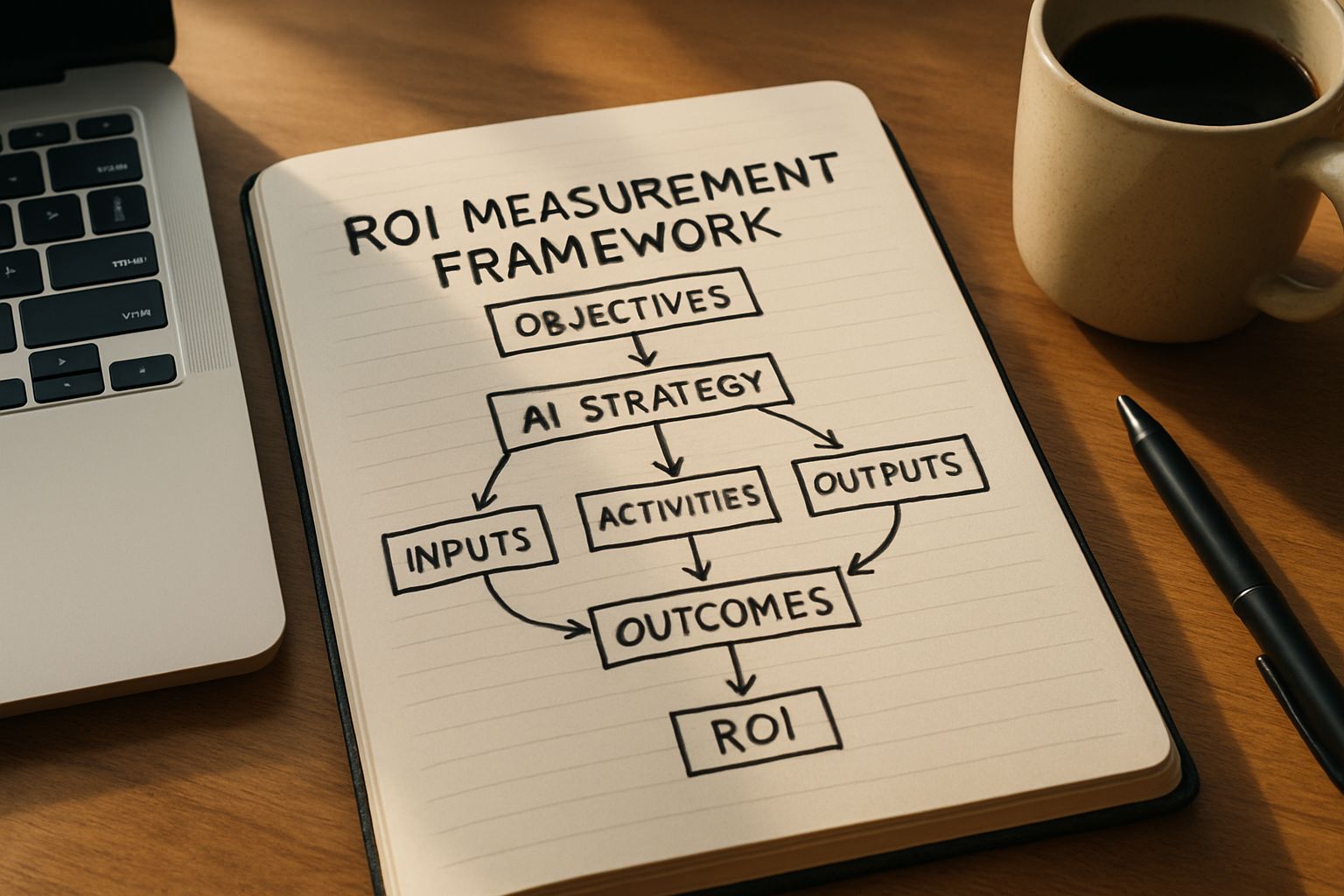
This article presents a practical roadmap that carries AI from pilot to profitability. It blends latest research, proven AdaptOps milestones, and field examples across HR, SaaS, and operations. Follow each step to quantify value quickly and secure enterprise scale. Moreover, we highlight AI value tracking techniques that keep CFOs engaged.
Strategic AI ROI Measurement
Strategic AI ROI measurement starts before the first line of code. Teams define business hypotheses, choose outcome KPIs, and commit to a 90-day clock. Therefore, success becomes a financial go or no-go decision, not a science project.
Adoptify begins with a two-week Readiness Audit that ranks use cases by payback speed. The audit yields a pilot charter that finance, security, and HR all endorse. Consequently, every stakeholder knows why the pilot matters and how it will be judged.
A clear charter also reduces scope creep and protects timelines. Next, we explore why many pilots still fail despite good intent.
In summary, early alignment and disciplined gates anchor financial credibility. Let us examine the common traps that derail unprepared teams.
Why Pilots Often Stall
Research from MIT shows 95% of generative pilots never hit production revenue. Mis-scoped objectives and absent baselines top the blame list. However, governance gaps and user drop-off aggravate the loss.
- Technical metrics replace business KPIs.
- No counterfactual or A/B benchmark exists.
- Security reviews delay integration windows.
- Employees abandon tools without guidance.
Together, these traps convert promising demos into sunk cost. To escape, teams must capture trustworthy baseline data up front.
Capture Baseline Data First
Without credible baselines, AI ROI measurement becomes guesswork. Therefore, Adoptify instruments existing workflows before any model deploys. Telemetry captures task duration, error counts, and FTE costs per role.
Teams should focus on four immediate data points:
- Time per transaction.
- Throughput and error rate.
- Burdened labor cost.
- User sentiment scores.
Moreover, Adoptify’s dashboards convert every saved minute into cost equivalence instantly. This rapid AI value tracking reassures skeptical finance partners.
Collecting accurate baselines grounds future claims in evidence. With data ready, we can layer metrics for richer insight.
Comprehensive Four-Layer KPI Model
Adoptify builds scorecards across four aligned layers. Consequently, teams avoid debating metrics mid-pilot. The layers cover usage, output, operational, and financial results.
Activity metrics track daily active users, sessions, and prompt counts. Output metrics examine accuracy, quality, and straight-through processing rates. Operational metrics record time saved, SLA wins, and FTE equivalents. Finally, financial metrics display payback period, NPV, and risk bands.
Because each layer rolls into the next, attribution stays transparent. AI value tracking dashboards visualize the causal chain for executives. Consistent AI ROI measurement connects the layers and validates causality. Therefore, primary and secondary sponsors read the same data in real time.
Layered KPIs reinforce credibility and speed CFO approvals. The next challenge is guarding that value against compliance shocks.
Strong Governance Protects Returns
Security and compliance teams often pause pilots at the worst moment. However, embedded controls convert governance from blocker to booster. Adoptify auto-generates audit evidence, role access maps, and drift alerts.
These features feed the finance dashboard with risk-adjusted cost avoidance. Consequently, AI value tracking covers both upside and protected downside. That balanced picture satisfies risk committees and financial controllers together.
Robust governance also reduces future remediation expense, improving the AI ROI measurement trajectory. Therefore, projects move from experimental budgets into production funding faster.
Effective governance aligns security value with financial payback. Next, we show how adoption converts protected value into repeatable profit.
Persistent Adoption Drives Scale
Great pilots still collapse if users drop off after launch. In-app guidance, microlearning, and champion networks prevent that drop. Moreover, Adoptify pushes personalized tips based on live telemetry.
Weekly nudges raise active usage by double-digit percentages in HR and IT teams. Consequently, outcome metrics continue climbing well beyond the 90-day gate.
Sustained adoption also creates new data for the next business case. Hence, each win shortens the path for subsequent use cases.
Adoption ensures measured benefits persist and compound. With users engaged, we can translate metrics into bankable profit.
From Metrics To Profit
Financial controllers care about cash, not dashboards. Therefore, teams must convert numbers into traditional investment metrics. Adoptify’s engine calculates payback, internal rate of return, and scenario bands instantly.
During the 90-day gate, executives compare those figures against the original AI ROI measurement target. Because data flows automatically, debates focus on strategy, not accuracy. If returns beat hurdle rates, AdaptOps scales the solution enterprise-wide.
Meanwhile, AI value tracking continues, feeding board reports each quarter. Consequently, benefits remain visible and funding remains reliable.
Profitable pilots close the GenAI divide and silence ROI skeptics. Finally, we recap the playbook and invite you to accelerate outcomes.
Final Thoughts And Action
Measured pilots, layered KPIs, and disciplined governance transform AI from curiosity to cash. The framework above guides leaders through baseline capture, adoption levers, and AI ROI measurement excellence. Follow the cadence to deliver repeatable value across HR, SaaS, and enterprise operations.
Why Adoptify AI? Our AI-powered digital adoption platform merges interactive in-app guidance, intelligent user analytics, and automated workflows. Clients enjoy faster onboarding, higher productivity, and enterprise-grade security at global scale.
Visit Adoptify AI today and turn saved minutes into profit within 90 days. Start scaling AI with confidence and measurable returns.
Frequently Asked Questions
- How does Adoptify AI help measure AI ROI?
Adoptify AI measures AI ROI by capturing baseline data and leveraging automated dashboards. Its AdaptOps framework tracks usage, operational metrics, and financial results for clear, data-driven pilot evaluations and scalable AI implementation. - What are the key benefits of Adoptify AI’s digital adoption platform?
Adoptify AI offers in-app guidance, intelligent user analytics, and automated workflows that streamline onboarding and boost productivity. Its real-time dashboards and security features ensure measurable ROI and efficient AI adoption. - How does capturing baseline data improve AI pilot success?
By capturing baseline data, Adoptify AI establishes accurate performance metrics before deployment. This step prevents mis-scoped objectives, ensures clear KPIs, and builds a strong foundation for robust AI ROI measurement. - How does persistent user adoption drive AI profitability using Adoptify AI?
Persistent user adoption, supported by in-app guidance and microlearning features, ensures continuous engagement and data capture. This ongoing usage validates ROI, drives iterative improvements, and fosters scalable AI integration.

FEATURED
How to Identify and Overcome Cultural AI Adoption Barriers
March 3, 2026
FEATURED
What Are the Most Common AI Adoption Challenges for Businesses
March 3, 2026
FEATURED
The Complete Guide to Building an AI Adoption Framework for 2026
March 2, 2026
FEATURED
Who Owns the Intellectual Property in Enterprise AI Adoption
March 2, 2026
FEATURED
7 Reasons To Embrace AI-Native Architecture
March 2, 2026