Organizational Readiness Checklist: Scale AI With Confidence
Generative AI hype feels unstoppable, yet scale remains elusive for many enterprises. Robust organizational readiness separates brief experiments from lasting competitive gains. Companies racing into pilots often discover gaps in culture, governance, and skills.
Recent McKinsey data shows 88% of organizations use AI somewhere, yet only a third scale initiatives. Meanwhile, Gartner links high maturity with structured governance that keeps projects alive for three years or more. Consequently, leaders now demand an organizational readiness for ai checklist that converts hype into hard numbers.
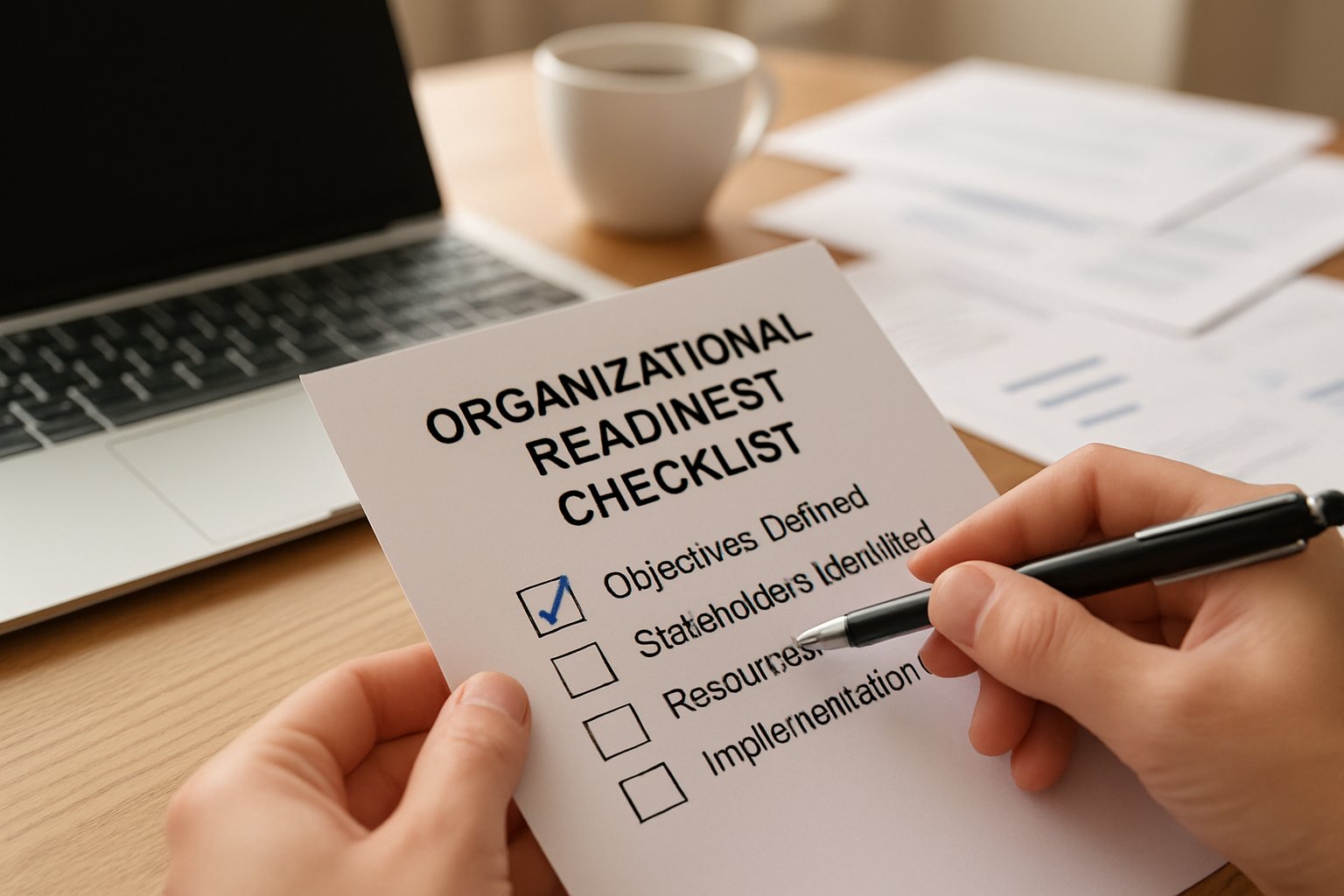
This article distills AdaptOps best practices, industry benchmarks, and proven guardrails into the ultimate organizational readiness checklist. Follow this step-by-step guide to assess culture and pilot with clear ROI. It will embed governance and unlock rapid ai adoption across the enterprise.
Core Organizational Readiness Essentials
Every readiness program begins with clear objectives. Start by mapping business goals to high-value AI use cases. Moreover, link each case to a financial or experience metric owners already report. That alignment keeps sponsors engaged when priorities shift.
Next, create a cross-functional governance council with legal, security, HR, and finance leaders. Consequently, decisions land faster and conflicting policies surface early. Document member roles, meeting cadence, and escalation paths to maintain momentum.
Teams should capture baseline artifacts before any code ships:
- Executive charter with success metrics.
- Data inventory and quality scores.
- Risk register covering privacy and model bias.
- Change-management plan aligned to AdaptOps gates.
In short, establishing objectives and governance early prevents costly rework. Essentials formed here anchor every later AdaptOps gate.
With the foundation set, assess cultural readiness to ensure teams embrace change.
Assess Cultural Foundations First
Culture decides whether tools become habits or shelfware. McKinsey warns that many stalled programs lacked executive modeling. Therefore, start with leadership workshops showcasing AI outputs on real data. Leaders who demo new workflows signal permission to experiment.
Employee sentiment surveys reveal hidden blockers. Additionally, Gartner links psychological safety with faster experimentation and higher project longevity. Gauge trust levels, reward safe failure, and celebrate early wins publicly.
An organizational readiness for ai checklist should include culture pulse checkpoints every quarter. Use short polls to track openness, training satisfaction, and perceived value from ai adoption.
Summing up, leadership modeling and psychological safety accelerate experimentation. Healthy culture metrics feed directly into the next governance step.
After measuring culture, set guardrails before pilots begin.
Set Governance Guardrails Early
Governance transforms novel demos into sustainable services. Moreover, ISO/IEC 42001 now offers a management-system blueprint for trustworthy AI. Adopt the standard’s principles, even if certification remains distant.
Adoptify’s AdaptOps model codifies guardrails as evidence artifacts. For each phase, teams must present model cards, architecture diagrams, data-leakage tests, and rollback scripts. Consequently, executive gates rely on facts, not optimism.
The minimum governance package should include:
- Signed impact assessment aligned to ISO/IEC 42005.
- Data-provenance and lineage documentation.
- Cost estimator tied to minutes-saved KPIs.
- Vendor exit and rollback rehearsals.
In essence, clear guardrails let innovators move quickly without fear. Documented evidence also satisfies auditors and regulators later.
With guardrails agreed, organizations can design focused pilots that prove value fast.
Design Sharp ROI Pilots
Pilots succeed when scoped tightly. Microsoft’s 11-by-11 research shows habits form after saving 11 minutes daily over 11 weeks. Therefore, choose tasks with repetitive steps and measurable baselines.
Adoptify recommends 6–12 week pilots covering 50–200 users. Weekly telemetry tracks minutes saved, error reductions, and sentiment shifts. Moreover, ROI dashboards convert those signals into CFO-ready cash projections.
Include an organizational readiness for ai checklist item that states pilot exit criteria up front. Clear gates prevent the dreaded “pilot-to-nowhere” and accelerate ai adoption enterprise-wide.
To summarize, small, metric-driven pilots reveal business value within a single quarter. Evidence collected here fuels the scaling playbook.
Next, verify data pipelines can handle production volumes without surprises.
Fortify Data Foundations Continuously
No model survives bad data. Consequently, teams must audit lineage, labeling cadence, and drift risks before scaling. Implement continuous validation combined with ModelOps telemetry to catch issues early.
Data controls also safeguard privacy. Additionally, runtime DLP policies and encryption enforce compliance in regulated sectors. Adoptify provides templates for HIPAA, SOC-2, and GDPR so time-pressed teams start strong.
Strengthening pipelines appears on every organizational readiness dashboard because data quality drives trustworthy outcomes.
In brief, solid data pipelines reduce rework and risk. Clean inputs allow scaled workloads to remain efficient and compliant.
Once data flows reliably, people need targeted enablement to exploit new capabilities.
Enable People And Scale
Technology fails without skilled users. Therefore, combine role-based learning paths, champion networks, and in-app guidance. AdaptOps integrates impact metrics so training teams track minutes saved rather than seat time.
Recent surveys show 74% of employees use AI but only a third receive formal instruction. Consequently, skills gaps persist long after licenses are purchased. Address this by delivering contextual tips directly within workflows.
An internal organizational readiness scorecard should tie enablement progress to productivity dashboards. Moreover, ai adoption accelerates when workers see personal time restored each day.
Ultimately, people fuel the scale phase by transforming insights into repeatable habits. Trained users close the loop on your investment.
All pieces now align, enabling a controlled march toward enterprise value.
Conclusion
Prepared organizations unlock sustainable AI returns. By aligning culture, guardrails, pilots, data, and people, enterprises turn experimentation into durable value. Adoptify AI makes that journey simple.
Why Adoptify AI? The AI-powered platform embeds interactive in-app guidance, intelligent user analytics, and automated workflow support. Consequently, teams onboard faster, drive higher productivity, and scale securely across the enterprise.
Accelerate your organizational readiness with AdaptOps checklists, ROI dashboards, and governance kits—all delivered through enterprise-grade security. Visit Adoptify AI today and supercharge ai adoption.
Frequently Asked Questions
- What is organizational readiness for AI adoption?
Organizational readiness ensures clear objectives, structured governance, and cultural alignment to scale AI. Adoptify AI supports this with AdaptOps checklists and role-based enablement to drive measurable ROI. - How do governance guardrails accelerate AI deployment?
Governance guardrails define risk assessments, data provenance, and control measures, enabling faster AI rollout. With audit trails and automated workflow support, Adoptify AI helps secure and scale digital initiatives. - What role does cultural readiness play in digital adoption?
Cultural readiness nurtures leadership buy-in and safe experimentation, addressing hidden blockers. Adoptify AI reinforces this with in-app guidance and user analytics to align teams for effective digital adoption. - How do ROI pilots support sustainable AI benefits?
ROI pilots validate AI impact through clear metrics like minutes saved and error reduction. They set measurable goals and execute governance, with Adoptify AI offering dashboards for tracking pilot success.

FEATURED
Scaling Retail Operations Through Corporate AI Adoption
February 27, 2026
FEATURED
How Corporate AI Adoption Reduced Operational Costs by 40%
February 27, 2026
FEATURED
Boutique Enterprise AI Adoption vs Big Four Consulting
February 25, 2026
FEATURED
Security Audit for Corporate AI Adoption
February 25, 2026
FEATURED
What is the Average Investment for Enterprise AI Adoption
February 20, 2026