Workforce Transition: Your AI Upskilling Playbook
AI is no longer experimental; it is operational. Consequently, leadership teams now face a pressing workforce transition. Employees must gain new technical and human-centered abilities while still meeting today’s targets. Moreover, HR, IT, and L&D leaders must coordinate training, change management, and governance in real time. Failure risks stalled pilots, compliance gaps, and lost competitive edge. Thankfully, proven frameworks and data-driven platforms like Adoptify.ai remove guesswork and accelerate impact.
Workforce Transition Reality Check
The World Economic Forum forecasts 78 million net new roles by 2030. However, 63 percent of employers cite widening skills gaps as their top obstacle. This gap widens as ai adoption spreads faster than enablement programs scale. A clear-eyed view of current capability is therefore mandatory.
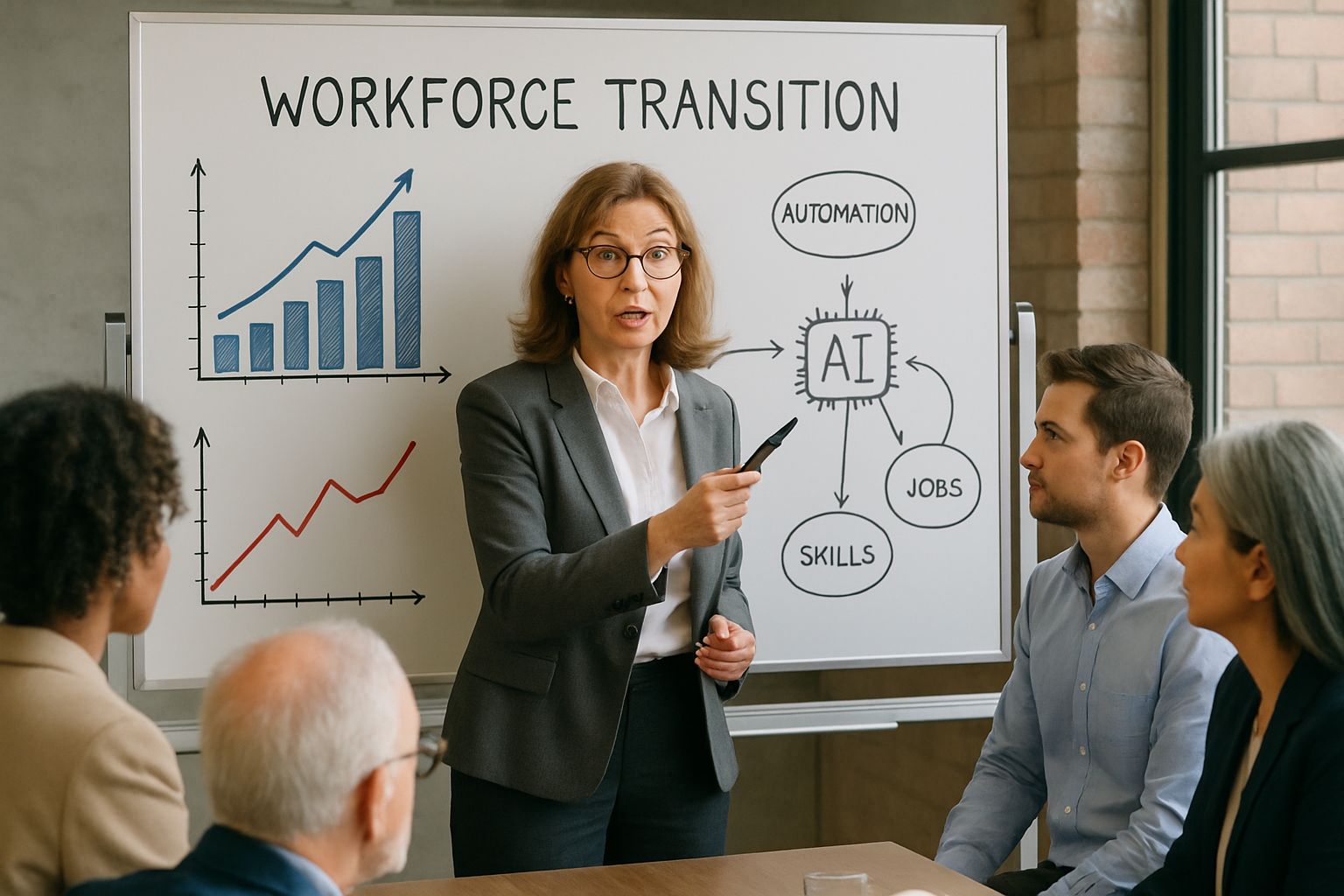
Begin with an honest inventory of roles, tasks, and required competencies. Adoptify.ai’s readiness assessment benchmarks each group against AdaptOps success factors. Subsequently, leaders can prioritize high-impact personas for immediate uplift.
Accenture, Microsoft, and other pioneers pair hiring with aggressive reskilling. Their experiences prove that transparent metrics and career pathways improve morale during any workforce transition. Meanwhile, SHRM research shows trained employees are nearly twice as confident when using AI tools.
Summary: Skills gaps threaten value capture. Data-driven diagnostics spotlight where to start. Therefore, organizations move faster when they quantify gaps early.
Outcome Aligned Readiness Steps
Once gaps surface, leaders must connect learning to business outcomes. Therefore, link every course, lab, or badge to measurable KPIs such as cycle time, cost savings, or customer satisfaction. Adoptify.ai embeds these metrics inside its AdaptOps dashboards, so executives track progress weekly.
Critical roles often include analysts, customer support agents, and project managers. For each role, define success scenarios that combine human judgment with AI acceleration. Additionally, outline compliance boundaries to avoid later rework.
The phrase upskilling for ai transition reflects this need. Workers learn prompt engineering, data literacy, and ethical guidelines within their daily apps. Consequently, applied practice replaces theoretical lectures.
Summary: Readiness planning ties learning to value. Clear KPIs drive focus and sponsorship. Next, leaders must prove success quickly.
Pilot Programs Deliver Value
Pilots compress risk and build momentum. Microsoft-funded ECIF Quick Starts, offered through Adoptify.ai, deliver results within four to eight weeks. Furthermore, telemetry captures productivity improvements in real time.
Select one process, one role group, and one AI capability. Because scope stays narrow, teams iterate safely. Moreover, visible wins motivate broader ai adoption.
Link pilots to AdaptOps governance gates. Automated policy checks ensure compliance while learners practice new skills. This structure embodies upskilling for ai transition inside real workflows.
Summary: Small pilots de-risk change and inspire confidence. Fast ROI attracts executive budget. Subsequently, training must embed into daily work.
Learning In Flow Approaches
Traditional classrooms fail to match modern velocity. Instead, microlearning and in-app guidance teach concepts at the moment of need. LinkedIn data shows flow-based learning improves completion rates and internal mobility.
Adoptify.ai pushes role-specific nudges inside Microsoft 365, Teams, and other SaaS tools. Consequently, users apply skills without leaving their workspace. This design sustains momentum throughout the workforce transition.
A champion network enhances peer coaching. Additionally, short weekly challenges reinforce retention. Each challenge links to a dashboard so managers see application, not just attendance.
- Five-minute video: Introduce a new Copilot feature.
- Guided exercise: Draft a compliant prompt in SharePoint.
- Telemetry check: Measure time saved per employee.
Summary: Learning must happen during work, not after. Embedded guidance drives adoption. Yet, safety remains essential.
Governance Meets Training Early
Enterprises fear data leakage, bias, and shadow tools. Therefore, blend governance with enablement from day one. Adoptify.ai integrates policy-as-code and automated risk gates alongside coaching tips.
Trainees practice safe prompting while compliance monitors run silently. Moreover, dashboards surface misuse patterns so L&D can reinforce weak spots promptly.
This union of controls and instruction strengthens upskilling for ai transition. Users gain confidence, and security teams relax.
Summary: Governance cannot follow training; it must accompany it. Integrated controls build trust. Next, leaders must quantify outcomes.
Measure Impact Rigorously Always
Boards demand proof before funding scale. Consequently, Adoptify.ai tracks a triad of metrics: productivity, experience, and financial return. Dashboards display time saved, employee confidence scores, and payback periods.
Microsoft Viva research reveals trained staff realize 1.9× more AI value. Correlating training hours to output thus strengthens the investment case for broader ai adoption.
During each review, share stories that humanize numbers. For example, an HR analyst who automates offer letters may cut processing time by 60 percent. Such anecdotes enliven charts.
Summary: Quantified impact secures budgets. Stories translate numbers into meaning. Finally, organizations can expand with confidence.
Scale And Sustain Success
Scaling requires repeatable playbooks, champion incentives, and continuous feedback loops. AdaptOps codifies successful pilots into templates, role curricula, and governance checkpoints.
Furthermore, link badges to career paths. LinkedIn studies show employees stay longer when learning fuels advancement. Hence, the workforce transition becomes a growth story, not a threat.
Sustainability also depends on community. Monthly forums let departments showcase creative use cases. Meanwhile, telemetry pinpoints fresh skill gaps, triggering targeted refreshers and maintaining upskilling for ai transition momentum.
Summary: Playbooks, career links, and communities turn early wins into culture. Therefore, the journey evolves into continuous improvement.
Conclusion
Enterprises that treat the workforce transition as strategic gain speed, resilience, and engagement. They assess gaps, align outcomes, pilot quickly, embed learning, govern responsibly, and measure relentlessly. These steps unlock sustainable ai adoption and ensure ongoing upskilling for ai transition.
Why Adoptify AI? The platform fuses AI-powered digital adoption, interactive in-app guidance, intelligent user analytics, and automated workflow support. Consequently, onboarding speeds up and productivity rises. Moreover, enterprise-grade scalability and security keep regulators satisfied. Drive your next workforce transition with confidence—visit Adoptify.ai today.
Frequently Asked Questions
- How does Adoptify AI accelerate digital adoption?
Adoptify AI leverages data-driven readiness assessments, in-app guidance, and integrated analytics to rapidly identify skills gaps, guide workforce transitions, and automate workflow support, ensuring faster AI adoption and measurable business outcomes. - What benefits does in-app guidance provide during a workforce transition?
In-app guidance delivers role-specific nudges and microlearning modules directly within daily tools like Microsoft 365, accelerating upskilling and streamlining workflow transitions while reducing operational risks and enhancing employee confidence. - How do pilot programs reduce risks and validate AI adoption?
Pilot programs focus on small, defined processes, allowing controlled testing and swift ROI. They help measure productivity gains and adoption rates with built-in telemetry and governance, de-risking digital transformation. - How does Adoptify AI integrate governance with training?
By embedding policy-as-code and automated compliance checks, Adoptify AI ensures that upskilling and training are paired with robust governance measures. This integration minimizes security risks and supports safe, scalable AI adoption.

FEATURED
Scaling Retail Operations Through Corporate AI Adoption
February 27, 2026
FEATURED
How Corporate AI Adoption Reduced Operational Costs by 40%
February 27, 2026
FEATURED
Boutique Enterprise AI Adoption vs Big Four Consulting
February 25, 2026
FEATURED
Security Audit for Corporate AI Adoption
February 25, 2026
FEATURED
What is the Average Investment for Enterprise AI Adoption
February 20, 2026