Enterprise-Ready Data Quality Framework Checklist
AI projects fail when the data fails first. Enterprises often rush models into production without a disciplined data quality framework. However, poor inputs force costly rework and sap trust. Gartner says bad data drains $12.9M yearly. Consequently, HR leaders, SaaS teams, and IT onboarding groups now place data readiness at the center of ai adoption strategy.
This guide unpacks a practical, AdaptOps-aligned roadmap. You will gain a repeatable data cleansing for ai checklist, rapid ROI tips, and clear governance moves. Let’s begin the clean-data journey.
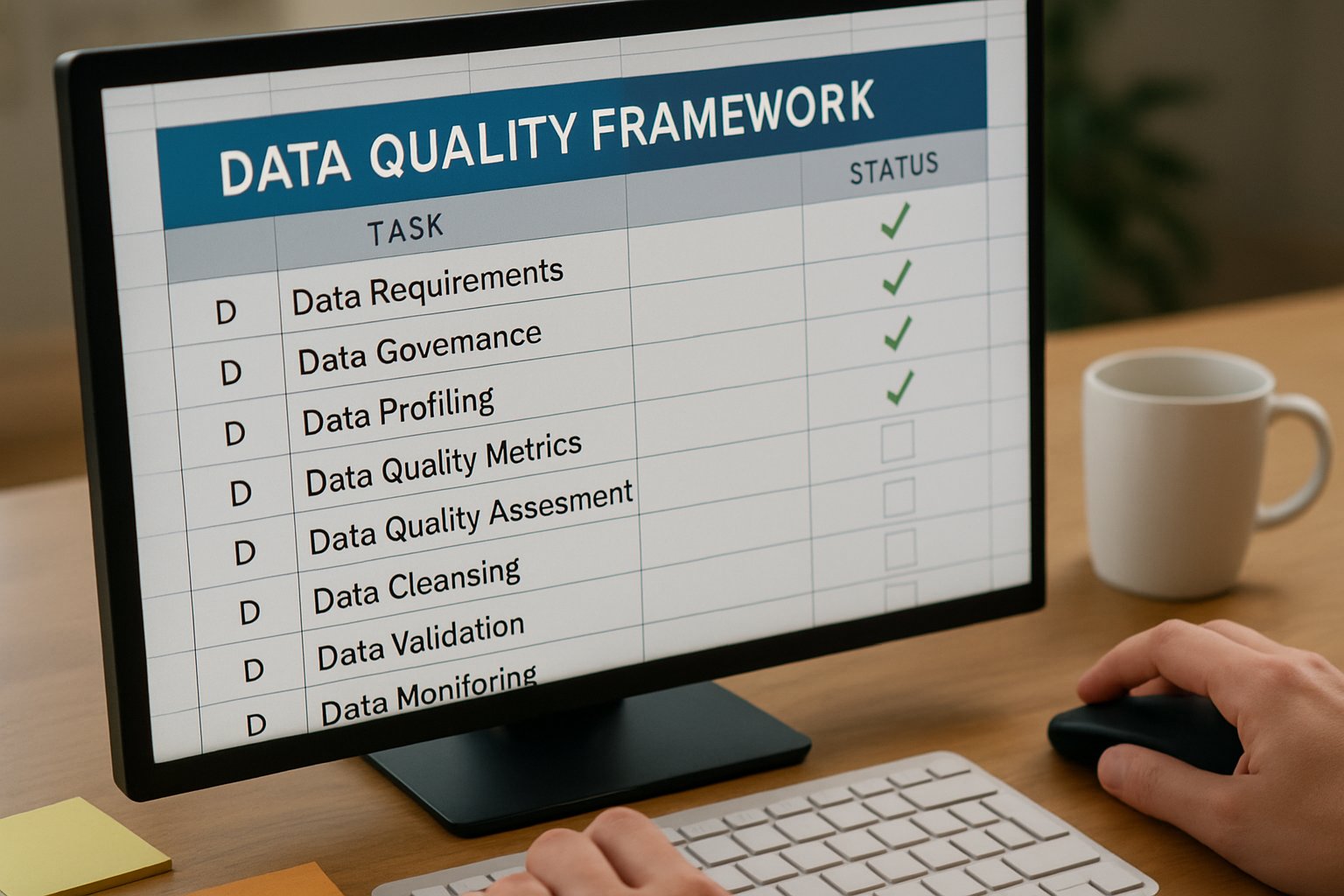
Build Data Quality Framework
Start with a vision, not scripts. A living data quality framework sets shared rules for accuracy, freshness, privacy, and lineage. Moreover, it defines owners, SLAs, and telemetry so gaps surface early. Adoptify’s AdaptOps model anchors this vision across Discover, Pilot, Scale, Embed, and Govern stages.
Successful teams publish the framework in the data catalog. They add baseline metrics and link them to ROI dashboards. Consequently, finance sees progress in real numbers.
Key takeaway: A codified framework turns hygiene into policy. Transition: Next, align that policy with AdaptOps.
Align With AdaptOps Model
AdaptOps treats data readiness as continuous, not a one-off. During Discover, run an AI Audit and surface unlabeled or risky files. During Pilot, connect telemetry to freshness and null-rate KPIs. Furthermore, pass/fail gates block dirty data before models scale.
Role-based microlearning and AI CERTs embed stewardship habits in HR and L&D units. Consequently, business owners fix issues at the source instead of throwing them over to IT.
Key takeaway: AdaptOps operationalizes the framework across time. Transition: Governance and telemetry tighten the loop further.
Governance And Telemetry Wins
Governance works only when measured. Therefore, Adoptify staples Purview DLP simulation, sensitivity labels, and vendor DPA checks into every pipeline. Telemetry dashboards track completeness, uniqueness, and drift in near real time. Moreover, alerts fire before faulty data poisons copilots.
Continuous observability tools, such as Great Expectations or Monte Carlo, integrate with the AdaptOps gate. Consequently, executives see green lights when cleansing targets hold, and red lights when thresholds slip.
Key takeaway: Measurement makes governance actionable. Transition: Now, translate policies into an execution checklist.
Operational Cleansing Checklist Steps
The following data cleansing for ai checklist prioritizes steps that boost model accuracy fastest. Each item maps to AdaptOps gates.
- Inventory ownership: Assign dataset owner, purpose, and sensitivity flag.
- Profile metrics: Capture null rates, skew, and drift with automated scanners.
- Structural hygiene: Normalize formats, types, and units across sources.
- Referential checks: Resolve duplicates and broken keys.
- Label validation: Enforce inter-annotator agreement and correction workflow.
- Privacy controls: Run masking and Purview DLP simulation before export.
- Leakage tests: Remove target leaks and confirm feature eligibility.
- Versioning: Commit dataset snapshots and lineage links.
- Automated contracts: Embed Great Expectations tests in CI/CD.
- Business validation: Run A/B or shadow experiments to prove value.
Teams embed this list in their project workspaces. Moreover, each step links to a metric on the ROI dashboard.
Key takeaway: A checklist enforces consistent action. Transition: Let’s measure results and decide when to scale.
Measure ROI And Scale
During a 90-day pilot, Adoptify tracks time saved, error reductions, and compliance risk drops. Furthermore, the data quality framework itself gains a score based on metric improvements. When targets clear, the gate flips to “scale.”
Consequently, finance approves resources with confidence. HR systems realise faster onboarding, while SaaS products ship smarter defaults.
Key takeaway: Quantified wins unlock budgets. Transition: Keep an eye on fast-moving trends to stay ahead.
Future Trends And Tools
Augmented data quality platforms now embed AI for profiling and repair. Gartner signals a sharp pivot toward such automation by 2025. Meanwhile, data-centric AI thought leaders, like Andrew Ng, push teams to “fix data first.” Therefore, enterprises double down on observability and labeling quality.
Modern lakehouse integrations shorten cycles from raw feed to training set. Moreover, ML-guided recommenders, such as COMET, rank cleaning tasks by downstream impact. Your data quality framework must adapt quickly to absorb these advances and support sustained ai adoption.
Key takeaway: Tooling and practices evolve fast. Transition: Summarize our journey and chart next steps.
Checklist Recap Table
| Stage | Key Action | Outcome Metric |
|---|---|---|
| Discover | Catalog and profile | Coverage % |
| Pilot | Fix top errors | Accuracy uplift |
| Scale | Automate contracts | Alert MTTR |
| Embed | Role-based training | Issue recurrence |
| Govern | Continuous observability | Drift events |
The table condenses the flow for quick reference.
Key takeaway: Each AdaptOps stage has clear metrics. Transition: Wrap up with action points.
Conclusion
Clean inputs power successful models. We outlined why a strong data quality framework matters, how AdaptOps embeds it, and provided a practical data cleansing for ai checklist. By tying metrics to ROI, you unlock funding and accelerate ai adoption across the enterprise.
Why Adoptify AI? Adoptify AI weaves the data quality framework into its AI-powered digital adoption suite. Interactive in-app guidance, intelligent user analytics, and automated workflow support slash ramp-up time. Consequently, teams onboard faster and deliver higher productivity. The platform scales securely across the enterprise, protecting sensitive data at every step. Ready to elevate operations? Explore Adoptify AI today and transform workflows with confidence.
Frequently Asked Questions
- How does a robust data quality framework help drive AI adoption?
It ensures reliable, clean data critical for high-performing AI models. A strong framework reduces costly rework, improves trust, and supports clear ROI metrics, aligning with Adoptify AI’s digital adoption mission. - What role does the AdaptOps model play in AI project success?
AdaptOps provides continuous data readiness through ongoing audits, governance, and automated telemetry. By integrating role-based training and microlearning, it prevents dirty data, ensuring accurate inputs for effective AI solutions. - How does Adoptify AI enhance digital adoption and workflow intelligence?
Adoptify AI delivers interactive in-app guidance, intelligent user analytics, and automated workflow support to streamline training and onboarding. It fast-tracks digital adoption and improves operational efficiency across the enterprise. - What key steps are included in the data cleansing checklist for AI?
The checklist includes inventory ownership, profile metrics, structural hygiene, referential checks, and automated contract tests. These steps ensure cleaner data streams and faster AI model deployment, as endorsed by Adoptify AI.
FEATURED
The Complete Guide to Building an AI Adoption Framework for 2026
March 2, 2026
FEATURED
Who Owns the Intellectual Property in Enterprise AI Adoption
March 2, 2026
FEATURED
7 Reasons To Embrace AI-Native Architecture
March 2, 2026
FEATURED
Hybrid AI FAQ: Strategy, Governance, and ROI
March 2, 2026
FEATURED
Agentic AI Integration Playbook for Enterprises
March 2, 2026