Building a Robust Data Quality Framework for Auditable AI
AI programs stall when data evidence fails audits. Therefore, enterprises now treat a data quality framework as a frontline control. The new ISO and EU rules demand measurable quality, complete lineage, and living documentation. Consequently, leaders must connect standards, observability, and human workflows from the start.
Data Quality Framework Pillars
Successful designs rest on five measurable pillars. Accuracy, completeness, timeliness, representativeness, and traceability now mirror ISO 42001 Annex A.7.4 controls. Moreover, ISO 5259-2 details how to score each pillar across pipelines. Forward-looking teams embed these scores into service-level objectives and dashboard them for constant review.
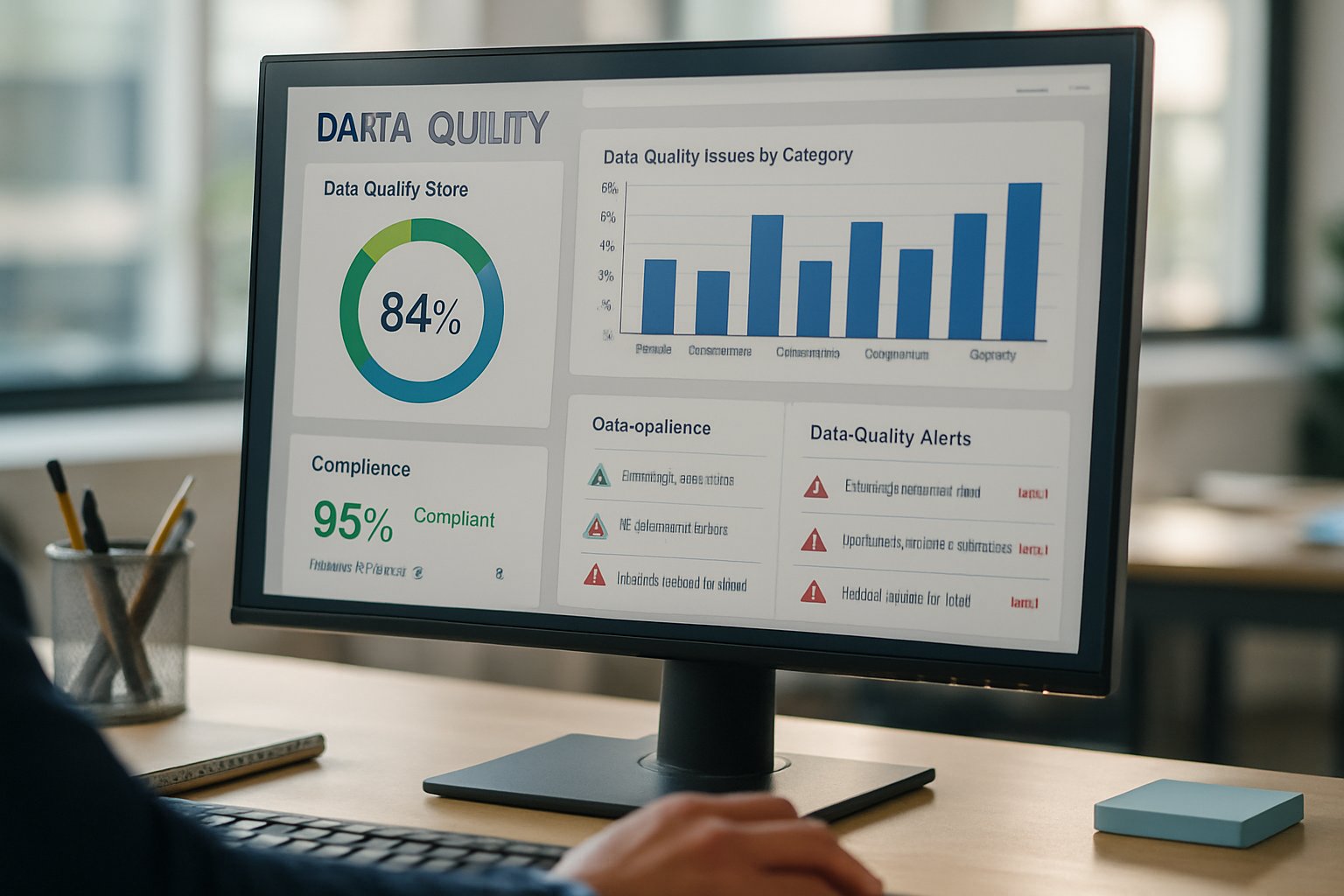
Gartner notes that poor pillar performance blocks 62% of production rollouts. However, firms using an explicit data quality auditing framework cut delay risks by half. They surface issues before regulators or customers detect them. Consequently, ROI timelines shorten.
Key takeaway: Treat every pillar as a contract. Next, align the contract with incoming standards.
Standards Drive Rapid Change
Regulators accelerated urgency. The EU AI Act Article 10 requires public summaries describing dataset relevance and bias controls. Meanwhile, ISO 42001 offers auditors a prescriptive checklist. Consequently, compliance now starts at design time, not after deployment.
Furthermore, NIST crosswalks map ISO controls to technical evidence. That mapping lets teams automate proof generation. Observability platforms now export machine-readable dataset cards that reference the same identifiers found in ISO tables.
Key takeaway: Adopt standards early. Next, automate the links between evidence and clauses.
Common Enterprise Pain Points
Many organizations still lack measurable thresholds. They describe “high quality data” with adjectives, not numbers. In contrast, auditors expect numeric gates such as 97% label completeness.
Secondly, fragmented toolchains lose lineage. Data hops across SaaS silos without consistent logging. Therefore, audit teams cannot build an unbroken evidence chain.
Thirdly, teams deploy models without runtime rollback. Drift surfaces weeks later, and incident reports become manual and slow.
- No numeric dataset contracts
- Broken lineage between pipelines
- Missing continuous validation controls
- Inconsistent role sign-off processes
Firms solving these gaps adopt an integrated data quality auditing framework. Additionally, they invest in structured ai adoption programs that teach roles how to execute sign-off chains.
Key takeaway: Document gaps first. Next, map each gap to an observable control.
Auditable Data Quality Metrics
Metrics convert policy into code. Therefore, teams must choose thresholds that align with business risk. For instance, a recruiting model may allow 0.5% label error, while pricing models need higher precision.
Moreover, each metric needs a lineage pointer. Datasheets for Datasets now include URI links to raw tables and versioned feature stores. Consequently, auditors can trace every number to its physical source.
The table below shows popular metrics and recommended thresholds.
| Metric | Suggested Baseline | Evidence Artifact |
|---|---|---|
| Label Completeness | ≥97% | Datasheet v1.2 |
| Schema Drift | <0.2% weekly | Observability Alert Log |
| Timeliness | <24 hours delay | Pipeline SLA Dashboard |
| Bias Δ | <2% group spread | Fairness Scan Report |
Using such tables inside a formal data quality framework makes audits fast and defensible.
Key takeaway: Tie every metric to a document. Next, store the pair in version control.
Implement Continuous Data Observability
Periodic cleansing is no longer enough. Instead, organizations move to continuous observability. Freshness, schema, volume, and lineage checks now run with every commit. Additionally, drift detectors guard live traffic.
Platforms like Monte Carlo and Acceldata stream anomalies into PagerDuty. Consequently, mean-time-to-detect shrinks from days to minutes. Enterprises that integrate observability within their data quality auditing framework satisfy ISO 5259-2 runtime expectations.
Moreover, Adoptify.ai injects rollback gates into CI/CD. These gates reject promotions when quality metrics fail. Therefore, bad data never reaches customers.
Key takeaway: Monitor everything, always. Next, automate rollback and notification.
Align People And Process
Technology alone cannot win. Employees need clear roles and rapid feedback loops. Therefore, leading companies embed micro-learning in the workflow. Sign-off screens remind data stewards of threshold duties.
Furthermore, AdaptOps rhythms—Discover, Pilot, Scale, Embed, Govern—create predictable checkpoints. At each stage, stakeholders approve dataset contracts and attach evidence. Consequently, the organization builds an auditable muscle that regulators trust.
During ai adoption, HR and L&D teams track certification completions. Operators who close incidents faster receive recognition. This positive reinforcement reduces burnout and increases retention.
Key takeaway: Train every role, early. Next, reward compliant behavior.
AdaptOps Operational Playbook
The AdaptOps playbook turns theory into daily action.
- Discover: Run a two-week readiness audit. Document baseline metrics for each critical dataset.
- Pilot: Launch a 90-day prove-value sprint. Track ROI dashboards to confirm business impact.
- Scale: Extend pipelines, yet keep gates. Automate dataset card generation at build time.
- Embed: Provide in-app guidance and role certifications. Ensure every change request links to evidence.
- Govern: Run quarterly review boards. Update thresholds against new regulations and risk appetite.
Teams following this sequence report 35% faster time-to-value and lower audit stress. Moreover, the playbook integrates tightly with any data quality framework already in place.
Key takeaway: Use a repeatable cadence. Next, iterate thresholds based on telemetry.
The journey now continues to your own environment.
Conclusion
Enterprises that embed a rigorous data quality framework reduce risk, speed ROI, and satisfy regulators. They align measurable metrics, continuous observability, and trained people under one AdaptOps umbrella.
Why Adoptify AI? Adoptify AI unifies AI-powered digital adoption, interactive in-app guidance, intelligent user analytics, and automated workflow support. Therefore, teams onboard faster, boost productivity, and scale securely across the enterprise. Experience a trusted data quality framework in action by visiting Adoptify AI today.
Frequently Asked Questions
- What is a data quality framework and why is it critical for compliance?
A data quality framework establishes measurable thresholds, audit trails, and continuous validation, helping enterprises meet ISO, EU, and NIST standards. It streamlines regulatory compliance, minimizes risks, and integrates with Adoptify AI’s in-app guidance and user analytics to support workflow automation. - How does continuous data observability improve audit efficiency?
Continuous data observability monitors freshness, schema, and lineage in real-time, reducing mean time to detect issues. With Adoptify AI’s automated rollback gates and user analytics, teams resolve data drift faster, enhancing audit efficiency and overall digital adoption. - How can digital adoption accelerate compliance and team workflows?
Digital adoption streamlines learning and workflow processes, empowering teams with interactive in-app guidance and real-time analytics. Adoptify AI supports role-based training and automated support, accelerating compliance and boosting productivity across enterprise systems. - What benefits does Adoptify AI offer in implementing a data quality framework?
Adoptify AI unifies AI-powered digital adoption with interactive in-app guidance, intelligent user analytics, and automated workflow support. This integrated approach simplifies data quality control, enhances audit readiness, and accelerates ROI through continuous observability and role-based training.
FEATURED
The Complete Guide to Building an AI Adoption Framework for 2026
March 2, 2026
FEATURED
Who Owns the Intellectual Property in Enterprise AI Adoption
March 2, 2026
FEATURED
7 Reasons To Embrace AI-Native Architecture
March 2, 2026
FEATURED
Hybrid AI FAQ: Strategy, Governance, and ROI
March 2, 2026
FEATURED
Agentic AI Integration Playbook for Enterprises
March 2, 2026