Roadmap to Data Maturity for Enterprise AI Success
Enterprises crave real results from generative AI. Yet most discover that models stall without disciplined data foundations. Consequently, data maturity now separates vanguard performers from frustrated experimenters. Recent surveys show 60 percent of leaders doubt their internal readiness. Meanwhile, only twelve percent report both revenue gains and cost drops from AI. The gap widens when governance, lineage, and measurement stay undefined. However, a clear roadmap fixes those issues before pilots fail. This article breaks down that journey, equips HR, IT, and SaaS teams, and references the AdaptOps model. We explore concrete steps, metrics, and governance moves that accelerate ai adoption and protect compliance. Finally, we frame why Adoptify AI offers an integrated path. It supports the road to data maturity for ai at enterprise scale.
Why Maturity Really Matters
Data drives every modern workflow, yet its quality often stays uneven across functions. Industry studies rank data maturity as the strongest predictor of AI outcome success.
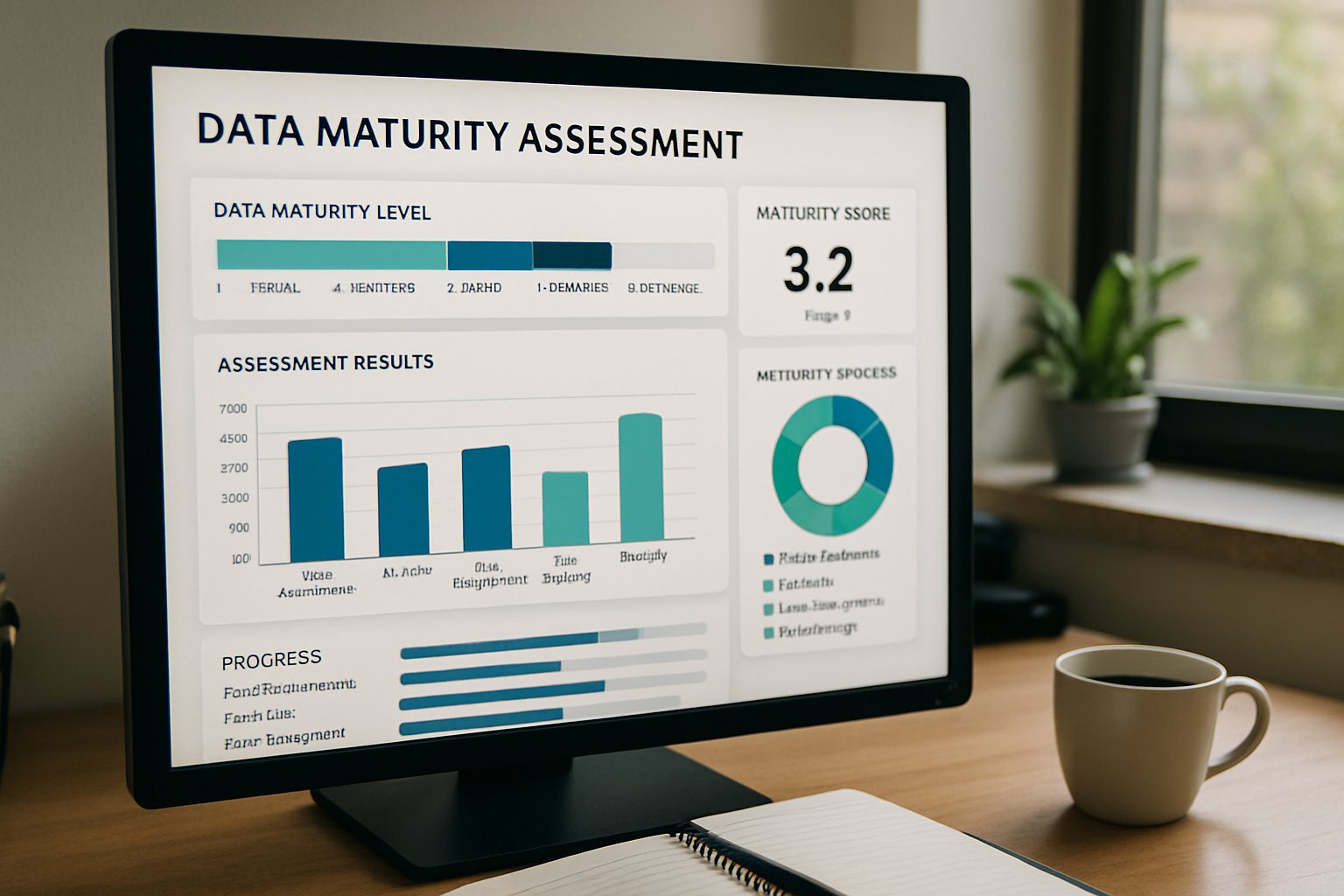
Moreover, Actian found 83 percent of firms face governance challenges while executives overrate readiness. Therefore, leaders must align perception with operational truth before funding large pilots.
The PwC CEO Survey reinforces this divide. Only twelve percent capture both cost and revenue benefits, forming a vanguard with disciplined datasets.
Effective programs start by grounding ambitions in verifiable readiness metrics. With clarity achieved, teams confidently progress to gap remediation and pilot selection. Next, we expose the gaps most enterprises encounter first.
Common Data Readiness Gaps
Many organizations store duplicates, inconsistent schemas, and undocumented sources across shadow systems. Such sprawl erodes lineage, slows discovery, and inflates security attack surfaces.
In contrast, successful ai adoption programs centralize governed access layers with semantic definitions. Another barrier involves missing data contracts between producers and consumers, causing silent breakages downstream.
Furthermore, lack of observability hides drift, freshness issues, and compliance breaches. Misalignment between leadership and operations often widens gaps further. Executives declare readiness, yet engineers still hunt for accurate reference tables and lineage documentation.
Addressing contracts, lineage, and observability raises data maturity quickly. Consequently, pilot teams avoid rework and can focus on measurable value. Let us map these remediation efforts to the AdaptOps roadmap stages.
AdaptOps Roadmap Core Stages
Adoptify’s AdaptOps model structures four disciplined phases: Discover, Pilot, Scale, and Embed. Each phase lasts defined sprints, includes decision gates, and locks scope to maintain momentum for ai adoption.
During Discover, an AI Audit scores architecture, governance, and the current data maturity across domains. Pilot Acceleration then selects two or three use cases with baseline dashboards measuring minutes saved and finance KPIs.
Moreover, governance templates and Purview simulations enforce access controls before scaling. Scale standardizes datasets, RAG indices, and MLOps processes. Embed integrates telemetry, champion networks, and continuous improvement loops.
The sequence aligns directly to the road to data maturity for ai, reducing typical pilot-to-production drop off. Discover usually lasts two weeks when teams commit dedicated resources. Pilot Acceleration follows for six weeks, giving enough runway to gather statistically robust adoption telemetry.
The staged rhythm converts scattered efforts into predictable progress. Consequently, leadership receives evidence before approving broader investments. Compliance pressures make that evidence even more vital.
Governance And Compliance Essentials
Regulations such as the EU AI Act demand auditable lineage, policy controls, and transparent evaluations. Therefore, enterprises must embed governance by design rather than bolt controls later.
AdaptOps provides policy repositories, Purview checks, and access guardrails mapped to NIST AI RMF. Additionally, decision logs and TEVV documentation create defensible proof for regulators and boards.
Mature teams set SLIs for freshness, completeness, and accuracy and attach automated tests to pipeline promotions. Auditors now expect organizations to provide provenance graphs within hours, not weeks. Automated lineage tools embedded through AdaptOps satisfy these demands without manual spreadsheets.
Strong governance accelerates approval while cutting risk. This discipline further raises data maturity and secures stakeholder trust. Yet measurement still decides whether programs survive or stall.
Metrics That Prove Value
Executives expect clear financial signals within ninety days. Adoptify dashboards translate minutes saved, reduced queries, and faster cycle times into dollars.
For example, Copilot pilots often record 60–75 minutes saved per user daily. Moreover, baseline comparisons reveal trends and trigger action when progress plateaus.
- Minutes saved per role
- Cycle-time reduction per task
- Customer case resolution speed
- Compliance audit pass rate
- Cloud cost per prediction
Tracking those five metrics keeps the road to data maturity for ai transparent and accountable. Business leaders also watch lagging indicators like churn, ticket deflection, and procurement cycle time. Integrating those metrics into the same dashboard prevents siloed storytelling and budget disputes.
Quantified wins build momentum across finance, HR, and product teams. Therefore, organizations can unlock incremental budgets with confidence. Yet people, not dashboards, ultimately decide adoption success.
People Drive Change Success
Employees embrace new workflows when training feels relevant, timely, and embedded within tools. Adoptify delivers interactive in-app guidance and microlearning paths aligned to each role’s context.
Furthermore, behavior analytics surface friction points, allowing enablement teams to iterate campaigns rapidly. Champion networks and incentivized communities share playbooks and spread cultural buy-in across departments.
This human-centric loop strengthens data maturity because correct usage preserves lineage and improves data quality. L&D teams should pair microlearning with spaced repetition to reinforce changed behavior. Additionally, weekend hackathons encourage exploration and surface innovative use cases for upcoming sprints.
Empowered users complete tasks faster and feed cleaner data back. Subsequently, the organization closes its readiness gaps faster. Finally, consolidate actions with a concise checklist for leadership.
Practical Next Steps Checklist
Leaders can launch momentum by following this ten-point starter list.
- Run an AI Audit and publish the readiness score.
- Define three critical data contracts with owners.
- Establish SLIs for freshness and accuracy.
- Select one measurable pilot linked to revenue.
- Create a governance backlog with policy owners.
- Spin up AdaptOps telemetry dashboards instantly.
- Secure co-funding such as Microsoft ECIF.
- Launch champion network and microlearning modules.
- Review metrics at 30, 60, and 90 days.
- Decide to scale or adjust based on evidence.
Completing the checklist propels teams along the road to data maturity for ai with disciplined cadence. Leaders repeating the checklist quarterly create a virtuous flywheel of improvement. Progress then cascades into strategic planning cycles and capital allocation reviews.
Small, time-boxed wins snowball into enterprise transformation. Consequently, stakeholders witness tangible benefits early and often. We now conclude with final reflections and an invitation to act.
Conclusion
A structured focus on data maturity accelerates trustworthy AI outcomes and measurable ROI. By auditing, governing, measuring, and upskilling, enterprises convert pilots into scalable value.
Adoptify AI answers the critical “why now?” for ai adoption leaders. The platform combines AI-powered digital adoption capabilities, interactive in-app guidance, and intelligent user analytics. Moreover, automated workflow support drives faster onboarding, higher productivity, and verifiable compliance across functions. Enterprise scalability and security come baked in, matching even strict regulatory demands.
Explore how Adoptify AI can move your organization further along the road to data maturity for ai. Visit Adoptify.ai today and start transforming workflows.
Frequently Asked Questions
- How does Adoptify AI accelerate digital adoption and data maturity?
Adoptify AI integrates in-app guidance, interactive microlearning, and automated workflow support to streamline digital adoption. Its user analytics and AdaptOps roadmap ensure efficient data maturity and scalable AI pilots. - What role does robust governance play in AI success?
Robust governance, powered by Adoptify AI, enforces data lineage, compliance, and automated monitoring. This strengthens trust and enables secure, enterprise-scale AI outcomes through clear metrics and policy controls. - How do in-app guidance and user analytics contribute to improved workflow intelligence?
In-app guidance and real-time user analytics empower teams to identify friction points, optimize processes, and enhance workflow intelligence. This data-driven approach accelerates digital adoption and boosts overall productivity. - What practical steps can organizations take to prepare for AI pilot success?
Organizations should conduct an AI Audit, define clear data contracts, and establish performance SLIs. Adoptify AI’s AdaptOps model then guides pilot selection, measurable metrics, and scalable implementation for AI success.
FEATURED
The Complete Guide to Building an AI Adoption Framework for 2026
March 2, 2026
FEATURED
Who Owns the Intellectual Property in Enterprise AI Adoption
March 2, 2026
FEATURED
7 Reasons To Embrace AI-Native Architecture
March 2, 2026
FEATURED
Hybrid AI FAQ: Strategy, Governance, and ROI
March 2, 2026
FEATURED
Agentic AI Integration Playbook for Enterprises
March 2, 2026