Developing an Automated Data Quality Framework
Dirty data still cripples promising AI rollouts. Models crash, dashboards mislead, and stakeholders lose patience. Consequently, enterprises demand a resilient data quality framework before scaling critical workloads. Moreover, 74% already use AI tools, yet 59% cannot measure value. These gaps create board-level urgency around governed, measurable ai adoption. Therefore, this article outlines an automated approach that aligns with Adoptify.ai’s AdaptOps playbook. We will examine phased implementation, modern observability tooling, and cultural enablers that shrink incident MTTR. Finally, you will learn how to prove rapid ROI within ninety days. Each recommendation targets HR leaders, SaaS teams, IT onboarding groups, and transformation executives. Proceed to build confidence, governance, and sustained productivity across every AI pipeline.
Automated Data Quality Framework
An automated data quality framework combines policy, code, and culture. It embeds continuous checks into every ingestion, transformation, and model stage. Moreover, it triggers remediation workflows the moment anomalies appear.
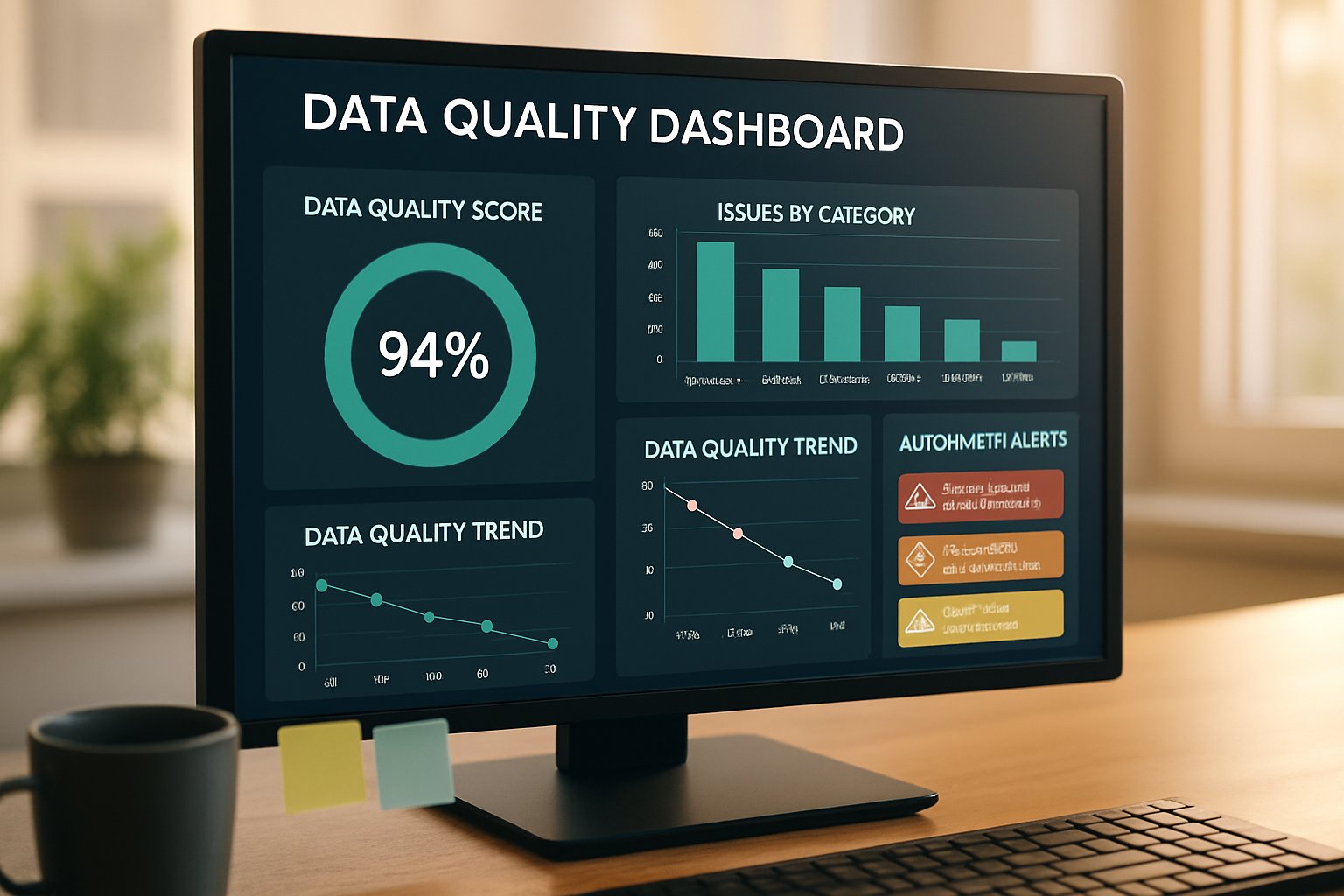
Traditional profiling happens monthly and misses silent drifts. In contrast, modern observability surfaces freshness, volume, schema, and distribution signals in minutes. Consequently, teams catch issues before dashboards break or models hallucinate.
Governance binds the framework together. Clear data contracts, SLAs, and RACI matrices define ownership. Therefore, alerts always reach the accountable steward with context and runbook links.
Finally, AdaptOps ROI dashboards expose business impact instantly. Executives view reduced incident counts alongside model accuracy gains. That transparency fuels faster ai adoption across departments.
In short, the framework unifies technology, governance, and people. Next, understand why unreliable data hinders progress.
Why Reliable Data Matters
Bad data costs companies 20% of revenue, according to Ataccama. Meanwhile, Gartner predicts 50% will adopt observability platforms by 2026. These statistics emphasize urgency for reliable pipelines powering GenAI, HR analytics, and SaaS usage metrics.
Dirty inputs derail model fine-tuning, warns Databricks scientist Jonathan Frankle. Moreover, unstructured corpora feed hallucinations and compliance risks into LLMs. Therefore, leaders must invest upstream, not just tweak hyperparameters downstream.
Reliable data accelerates ai adoption because teams trust the outputs. Consequently, training programs gain traction, and workflows embed AI recommendations confidently. Executives then approve wider budgets, creating a positive feedback loop.
Reliable data prevents costly rework and boosts stakeholder confidence. Next, learn how AdaptOps audits establish that reliability baseline.
AdaptOps Audit Phase Kickoff
Every journey starts with a focused data foundations audit. Adoptify’s ECIF quick start delivers this within two weeks. It inventories datasets, owners, criticality, and existing validation coverage.
Moreover, the audit scores maturity across seven pillars, including governance and talent. Teams leave with prioritized datasets and draft SLOs for freshness, completeness, and drift. These artifacts seed the forthcoming pilot.
During workshops, HR and L&D leads map stewardship roles. SaaS product managers align data contracts with release cycles. Consequently, fragmented ownership dissolves before automation begins.
The audit clarifies scope and success metrics for the new data quality framework. With priorities locked, the ninety-day pilot can launch confidently.
Build Rapid Ninety-Day Pilot
Pilot work proves value fast and mitigates analysis paralysis. Adoptify recommends targeting one to three high-impact pipelines. Moreover, baseline measures of incident MTTR and model accuracy guide ROI tracking.
Engineers implement schema validation, freshness thresholds, duplication checks, and distribution monitoring. Tools like TensorFlow Data Validation or Great Expectations simplify rule creation. Consequently, first alerts appear within days, surfacing hidden defects.
Exit criteria remain explicit. For example, cut incident MTTR 40% and improve model precision two points. ROI dashboards capture these improvements continuously.
Success stories convince executives and accelerate ai adoption. Next, harden the pilot with continuous observability.
Instrument Continuous Quality Signals
Data observability expands the automated guardrail set. Platforms capture metrics, lineage, schema changes, and anomaly scores in real time. Moreover, ML detectors uncover unknown issues invisible to static tests.
Key signals include the following elements.
- Freshness: lag beyond source timestamp thresholds.
- Volume: surges, drops, or missing partitions.
- Schema: unexpected column addition or datatype shift.
- Distribution: drift in categorical cardinality or numeric range.
- Lineage: upstream change impacting downstream models.
Alerts push to Slack, ServiceNow, or PagerDuty with owner tags. Therefore, response starts within minutes, not hours.
Continuous signals transform the pilot into a living quality radar. Next, close the loop with automated remediation workflows.
Automate Detection And Remediation
Detection without remediation only shifts toil to humans. Consequently, modern frameworks integrate playbooks directly with orchestration engines. Airflow, Vertex, or Dataproc jobs roll back bad batches automatically.
Schema violations trigger quarantine tasks and email the data producer instantly. Moreover, near-duplicate detectors can purge redundant documents before indexing an LLM corpus. That capability protects GenAI outputs from hallucination sources.
An automated data quality framework should measure each remediation’s success. Dashboards display percentage of incidents auto-resolved and remaining MTTR. Therefore, leaders see manpower savings in real dollars.
Automated fixes slash downtime and sustain developer morale. Finally, embed contracts and culture to lock gains.
Track Impact And ROI
Measurement links data work to business outcomes. Forrester shows 132% ROI when pilots track clear KPIs. Adoptify’s dashboards correlate incident reduction with revenue, churn, or compliance savings.
Operational metrics include incident rate per dataset, MTTR, and auto-resolution percentage. Business metrics include model accuracy uplift and FTE hours saved. Moreover, executives filter data by department, enabling targeted reinvestment.
Quarterly reviews compare actuals against SLOs set during the audit. Consequently, governance boards adjust contracts or add new checks quickly.
Transparent metrics keep momentum behind the entire data quality framework. Now, see how Adoptify AI turns this vision into daily reality.
Conclusion
A disciplined data quality framework guarantees reliable inputs, faster experimentation, and measurable business returns. Start with an AdaptOps audit, run a focused pilot, then scale observability, automation, and governance. Moreover, continuous dashboards transform technical wins into executive confidence.
Why Adoptify AI? The platform blends AI-powered digital adoption capabilities with interactive in-app guidance and intelligent user analytics. Automated workflow support accelerates onboarding, boosts productivity, and preserves enterprise security at scale. Therefore, enterprises embed AI successfully, not sporadically. Visit Adoptify AI to operationalize your automated data quality framework today.
Frequently Asked Questions
- What is an automated data quality framework and why is it important?
An automated data quality framework combines policy, code, and culture to ensure reliable inputs. It reduces downtime and enhances digital adoption using in-app guidance, user analytics, and automated support. - How does the AdaptOps audit phase streamline AI adoption?
The AdaptOps audit inventories datasets, establishes clear governance, and sets SLAs. This phase unifies stakeholders and leverages user analytics to accelerate digital adoption and demonstrate rapid ROI. - Why is continuous data observability essential for workflow intelligence?
Continuous observability monitors data freshness, schema, volume, and distribution in real time. Early anomaly detection enables automated remediation, bolstering overall workflow intelligence and supporting digital transformation. - How does a rapid ninety-day pilot drive measurable ROI in AI deployment?
A focused ninety-day pilot tests high-impact pipelines with clear KPIs like reduced MTTR and improved model accuracy. This fast-track approach accelerates digital adoption, proving ROI while reinforcing automated support.

FEATURED
How to Identify and Overcome Cultural AI Adoption Barriers
March 3, 2026
FEATURED
What Are the Most Common AI Adoption Challenges for Businesses
March 3, 2026
FEATURED
The Complete Guide to Building an AI Adoption Framework for 2026
March 2, 2026
FEATURED
Who Owns the Intellectual Property in Enterprise AI Adoption
March 2, 2026
FEATURED
7 Reasons To Embrace AI-Native Architecture
March 2, 2026