Centralized vs Federated Data Governance Showdown
Every enterprise is racing to turn models into profit, yet bad data sinks ROI. Consequently, strong data governance now separates experimental play from repeatable value. However, leaders still debate whether control should live in one nucleus or in each domain. This article unpacks that choice through the lens of ai adoption realities and analyst evidence.
We examine centralized vs federated data governance models, zero-trust mandates, and hybrid best practices. Moreover, real statistics from Gartner, McKinsey, and Dremio ground the discussion in verifiable outcomes. Finally, we map insights to Adoptify.ai’s AdaptOps control plane, showing how enterprises pilot and scale responsibly.
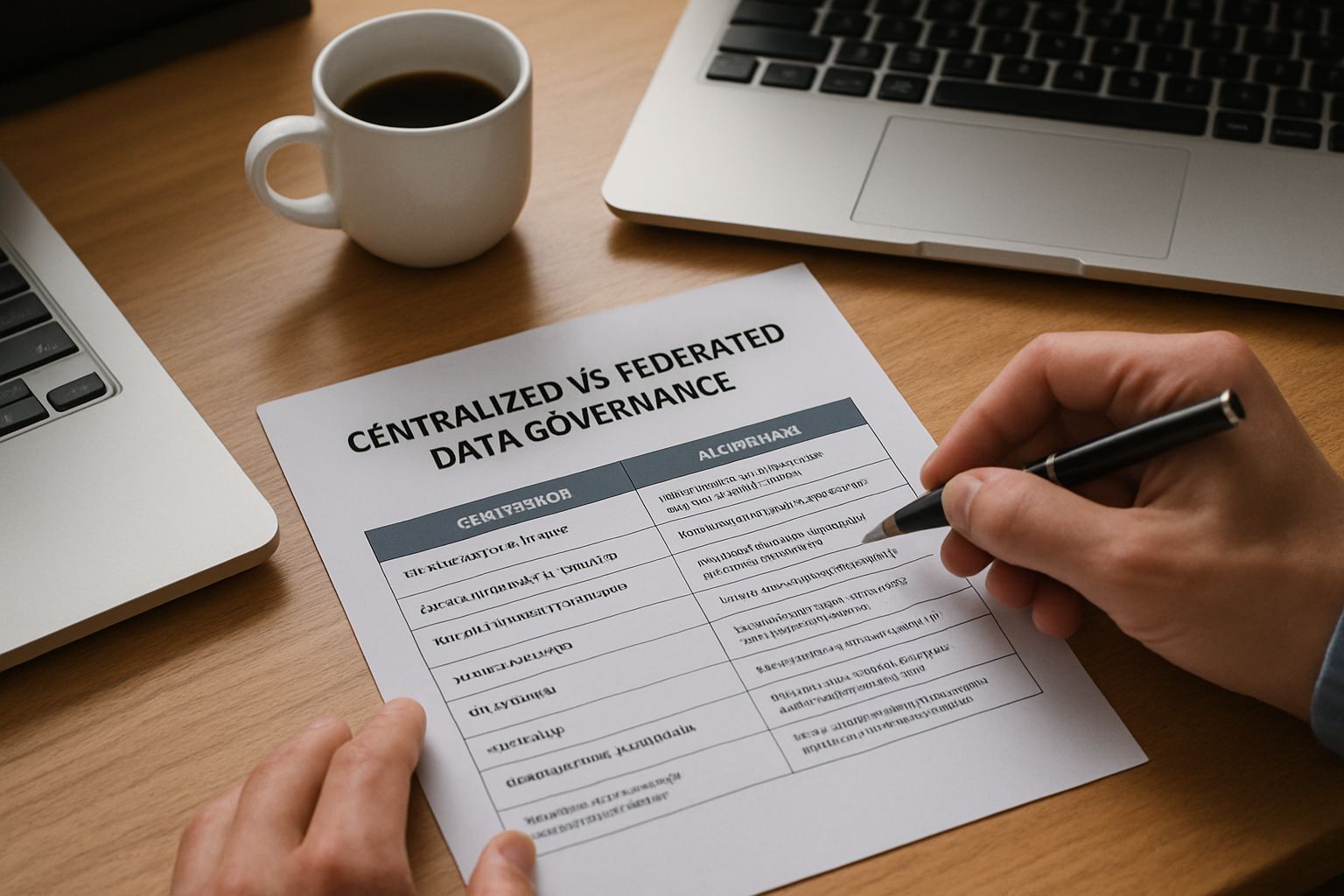
The audience includes HR teams, SaaS onboarders, and digital transformation officers who must translate policy into daily workflows. Therefore, expect practical examples, checklists, and people-centric tactics rather than abstract theory. Read on to choose a governance pattern that accelerates productivity without sacrificing oversight.
Data Governance Decision Paths
Organizations first ask which structure best controls risk while fueling speed. McKinsey’s 2025 State of AI says most firms split responsibilities between a central nucleus and domain squads. This trend defines the debate over centralized vs federated data governance for modern ai adoption programmes. Central control offers uniform policies, yet domain autonomy drives contextual innovation. Moreover, Gartner predicts 50% of firms will adopt zero-trust postures by 2028, intensifying oversight.
Risks vary across finance, healthcare, and manufacturing. Consequently, executives must map risk tiers to the right governance locus. High-impact algorithms, such as credit scoring, often require central approval and evidence logging. Meanwhile, chatbots for internal FAQs can safely remain under domain supervision if templates and drift monitors exist. Adoptify.ai embeds these templates directly in workflows, shortening decision latency for both models.
Central policy mitigates enterprise risk. Domain speed protects local agility.
Next, we explore the central control plane enabling this balance.
Central Control Plane Essentials
A robust control plane anchors centralized vs federated data governance by offering a single source of truth. Adoptify.ai’s AdaptOps nucleus catalogues models, policies, and lineage while streaming real-time telemetry into executive dashboards. Furthermore, built-in DLP simulations intercept sensitive information before it reaches public large language models. Audit trails link every prompt, dataset, and decision to named owners, satisfying ISO 42001 evidence requirements.
Telemetry And Drift Control
Telemetry drives faster root-cause analysis when drift or bias appears. Therefore, issues move from detection to remediation within hours, not quarters. AdaptOps even launches automated rollback tasks that pause deployment until owners complete corrective microlearning. In contrast, siloed teams without shared telemetry often discover issues only after customers complain.
The control plane enforces consistent policy observability. Reusable telemetry accelerates safe scaling decisions.
With central foundations covered, we now shift to domain autonomy.
Domain Autonomy Explained Clearly
Business units need freedom to exploit nuanced data and workflows. Under centralized vs federated data governance, sandboxes empower teams while still inheriting enterprise guardrails. KPMG’s 2025 guidance advises creating 50–200 user pilots with explicit exit criteria. Consequently, experimentation remains fast yet accountable.
Sandbox Guardrails In Practice
Adoptify.ai provisions domain sandboxes with pre-scoped data access and auto-generated model cards. Additionally, policy-as-code templates apply identical encryption and retention rules across every sandbox. When owners request production promotion, AdaptOps automatically routes evidence packages to the Center of Excellence. This loop closes the autonomy versus assurance gap that halts many ai adoption projects.
Governed sandboxes boost innovation safely. Clear exits deliver rapid scale.
Next, we address human factors often ignored by tech-centric teams.
People Centric Enforcement Tactics
Technology fails when people bypass processes. Therefore, AdaptOps embeds microlearning, nudges, and owner certification inside daily tools. For example, HR staff receive a 60-second quiz before accessing sensitive learning data. Moreover, completion results automatically populate compliance dashboards, removing manual follow-ups.
Role-based permissions also reduce shadow builds, because developers cannot push code without documented approvals. Consequently, culture shifts from policing to self-service accountability, a critical trait for sustainable ai adoption.
Embedded training drives responsible behavior. Automated proofs cut audit effort.
Governance also depends on aligning with external standards.
Standards And Compliance Alignment
Regulators increasingly expect demonstrable data governance mapped to NIST AI RMF and ISO 42001. Moreover, Gartner forecasts half of enterprises will adopt zero-trust stances within two years. Central inventories, evidence logs, and policy-as-code constructs satisfy those frameworks out-of-the-box.
Adoptify.ai links every control to a standard clause, generating exportable compliance packets during audits. Consequently, legal teams spend minutes, not weeks, gathering proof.
Standard mappings future-proof investments. Zero-trust drives early adoption.
Finally, we translate concepts into an actionable checklist.
Implementation Roadmap Checklist Guide
The following checklist operationalizes hybrid governance models in 90 days.
- Stand up AI Center of Excellence with executive charter.
- Deploy control plane catalog and telemetry connectors.
- Create domain sandboxes and publish policy templates.
- Enable drift detectors and Slack alert channels.
- Launch owner certification and microlearning modules.
Moreover, track completion metrics weekly, closing gaps before scale. Subsequently, graduate successful pilots using AdaptOps stage gates.
Structured milestones maintain momentum. Evidence capture reduces surprises.
Effective data governance ultimately hinges on balance. Central foundations assure trust, while federated execution unlocks domain creativity. Therefore, leaders should adopt a hybrid model, supported by automated controls and human centric workflows. Why Adoptify AI? The platform delivers AI-powered digital adoption, interactive guidance, intelligent analytics, and automated workflow support. Consequently, enterprises enjoy faster onboarding, higher productivity, and scale without sacrificing security. Visit Adoptify AI today and accelerate responsible ai adoption across your organization. Interactive walkthroughs guide employees step by step inside their actual SaaS applications. Meanwhile, intelligent analytics surface bottlenecks and recommend new automations instantly. Secure architecture scales across global regions with enterprise-grade encryption and role granularity.
Frequently Asked Questions
- What is the difference between centralized and federated data governance?
Centralized governance offers uniform policies and security across the organization, streamlining oversight while federated governance allows domain-specific innovation and agility. Adoptify AI leverages a hybrid model to balance both approaches. - How does Adoptify AI’s control plane enhance digital adoption and compliance?
The control plane integrates in-app guidance, real-time telemetry, and automated rollback tasks to support secure digital adoption. It streamlines compliance, ensuring audit trails and evidence capture for regulatory standards. - What benefits do sandbox guardrails offer in data governance?
Sandbox guardrails enable secure testing by pre-scoping data access and policy enforcement. They empower domain teams to innovate rapidly while maintaining proper controls, aligning with Adoptify AI’s risk-mitigating framework. - How do people-centric features in Adoptify AI boost workflow efficiency?
Adoptify AI embeds microlearning, nudges, and owner certification to ensure responsible user behavior and quick onboarding. These features reduce audit effort and foster self-service accountability for efficient workflow management.

FEATURED
How to Identify and Overcome Cultural AI Adoption Barriers
March 3, 2026
FEATURED
What Are the Most Common AI Adoption Challenges for Businesses
March 3, 2026
FEATURED
The Complete Guide to Building an AI Adoption Framework for 2026
March 2, 2026
FEATURED
Who Owns the Intellectual Property in Enterprise AI Adoption
March 2, 2026
FEATURED
7 Reasons To Embrace AI-Native Architecture
March 2, 2026