Hybrid AI Playbook: Executive Guide to AI-Native Architecture
Executives feel the ground shifting under every technology roadmap. However, Hybrid AI now anchors boardroom conversations because latency, privacy, and cost demands collide. Consequently, leaders ask whether their legacy stack can survive the shift toward AI-Native Architecture and accelerated ai adoption.
This guide answers what is hybrid ai architecture, why it matters, and how to govern it. Moreover, we translate analyst data, vendor moves, and Adoptify insights into an execution blueprint. Therefore, HR, IT, and SaaS teams can convert proof-of-concept excitement into profitable scale.

Meanwhile, Gartner forecasts AI spending topping two trillion dollars by 2026, validating your budget battles. In contrast, RAND warns that more than 80% of projects stall before production. Subsequently, success demands governance, telemetry, and change management equal to model talent. Ultimately, this article delivers an actionable, metrics-driven map from pilot to enterprise scale.
Hybrid AI Market Drivers
Global Investment Surge Trends
Gartner’s latest forecast signals a historic investment wave. Moreover, worldwide AI spending will reach $1.48 trillion in 2025 and surpass $2 trillion one year later. Such momentum directly accelerates Hybrid AI programs because executives must balance cloud, edge, and device economics.
McKinsey adds that generative capabilities could unlock up to $4.4 trillion of annual value. Consequently, boards now demand quick wins that validate productivity, cost, and revenue boosts. However, that value remains theoretical without operational readiness and disciplined ai adoption strategies.
Spending surges and economic upside fuel urgency. Therefore, market signals justify funding hybrid programs today. Next, we clarify how leaders should frame the concept itself.
Defining Modern Hybrid AI
Key Terminology Clarified Now
Stakeholders first ask what is hybrid ai architecture when scoping new initiatives. Simply stated, Hybrid AI routes model inference locally when possible and falls back to cloud capacity when required. Meanwhile, orchestration layers monitor latency, privacy, and cost signals to choose the optimal path.
This approach differs from traditional cloud-only deployments because it embeds intelligence everywhere—edge devices, on-prem clusters, and hyperscaler GPUs. Furthermore, an AI-native data stack treats data and model execution as a single system, enabling real-time contextual reasoning. Consequently, developers package models as containers and promote them through GitOps pipelines for reproducibility.
Hybrid routing plus integrated data planes compose the new baseline. Therefore, executives must master these definitions before approving budgets. The next section dissects the building blocks that realize this vision.
Core Architecture Building Blocks
Data Plane Evolution Path
Four layers underpin any serious deployment. Firstly, the data plane now supports vector search, embeddings, and streaming context. Secondly, the model plane hosts containerized models optimized for both CPU and GPU execution. Thirdly, the control plane orchestrates routing, scaling, and security via standards like the Model Context Protocol.
Moreover, AI-Native Architecture blurs lines between planes by co-locating model execution with transactional data. Hybrid AI further relies on container images to decouple hardware constraints. In contrast, legacy stacks rely on detached analytic stores and nightly batch refreshes. Teams asking what is hybrid ai architecture must consider these converging planes the default assumption. Consequently, telemetry hooks track performance and drift at every tier, feeding executive dashboards.
A unified data-model plane reduces latency and integration debt. Therefore, building blocks chosen today dictate future agility. Governance adds the missing risk guardrails, which we examine next.
Governance And Risk Controls
Compliance Gates Explained Clearly
Governance failures derail many initiatives faster than model errors. Therefore, executives must embed policy gates at every AdaptOps phase—Discover, Pilot, Scale, Embed, Govern. Moreover, dashboards should surface fairness scores, drift alerts, and incident hotlines within one click.
AdaptOps links those dashboards to funding approvals, creating measurable accountability. Hybrid AI benefits when centralized inventory tracks each edge model, associated data, and runtime metrics. Additionally, automated rollback protects users if an update violates risk thresholds. Such rigor accelerates responsible ai adoption across HR, finance, and operations.
Strong governance converts risk into trust capital. Consequently, oversight becomes a growth enabler rather than a hurdle. Next, we translate these controls into day-to-day operations.
Operational Execution Model Guide
AdaptOps Loop Mechanics Explained
AdaptOps defines a repeatable five-phase loop. Firstly, teams discover viable use cases and validate KPIs. Secondly, pilots run under tight scope, leveraging in-app guidance to reinforce ai adoption habits.
Thirdly, successful pilots scale with automated container promotion and observability hooks. Fourthly, teams embed workflows into everyday tools such as Microsoft 365 plus custom line-of-business apps. Fifthly, continuous governance audits maintain compliance without blocking speed. Furthermore, AI-Native Architecture aligns perfectly with this loop because data, models, and pipelines share version control.
Hybrid AI thrives under such disciplined promotion flows and rollback guarantees. Therefore, operations teams gain predictability and executives gain proof of impact. AdaptOps turns architecture theory into shipped value. Consequently, disciplined execution closes the pilot-to-production gap. We now outline concrete executive actions that compress time to ROI.
Executive Action Checklist Steps
Executives can benchmark success against five practical steps.
- Define one P&L KPI and tie funding to that metric.
- Run an AI readiness assessment covering data, infrastructure, and security scopes.
- Mandate AdaptOps phase gates with specific fairness, latency, and ROI thresholds.
- Enforce containerized releases promoted through GitOps pipelines with rollback plans.
- Budget continuous training programs that reinforce ai adoption and track engagement.
Moreover, executives should schedule quarterly business reviews that spotlight telemetry against those KPIs. In contrast, many pilots vanish when metrics remain hidden.
A visible checklist drives alignment and funding confidence. Therefore, leadership focus amplifies hybrid returns. Finally, we scan emerging standards that future-proof these investments.
Future Proofing Strategies Today
Emerging Protocol Standards Trends
Standards like the Model Context Protocol enable secure agent coordination across tools. Furthermore, capability attestation and message authentication mitigate prompt injection and tool misuse. Implementations should adopt these patterns early to avoid costly retrofits.
Meanwhile, vendors release AI-Native Architecture components that integrate vector search, agent frameworks, and observability by default. Consequently, planners must track release roadmaps and negotiate upgrade clauses within contracts. Additionally, teams should revisit what is hybrid ai architecture annually as protocols evolve.
Open standards and vendor roadmaps guarantee interoperability. Therefore, future proofing protects long-term ROI and security posture. The conclusion distills every insight into an executive takeaway.
Conclusion
Hybrid AI, paired with AI-Native Architecture, offers speed, privacy, and cost advantages impossible for monolithic stacks. However, value only materializes when executives fund governance, telemetry, and relentless ai adoption programs. Therefore, apply the AdaptOps loop, follow the action checklist, and embrace open standards to accelerate ROI.
Adoptify AI delivers AI-powered digital adoption capabilities that shorten onboarding and hardwire productivity gains. Interactive in-app guidance, intelligent user analytics, and automated workflow support remove friction across every role. Moreover, the platform scales securely across the enterprise, unifying Hybrid AI rollouts under one AdaptOps dashboard. Visit Adoptify AI today to modernize workflows and capture measurable value.
Frequently Asked Questions
- What is Hybrid AI Architecture?
Hybrid AI Architecture routes model inference locally and shifts to the cloud when necessary, optimizing performance, cost, and privacy. Adoptify AI enhances this process with in-app guidance, user analytics, and automated support for digital adoption. - How does governance support hybrid AI deployment?
Strong governance enforces compliance through telemetry tracking, automated rollbacks, and AdaptOps phase gates. These measures mitigate risk and ensure seamless scaling, with Adoptify Ai linking real-time analytics to support effective AI adoption. - What role does digital adoption play in Hybrid AI initiatives?
Digital adoption is essential for leveraging hybrid AI, enabling users to master new systems quickly. In-app guidance and interactive dashboards from Adoptify AI promote workflow intelligence and encourage effective, continuous AI adoption. - How can enterprises accelerate AI adoption and realize ROI?
Enterprises can boost AI adoption by implementing AdaptOps workflows, containerized releases, and real-time user analytics. Adoptify AI’s in-app guidance and automated support expedite the shift from pilot projects to full-scale, measurable deployments.
FEATURED
The Complete Guide to Building an AI Adoption Framework for 2026
March 2, 2026
FEATURED
Who Owns the Intellectual Property in Enterprise AI Adoption
March 2, 2026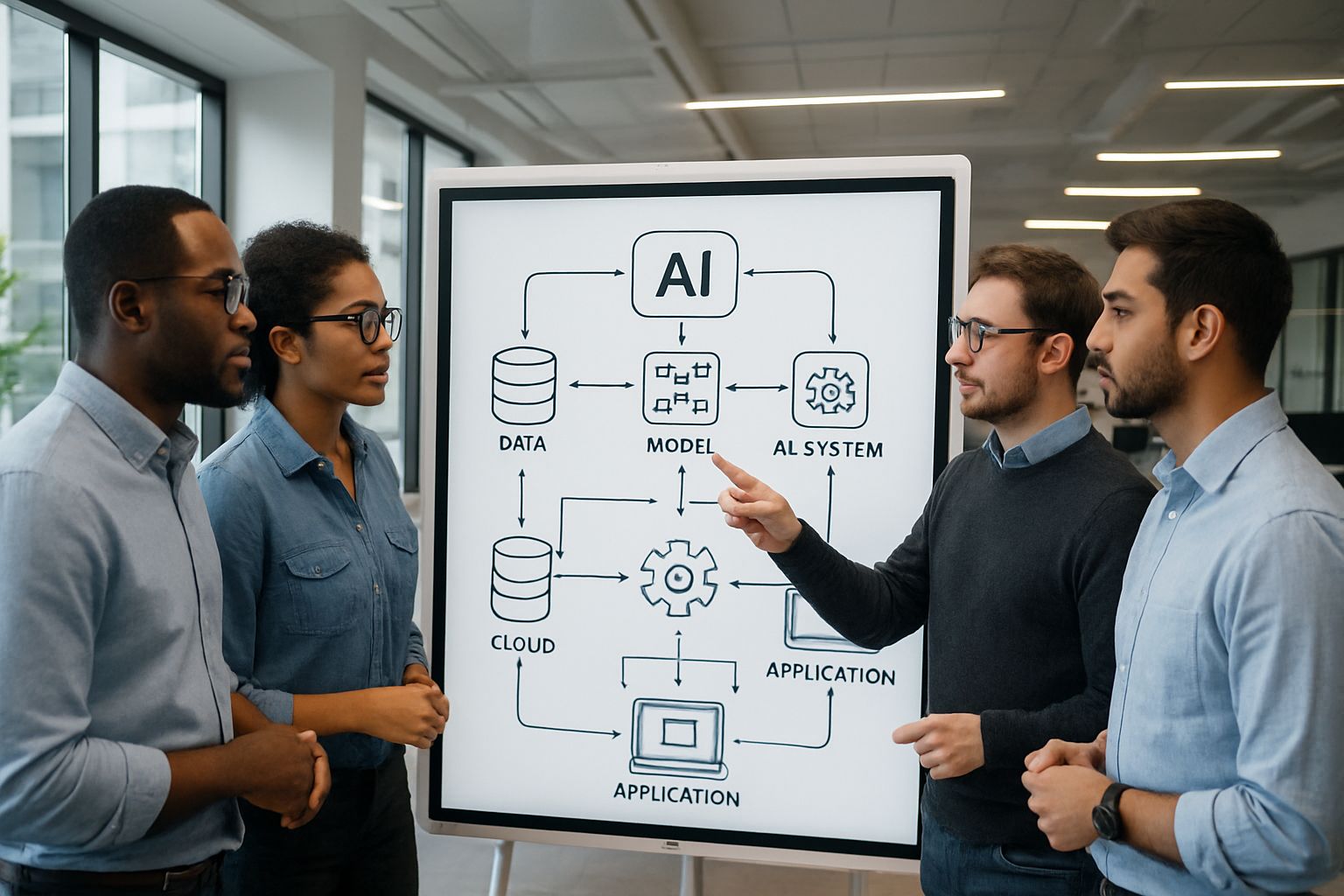
FEATURED
7 Reasons To Embrace AI-Native Architecture
March 2, 2026
FEATURED
Hybrid AI FAQ: Strategy, Governance, and ROI
March 2, 2026
FEATURED
Agentic AI Integration Playbook for Enterprises
March 2, 2026