Cloud AI vs Hybrid: Enterprise Deployment Guide
Introduction
Every enterprise feels the pressure to modernize operations with Cloud AI. However, leaders must weigh latency, compliance, and cost before picking an architecture. Many still ask, “what is the difference between cloud ai and hybrid ai?” This guide answers that question, maps current trends, and provides a proven roadmap for rapid ai adoption.
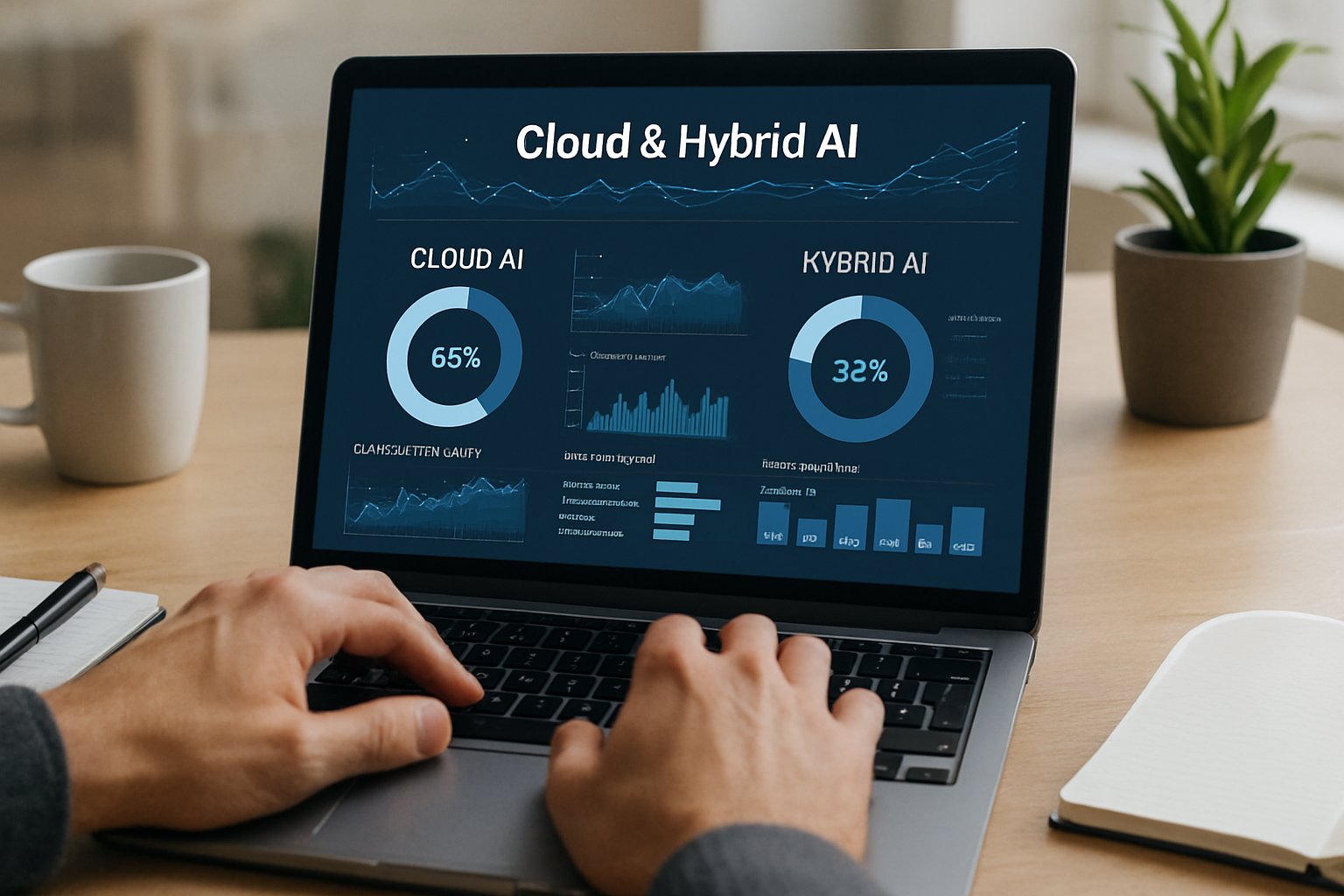
We draw on AdaptOps insights, Gartner forecasts, and MLOps practice to deliver a 1500-word blueprint. Consequently, HR, L&D, onboarding, and IT teams will gain precise next steps.
Cloud AI Market Trends
Worldwide AI spending will reach $2.52 trillion by 2026, according to Gartner. Furthermore, OpenAI reports explosive growth in enterprise ChatGPT usage, confirming mainstream ai adoption. Enterprises now embed models deeply within workflows rather than running lab pilots.
Despite rising budgets, pilot-to-scale failure rates remain high when governance lags. Therefore, market momentum alone cannot guarantee outcomes. Many executives again ask, “what is the difference between cloud ai and hybrid ai?”
Key Takeaways: Budgets soar, usage spikes, yet governance gaps threaten ROI. Consequently, architecture choices matter.
Hybrid AI Adoption Drivers
Hybrid AI balances scale with regulatory demands. Additionally, edge nodes solve real-time latency for manufacturing and telecom. Confidential computing options now protect data-in-use, unlocking new workloads in finance and healthcare.
Moreover, orchestration offerings such as Anthos, Azure Arc, and Outposts provide “train anywhere, deploy anywhere” flexibility. These platforms extend consistent policy and telemetry across environments, easing operational burden.
Key Takeaways: Hybrid AI satisfies compliance, latency, and resilience needs. Therefore, leadership must align architecture with workload demands.
Key Architecture Choice Factors
Enterprises evaluating architectures should score needs across five dimensions:
- Data residency mandates
- Inference latency targets
- Hardware cost optimization
- Availability and failover
- Operating skill maturity
For example, confidential claims processing data may remain on-prem, while model training scales in cloud GPUs. Meanwhile, retail recommendation engines push low-latency models to edge stores.
Many architects revisit the earlier question: “what is the difference between cloud ai and hybrid ai?” In essence, Cloud AI centralizes every stage, whereas Hybrid AI distributes workloads across cloud, on-prem, and edge while staying governed.
Key Takeaways: Score each workload against the five dimensions. Subsequently, map components to their optimal environments.
Effective MLOps Playbook Steps
Robust MLOps converts prototypes into governed services. Therefore, adopt the following pipeline:
- Version data within a feature store like Feast.
- Automate training with CI/CD and model registries.
- Deploy via Kubernetes-native serving such as KServe.
- Monitor drift, latency, and business KPIs.
- Trigger retraining when thresholds break.
Additionally, observability must span cloud and on-prem nodes. Telemetry feeding AdaptOps dashboards empowers go, stop, or scale decisions.
Key Takeaways: Unified pipelines ensure reproducibility and compliance. Consequently, MLOps maturity accelerates measurable outcomes.
Governance Via AdaptOps Model
Adoptify’s AdaptOps model enforces governance gates across hybrid surfaces. It embeds telemetry schemas, role-based enablement, and scale thresholds into every phase.
Furthermore, ROI dashboards correlate model calls to business metrics, reducing funding risk. Microlearning paths upskill developers, HR teams, and security officers simultaneously, closing the talent gap.
Because AdaptOps couples standards with rapid sprints, enterprises convert pilots to production within 90 days. Therefore, ai adoption becomes predictable rather than aspirational.
Key Takeaways: Governance-first rollout mitigates compliance risk and validates ROI quickly. Therefore, AdaptOps de-risks both Cloud AI and Hybrid AI programs.
Practical Action Plan Checklist
Follow this concise plan:
| Week | Action | Outcome |
|---|---|---|
| 1 | Run readiness assessment | Define architecture gaps |
| 2-4 | Build pilot pipeline | Measure latency & cost |
| 5-8 | Enable role training | Close skills gaps |
| 9-12 | Set governance gates | Secure compliance sign-off |
| 13+ | Scale validated workloads | Realize business ROI |
Additionally, revisit KPI dashboards weekly, adjusting scale decisions as telemetry guides. This disciplined cadence cements sustainable ai adoption.
Key Takeaways: A structured, time-boxed plan maintains momentum. Consequently, enterprises avoid pilot purgatory.
Conclusion And Next Steps
Enterprises now grasp the nuances between architectures, understand MLOps essentials, and hold a pragmatic action plan. Both Cloud AI and Hybrid AI thrive when governance, telemetry, and targeted upskilling intersect.
Why Adoptify AI? Cloud AI success demands more than code. Adoptify AI delivers AI-powered digital adoption, interactive in-app guidance, intelligent user analytics, and automated workflow support. Consequently, teams onboard faster, raise productivity, and scale securely across the enterprise. Explore how Adoptify AI accelerates your journey at Adoptify.ai.
Frequently Asked Questions
- What is the difference between Cloud AI and Hybrid AI?
Cloud AI centralizes processing while Hybrid AI distributes workloads across cloud, on-premises, and edge environments, ensuring compliance and low latency. Adoptify AI offers in-app guidance and automated support for seamless integration. - How does Adoptify AI streamline digital adoption?
Adoptify AI leverages interactive in-app guidance, intelligent user analytics, and automated workflow support to accelerate digital adoption, reduce onboarding time, and boost productivity across enterprise operations. - Why is governance important in AI adoption?
Robust governance mitigates compliance risk, maintains ROI, and validates AI models. With advanced telemetry and automated support, Adoptify AI ensures consistent policy enforcement and effective scaling of digital workflows. - How can MLOps practices boost enterprise AI adoption?
Effective MLOps, including versioned data, CI/CD automation, and telemetry dashboards, streamlines AI model training and deployment, leading to faster onboarding, enhanced efficiency, and strategic decision-making with Adoptify AI
FEATURED
The Complete Guide to Building an AI Adoption Framework for 2026
March 2, 2026
FEATURED
Who Owns the Intellectual Property in Enterprise AI Adoption
March 2, 2026
FEATURED
7 Reasons To Embrace AI-Native Architecture
March 2, 2026
FEATURED
Hybrid AI FAQ: Strategy, Governance, and ROI
March 2, 2026
FEATURED
Agentic AI Integration Playbook for Enterprises
March 2, 2026