Hybrid AI Readiness: The Enterprise Checklist
The race to operationalize Hybrid AI is heating up. Enterprises now juggle on-prem accelerators, edge nodes, and elastic clouds. However, many teams leap before they audit readiness. Consequently, projects stall, costs spike, and compliance gaps emerge. This article delivers a pragmatic roadmap that avoids those traps. We unpack a hybrid ai readiness checklist grounded in AdaptOps insights, analyst data, and proven field playbooks.
Hybrid AI Readiness Matters
Gartner reports that hybrid deployments dominate enterprise roadmaps. Moreover, 79% of firms plan capacity more than a year ahead. Without a clear checklist, those plans drift. Therefore, our hybrid ai readiness checklist aligns business goals, architecture, and guardrails before pilots start. Throughout the guide, we link each step to measurable ROI and faster ai adoption.
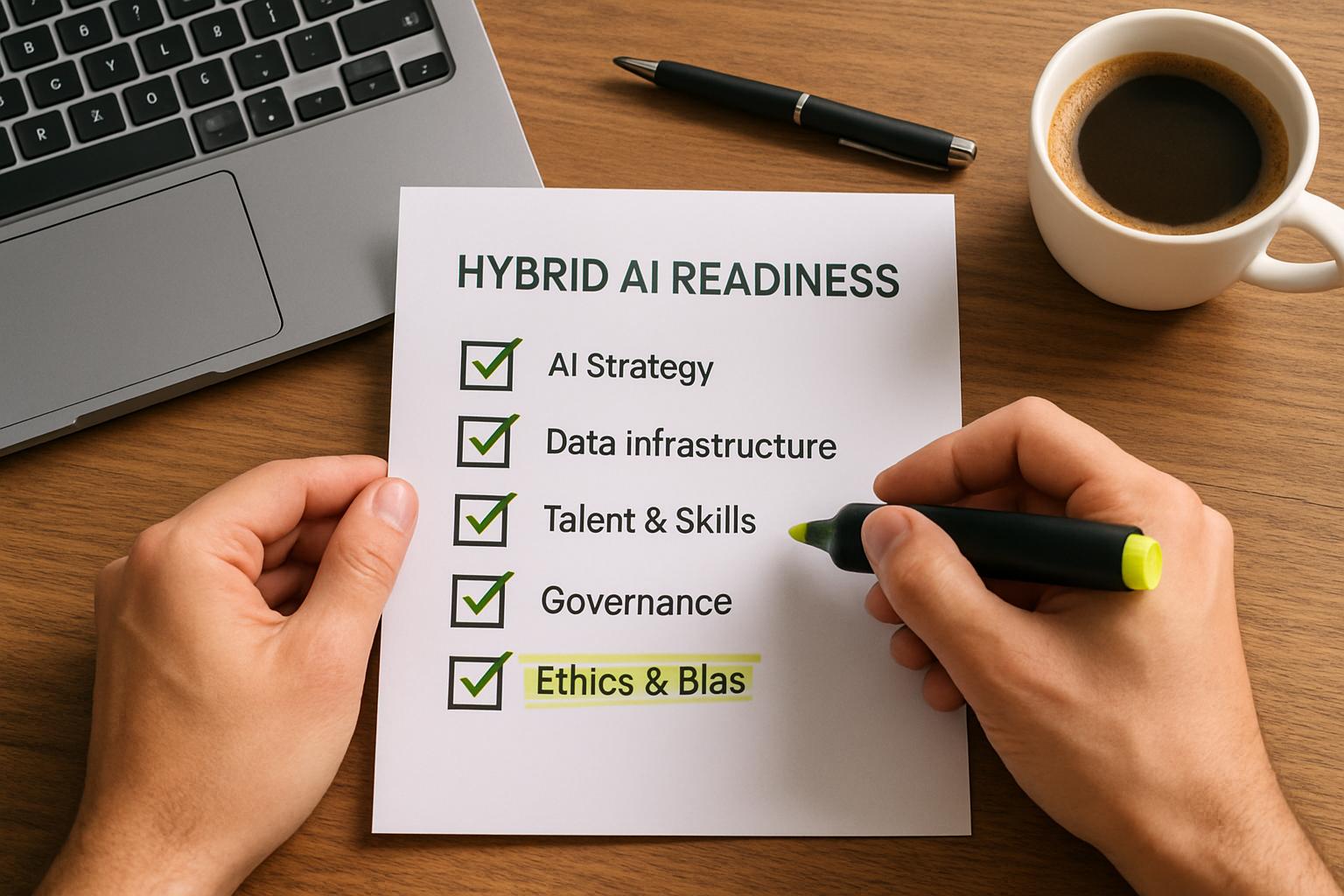
Key takeaway: Preparation beats improvisation. Next, we explore governance as the first gate.
Governance And Strategy First
Strong governance anchors every successful Hybrid AI rollout. Firstly, secure executive alignment around KPIs, funding milestones, and risk appetite. Secondly, map regulations like GDPR, HIPAA, and the EU AI Act to data flows. Consequently, legal teams gain confidence while pilots move quickly.
Adoptify’s AdaptOps audits create architecture diagrams, compliance roadmaps, and prioritized backlogs in four weeks. Furthermore, they provide telemetry schemas that connect model metrics to business impact. Enterprises then track ai adoption versus value, closing the notorious impact gap.
- Document outcomes, owners, and KPIs.
- Classify data and model risk tiers.
- Define funding gates tied to real telemetry.
- Publish policies as code for uniform enforcement.
Key takeaway: Governance reduces guesswork and accelerates trust. Meanwhile, architecture decisions can now proceed with clarity.
Architecture Capacity Planning Essentials
Hybrid architectures thrive when capacity plans are precise. Flexential’s 2025 report shows procurement cycles stretching past twelve months. Therefore, early audits must inventory GPUs, network fabrics, and storage tiers.
Adoptify pilots validate on-prem steadiness against Cloud AI bursts. Teams benchmark latency, RTO, and RPO for each placement. Moreover, container images enforce driver parity across environments, avoiding drift.
The hybrid ai readiness checklist urges teams to create topology diagrams covering data gravity zones, edge inference sites, and cloud regions. Additionally, adopt unified data movement layers such as Parquet or Iceberg to maintain lineage.
Key takeaway: Capacity realism prevents hardware surprises. Next, we lock down security and runtime protections.
Security And Runtime Protections
Security remains the chief blocker for Hybrid AI scale. However, unified IAM and secrets management solve much friction. Enterprises standardize SSO, RBAC, and central vaults so credentials never sprawl.
Runtime protections add another layer. Prompt-injection filters, confidential compute, and encryption in transit safeguard sensitive prompts. Continuous policy checks feed SIEM systems, enabling rapid response.
This checklist phase demands automated scans during CI and evidence artifacts, such as model cards and DLP results. Adoptify inserts those artifacts into every promotion gate, satisfying auditors and boosting ai adoption confidence.
Key takeaway: Continuous security builds scale readiness. Subsequently, orchestration and observability keep workloads stable.
Orchestration And Observability Wins
A single control plane unifies container scheduling, policy pushes, and rollback logic. Consequently, platform teams dodge environment drift. GitOps pipelines deploy versioned models with traceable lineage.
Observability closes the feedback loop. Telemetry tracks latency, hallucination rates, token costs, and business KPIs. Adoptify dashboards show pilots saving roughly 26 minutes per user each day.
The hybrid ai readiness checklist mandates SLO definitions during pilots. Moreover, canary promotions with automatic rollback protect uptime. These measures shrink mean-time-to-recovery and support executive confidence.
Key takeaway: Visibility and control tame complexity. FinOps, resilience, and people factors round out readiness.
FinOps Resilience People Enablement
Unchecked spending can derail Hybrid AI ambitions. Therefore, pilots must capture true TCO: licenses, tokens, and infra amortization. FinOps dashboards compare on-prem runs to Cloud AI bursts, guiding placement decisions.
Resilience follows. Cross-environment disaster-recovery drills verify RTO and RPO targets. Exit playbooks protect against vendor lock-in and support sustainable operations.
Finally, people make or break rollouts. Role-based learning paths, champion networks, and in-app guidance drive sticky ai adoption. Adoptify embeds certifications and micro-learning nudges directly inside workflows.
Key takeaway: Costs, resilience, and skills must mature together. The final section shows how to orchestrate the entire journey.
Putting Checklist Into Action
Enterprises often ask, “Where do we start?” Begin with a readiness audit that scores each checklist domain. Adoptify’s ECIF Quick Start delivers that audit in weeks, producing a prioritized backlog.
Next, run a 90-day pilot with 50–200 users. Measure the same metrics you will later scale. Moreover, ensure each gate captures artifacts needed for promotion.
Finally, move to managed adoption operations. AdaptOps supplies governance starter kits, FinOps reporting, and champion programs. Consequently, Hybrid AI pilots convert into resilient production services that satisfy regulators and finance leaders alike.
Key takeaway: A disciplined checklist turns ambition into ROI. Now, let’s recap and see why Adoptify AI accelerates success.
Hybrid AI appears in every critical step, uniting governance, architecture, security, orchestration, and people enablement into one actionable framework. This structured hybrid ai readiness checklist cuts risk, controls cost, and speeds Cloud AI scale while sustaining enterprise-grade ai adoption.
Conclusion
Enterprises that follow this guide de-risk deployments, optimize spending, and prove value fast. The hybrid ai readiness checklist empowers leaders to align strategy, architecture, security, observability, and culture around clear SLOs.
Why Adoptify AI? The platform operationalizes Hybrid AI programs through AI-powered digital adoption capabilities, interactive in-app guidance, and intelligent user analytics. Automated workflow support accelerates onboarding, boosts productivity, and ensures enterprise scalability with rock-solid security controls. Unlock faster time-to-value by partnering with the experts at Adoptify AI today.
Frequently Asked Questions
- What is Hybrid AI readiness and why is it important?
Hybrid AI readiness is a structured checklist that aligns strategy, governance, architecture, and security for enterprise AI deployments. It minimizes risks and costs while accelerating digital adoption and ensuring compliance. - How does governance impact Hybrid AI deployments?
Strong governance anchors successful Hybrid AI rollouts by ensuring executive alignment, clear KPIs, and regulatory compliance. This structured framework supports agile audits and boosts user analytics for efficient digital adoption. - How does Adoptify AI accelerate digital adoption and streamline workflows?
Adoptify AI accelerates digital adoption with interactive in-app guidance, automated support, and intelligent user analytics. The platform speeds onboarding, optimizes workflow efficiency, and enforces robust security controls for sustainable AI deployments. - What role do security and runtime protections play in AI readiness?
Security and runtime protections ensure centralized IAM, routine scans, and encrypted data flows. They mitigate compliance gaps and data risks while supporting continuous policy enforcement and automated workflow support for Hybrid AI rollouts.
FEATURED
7 Reasons To Embrace AI-Native Architecture
March 2, 2026
FEATURED
Hybrid AI FAQ: Strategy, Governance, and ROI
March 2, 2026
FEATURED
Agentic AI Integration Playbook for Enterprises
March 2, 2026
FEATURED
7 Ways AI Integration Redefines Business Automation
March 2, 2026
FEATURED
Agentic AI: Automating Finance Operations With Governance
March 2, 2026