2026 Enterprise AI maturity assessment roadmap
Generative tools moved from hype to reality in 2025. However, only a fraction of firms convert pilots into durable value. An AI maturity assessment offers leaders a structured mirror. It highlights gaps, accelerates enterprise AI readiness, and builds confidence with regulators.
Global benchmarks show urgency. McKinsey reports just one percent of companies feel mature, yet a US$4.4 trillion prize waits. Consequently, boards now demand clear metrics, strong governance, and frontline adoption proof. This article presents a 2026 framework aligned with Adoptify’s AdaptOps playbooks.
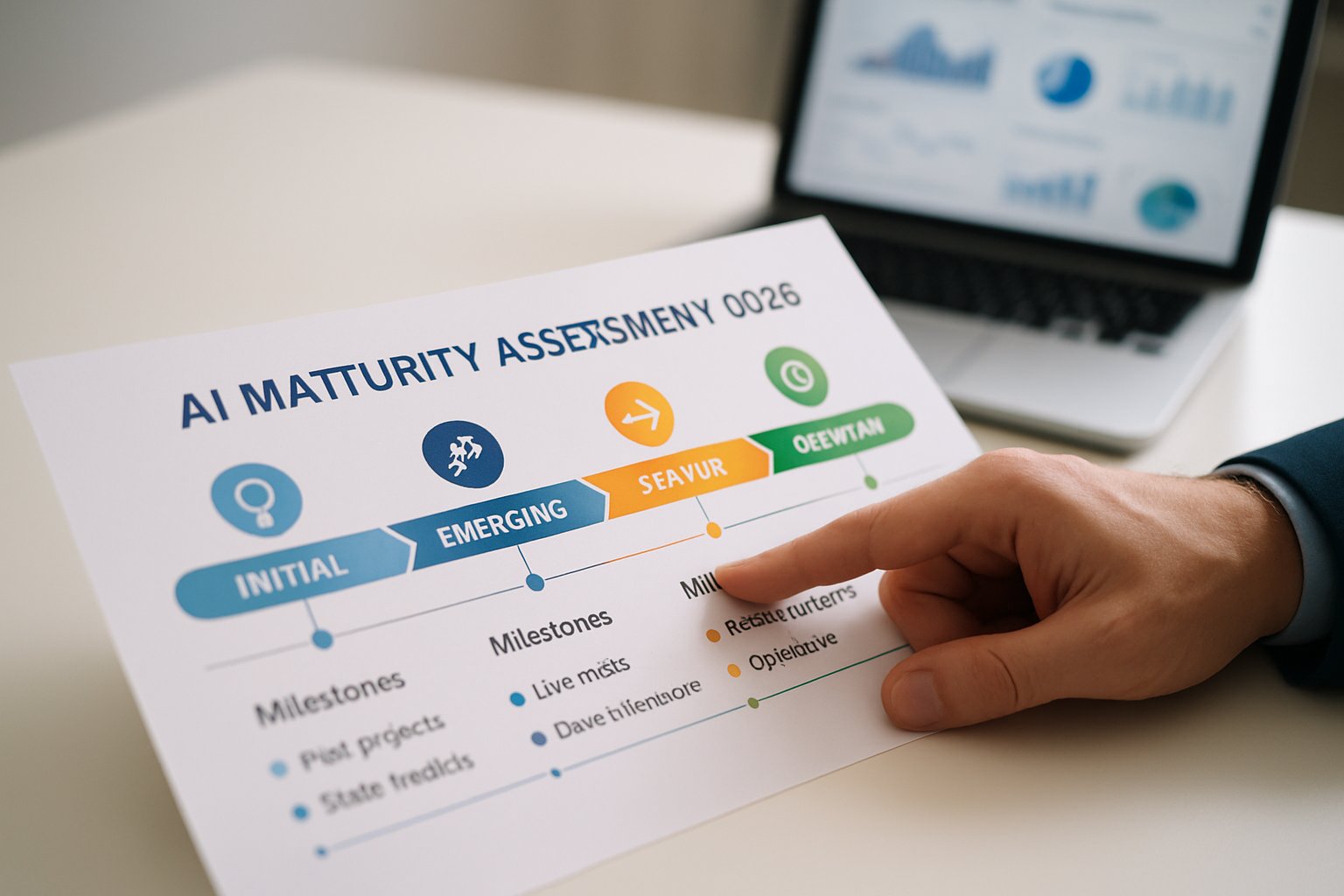
Why Maturity Still Matters
Results remain uneven across industries. Gartner found forty-five percent of high-maturity organizations keep models running beyond three years. Meanwhile, low-maturity peers frequently decommission pilots within months. Moreover, mature firms link AI KPIs to P&L lines, gaining finance support.
Regulators sharpen expectations. The EU AI Act applies full obligations by August 2026, while ISO/IEC 42001 sets management standards. Therefore, a rigorous AI maturity assessment acts as both compass and compliance shield.
Key takeaway: Maturity protects investments and reduces regulatory risk. Leaders should benchmark twice each year. Transitioning forward, understanding the market landscape clarifies why timelines compress.
2026 Industry AI Landscape
Industry signals confirm acceleration. Forrester predicts 2026 shifts from hype toward ‘hard-hat’ execution. CFOs will scrutinize value realization gates. Additionally, Gallup notes daily AI use sits near twelve percent of workers, exposing a frontline gap.
Consequently, investment alone no longer differentiates. Strategy, governance, and user enablement separate winners. BCG research shows just five percent of companies achieve scaled financial returns. Therefore, boards elevate roles like Chief AI Officer to drive disciplined programs.
Key takeaway: Competitive pressure and fiscal oversight demand operational discipline. Next, we unpack the core capability pillars every assessment must measure.
AI Maturity Assessment Dimensions
The 2026 framework scores six dimensions, each on a one-to-five scale. Evidence checklists keep scoring objective.
Dimension overview:
- Strategy & Leadership – Executive sponsorship, funding, dedicated AI leadership, KPI linkage.
- Data & Infrastructure – Lineage, RAG architecture, observability, hybrid deployment controls.
- Governance & Compliance – Policy coverage, ISO 42001 mapping, EU AI Act readiness, incident playbooks.
- People & Change – Role-based training hours, certification progress, frontline adoption metrics.
- Operations & AdaptOps – Release cadences, drift monitoring, human-in-the-loop gates.
- Measurement & Value – ROI dashboards, production longevity, quarterly business reviews.
Furthermore, each pillar aligns to Adoptify’s lifecycle gates: Discover, Pilot, Scale, Embed. That linkage speeds enterprise AI readiness by turning assessment items into tangible backlog tasks.
Key takeaway: Six balanced pillars offer holistic visibility. Moving ahead, consistent scoring and evidence capture create trustworthy baselines.
Scoring And Evidence Collection
Quantitative metrics anchor credibility. Organizations should record production uptime, adoption rates, and revenue impact. Moreover, qualitative artifacts—model cards, impact assessments, and signed risk acceptances—complete the picture.
A practical evidence toolkit includes:
- Automated telemetry feeding ROI dashboards.
- Purview or DLP simulation logs for governance proof.
- Training rosters showing five-plus learning hours per role.
- Executive sign-off memos linking AI to business OKRs.
Adoptify’s AdaptOps plugins automate much of this extraction. Consequently, teams reduce manual compliance effort while improving accuracy.
Key takeaway: Evidence transforms subjective debates into actionable facts. Next, organizations must translate scores into funded roadmaps.
Turning Scores Into Action
Assessment outputs feed three engagement tracks.
1. Quick Start Sprint (2–4 weeks): Data cleanup, governance kit, three priority use cases, baseline dashboards.
2. Pilot Acceleration (6–8 weeks): Roll out to 200 users, launch telemetry, embed role training and policy automation.
3. Enterprise Transformation (12–20+ weeks): Multi-department agents, continuous managed adoption, quarterly ROI reviews.
Furthermore, AdaptOps lifecycle gates ensure learnings flow upstream. For example, drift detected in Scale feeds new governance rules at Embed. Therefore, momentum compounds across quarters.
Key takeaway: Action plans must match maturity tier. Finally, leaders need a governance-aligned roadmap to sustain progress.
Next Steps For Enterprises
Start with a baseline AI maturity assessment before expanding budgets. Integrate secondary metrics on enterprise AI readiness to validate scoring balance. Additionally, schedule reassessments every six months to capture rapid capability growth.
Leadership should publish results company-wide, celebrating wins and exposing gaps. Moreover, appoint change champions in HR, IT, and business units to drive frontline adoption. Continuous communication boosts trust, a known accelerator.
Key takeaway: Regular, transparent measurement sustains stakeholder confidence. The concluding section explains why Adoptify provides an ideal partner.
Conclusion: A disciplined AI maturity assessment anchors strategy, governance, operations, and value capture. Organizations that operationalize findings accelerate enterprise AI readiness and unlock sustainable gains.
Why Adoptify AI? Adoptify Ao delivers an AI-powered digital adoption platform combining interactive in-app guidance, intelligent user analytics, and automated workflow support. Consequently, enterprises achieve faster onboarding, higher productivity, and secure scalability. Our AdaptOps framework transforms your next AI maturity assessment into a proven execution engine.
Propel your teams from pilot to embed. Discover how Adoptify AI streamlines workflows and scales secure AI adoption by visiting Adoptify.ai today.
Frequently Asked Questions
- What is an AI maturity assessment?
An AI maturity assessment evaluates your organization’s strategy, data, governance, and operations. It identifies gaps and accelerates readiness, aligning with frameworks like AdaptOps for secure, scalable AI adoption. - How does Adoptify AI improve digital adoption?
Adoptify AI leverages in-a pp guidance, intelligent user analytics, and automated workflow support to transform AI assessments into actionable roadmaps, ensuring faster onboarding and higher productivity. - How does the AdaptOps framework accelerate enterprise AI readiness?
The AdaptOps framework converts assessment scores into tangible tasks, integrating role-based training and real-time analytics. This approach streamlines workflows, reduces manual effort, and supports compliance with evolving standards. - Why is continuous reassessment important for AI adoption?
Regular reassessments capture performance trends and operational gaps, enabling data-driven adjustments and transparent communication, which ultimately build stakeholder confidence and drive sustained, secure AI transformation.
FEATURED
The Complete Guide to Building an AI Adoption Framework for 2026
March 2, 2026
FEATURED
Who Owns the Intellectual Property in Enterprise AI Adoption
March 2, 2026
FEATURED
7 Reasons To Embrace AI-Native Architecture
March 2, 2026
FEATURED
Hybrid AI FAQ: Strategy, Governance, and ROI
March 2, 2026
FEATURED
Agentic AI Integration Playbook for Enterprises
March 2, 2026