2026 Guide to Microsoft Copilot Pricing and Licensing
Microsoft Copilot Pricing is top-of-mind for every CIO exploring generative AI. Buyers must grasp new tiers, hidden meters, and promotion windows before signing multi-year deals. Therefore, this guide unpacks the 2026 landscape, compares options, and shares proven tactics for smart procurement.
Additionally, we connect each insight to real-world change programs. Enterprises, HR leaders, and SaaS operators will learn how to align budgets, governance, and microsoft copilot adoption goals without surprises.
Microsoft Copilot Pricing Landscape
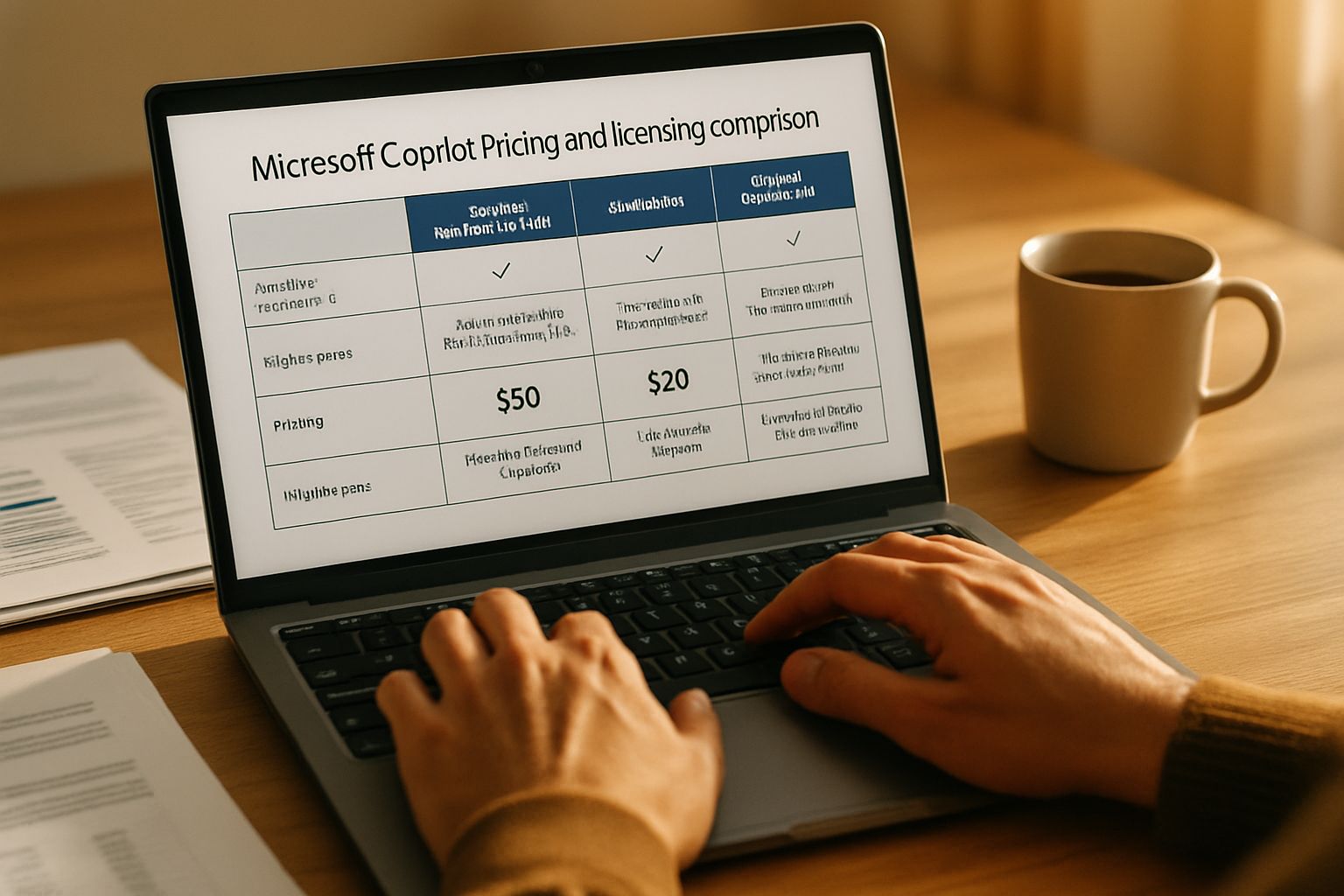
Microsoft’s flagship add-on still lists at $30 per user each month. Meanwhile, the new SMB SKU—Copilot Business—drops to $21, with a $18 launch promo until March 31, 2026. These numbers anchor every Microsoft 365 Copilot Licensing negotiation.
However, buyers must also track future Microsoft 365 base increases effective July 2026. Consequently, multi-year TCO modeling is essential. Gartner warns that 49% of AI programs stall when value is unclear. That warning underscores the need for a clear Copilot ROI and licensing strategy.
For reference, here is the current public rate card:
- Microsoft 365 Copilot (Enterprise): $30/user/month
- Microsoft 365 Copilot Business: $21/user/month
- Intro Promo (SMB): $18/user/month through 3/31/26
In summary, headline prices seem simple. Yet eligibility rules and upcoming price shifts demand deeper analysis. Now let’s examine the SMB tier changes.
SMB Pricing Tier Changes
Copilot Business targets firms with 300 or fewer seats. Importantly, qualifying users must hold Business Basic, Standard, or Premium. That nuance impacts Microsoft Copilot license cost forecasts.
Moreover, Microsoft caps the discount window, pushing fast decisions. Enterprises with mixed headcounts can stage rollouts: assign Copilot Business to eligible cohorts while larger groups pilot the enterprise add-on. Such hybrid licensing lowers initial Copilot License Cost outlay.
Gartner expects competitors to match aggressive SMB tiers. Consequently, procurement teams should benchmark Google Workspace Gemini bundles when crafting an overall Copilot ROI and licensing strategy.
Key takeaway: the SMB SKU unlocks lower entry prices, yet eligibility limits matter. Next, we uncover hidden metered expenses that often derail budgets.
Hidden Metered Cost Drivers
List prices tell only half the story. Copilot Studio, agents, and connector quotas introduce metered charges that inflate the apparent Copilot License Cost.
Studio And Agent Meters
Studio access ships with the license, yet agent execution burns prepaid credits or Azure consumption. Therefore, organizations should model usage early and buy credit packs with up to 20% savings.
Connector And Index Fees
Eligible tenants enjoy a 50-million-item index quota. Heavy ingestion pushes workloads into paid tiers. Furthermore, complex external data sources may increase Microsoft Copilot license cost.
Consider the following potential overruns:
- Agent bursts exceeding reserved capacity
- High-volume indexing of legacy repositories
- Region-specific egress and latency optimizations
Consequently, hidden meters can outpace sticker prices without governance. Up next, we outline strategies to optimize licensing.
Optimizing License Cost Strategy
Smart buyers combine discounts, pilots, and usage telemetry. Adoptify AI’s AdaptOps loop—Discover, Pilot, Scale, Embed—provides a proven framework.
Add-on Versus Bundle Choice
First, map base SKUs. Then compare the add-on to full bundle costs. Often, Business Standard plus Copilot Business totals $30.50, while E3 plus the add-on climbs above $45. Clear math guides Copilot Pro vs Microsoft 365 Copilot debates.
ECIF-Funded Pilots
Microsoft offers ECIF credits that offset early microsoft copilot adoption spend. Adoptify AI helps secure these funds, reducing immediate Copilot License Cost.
- Run 50-200 user pilots.
- Track KPIs like time saved per document.
- Present dashboards to finance for scaling approval.
Therefore, data-driven pilots de-risk long-term commitments. The next section covers governance safeguards required before rollout.
Governance Before Copilot Rollout
Security teams often gate AI purchases. Purview simulations, DLP, and role-based access reduce that friction. Moreover, they protect sensitive data when prompts interact with enterprise repositories.
Adoptify AI templates accelerate compliance sign-off by 40%. Consequently, organizations move from pilot to production faster, sustaining momentum for microsoft copilot adoption.
Remember, governance is not optional. It is a central pillar in every Copilot ROI and licensing strategy. Our final section details how to measure that ROI.
Copilot ROI Measurement Playbook
Forrester TEI studies project ROIs between 52% and 468%. However, actual gains rely on structured measurement.
Adoptify AI embeds real-time analytics across Teams, Outlook, and SharePoint. Dashboards tie Copilot usage to KPIs like case resolution time or revenue per rep, clarifying Copilot Pro vs Microsoft 365 Copilot value.
The playbook:
- Define baseline productivity metrics.
- Collect telemetry during pilot weeks 1-4.
- Compare trend deltas at week 12.
- Project annualized savings against total Microsoft 365 Copilot Licensing cost.
Consequently, finance leaders gain confidence to fund expansion. We now conclude with next steps and why Adoptify AI matters.
Conclusion
2026 Microsoft Copilot Pricing demands more than list-price awareness. Leaders must master SMB tiers, hidden meters, governance, and ROI telemetry. Structured pilots and proactive negotiation lower risk and unlock rapid value.
Why Adoptify AI? The AI-powered platform streamlines Microsoft Copilot Pricing rollouts with interactive in-app guidance, intelligent user analytics, and automated workflow support. Consequently, teams onboard faster, boost productivity, and scale securely across the enterprise. Discover how Adoptify AI elevates your Copilot ROI and licensing strategy at Adoptify AI.
Frequently Asked Questions
- What are the key factors influencing Microsoft Copilot pricing?
Pricing factors include base rates, SMB tier eligibility, hidden metered costs like agent usage and index fees, and evolving license terms. These require careful modeling and proactive negotiation for a clear Copilot ROI. - How does Adoptify AI streamline Microsoft Copilot adoption?
Adoptify AI leverages in-app guidance, real-time analytics, and automated workflow support to simplify pilots and governance. This helps secure ECIF credits, reduce hidden costs, and optimize your licensing strategy. - What hidden costs should organizations consider with Microsoft Copilot?
Hidden costs include charges for agent execution, connector indexes, and region-specific optimizations. Monitoring these metered expenses is crucial to avoid budget overruns and ensure accurate licensing cost projections. - How do robust pilots and governance practices enhance Copilot ROI?
Structured pilots with usage telemetry and strong governance validate productivity improvements. Adoptify AI’s AdaptOps loop and analytics provide clear KPIs, mitigating risks of hidden expenses and ensuring a secured ROI.
FEATURED
Artificial intelligence adoption: Inbox zero with Copilot
February 3, 2026
FEATURED
Artificial intelligence adoption: myths leaders must crush
February 3, 2026
FEATURED
Establishing Ethical Artificial Intelligence Adoption Guidelines
February 3, 2026
FEATURED
Artificial Intelligence Adoption: Models, Skills, ROI
February 3, 2026
FEATURED
20-Point Artificial Intelligence Adoption Readiness Checklist
February 3, 2026