2026 Microsoft Copilot Governance Framework: Executive Guide
Generative AI budgets keep rising, yet governance conversations still lag behind bold pilot launches. Consequently, Microsoft Copilot Governance now anchors every board discussion on AI risk, value, and speed. The 2026 framework promises an integrated control plane, lifecycle tooling, and measurable return on investment. However, executives still face fragmented policies, hidden costs, and unpredictable agent behavior. Moreover, regulators demand auditable evidence, not aspirational press releases. Adoptify research shows 74% of firms enable GenAI, yet only half own full governance programs. Consequently, many leaders expose data, budgets, and reputations to preventable harm. This article explains the emerging framework, maps it to enterprise challenges, and highlights pragmatic steps. Additionally, we compare agent control features with market peers to guide strategic investment. Finally, we illustrate how Adoptify’s AdaptOps model operationalizes these controls in weeks, not quarters.
Executive Risk Landscape 2026
Firstly, global analysts estimate generative AI could unlock up to $7.9 trillion in yearly value. Yet leadership exposure grows when policy, accountability, and spend tracking stay immature.
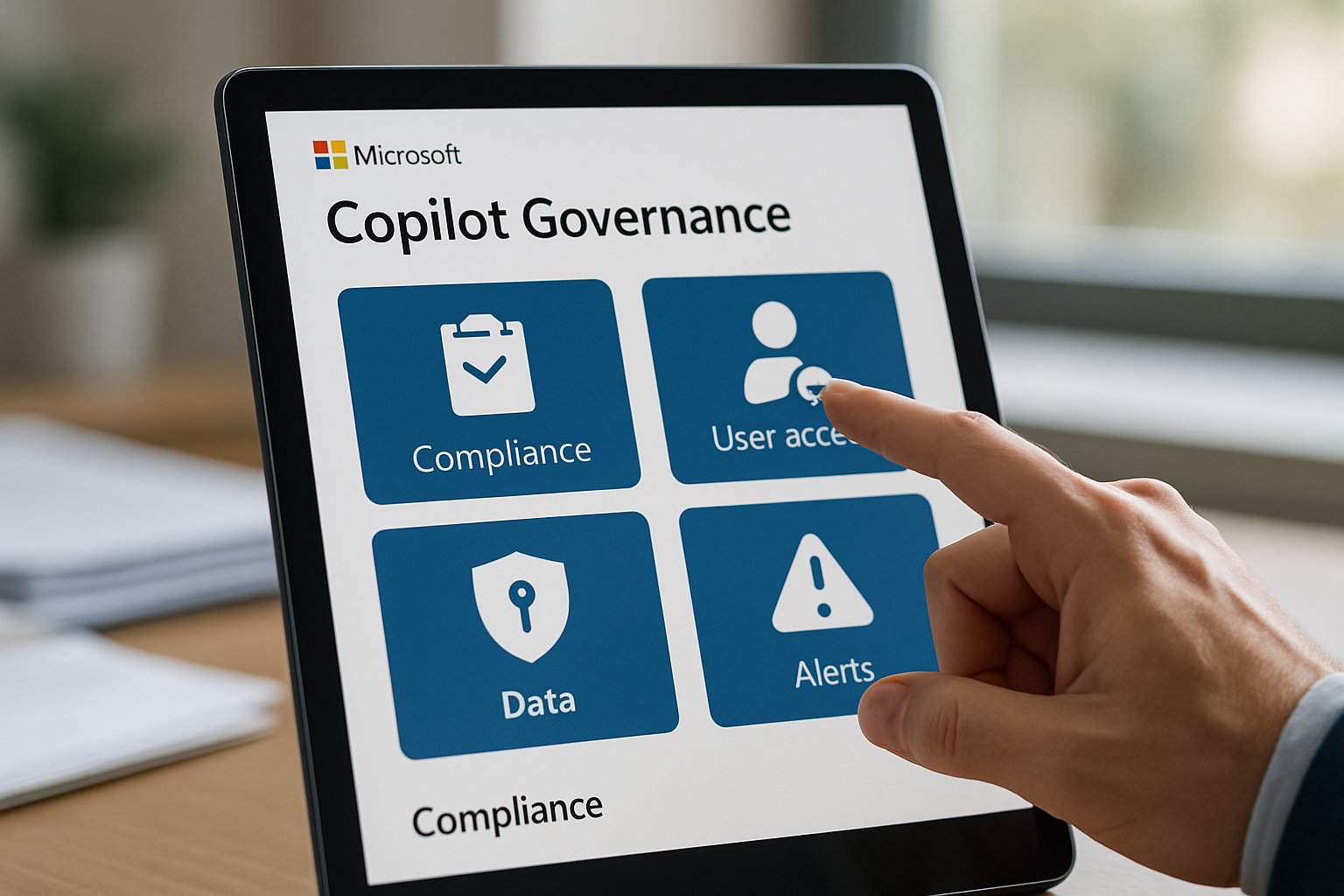
Inside Track reports Microsoft deployed Copilot to 300,000 internal users, highlighting scale implications. In contrast, midsize firms often struggle after only 500 licenses.
Regulators in the EU, India, and Brazil draft AI acts that mandate real-time transparency reporting. Boards risk fines and reputation damage if they ignore these regional timelines.
Cyber insurers also tighten policy wording, demanding evidence of prompt-injection testing and recovery playbooks. Therefore, the external pressure compounds the internal urgency to mature controls.
Therefore, executives weighing Artificial intelligence adoption must balance velocity against traceability, talent readiness, and regional regulation. Many also ask about Microsoft Copilot vs ChatGPT Enterprise economics, especially around unpredictable token drains.
In summary, risk now centers on unseen usage, unclear owners, and runaway costs. Next, we unpack the framework built to contain that exposure.
Microsoft Copilot Governance Stack
The Microsoft Copilot Governance stack combines the Copilot Control System, Purview, Entra, and Copilot Studio. Together, these layers form one tenant-level policy plane that enforces labeling, agent permissions, and audit evidence.
Moreover, Copilot Studio now ships agent lifecycle scorecards, red-team hooks, and drift detection gates. Consequently, executives receive clear signals before greenlighting broad rollouts.
Analysts still compare Microsoft Copilot vs ChatGPT Enterprise on transparency and governance automation depth. However, unified policy planes usually outperform vendor-specific bolt-ons during enterprise audits.
Importantly, the Control System exposes policy APIs, enabling integration with third-party governance platforms like Adoptify. This interoperability lets enterprises reuse existing risk engines and approval workflows.
Meanwhile, Purview connectors stretch beyond Microsoft 365 into popular SaaS ecosystems. Consequently, data lineage covers Salesforce, ServiceNow, and custom databases without extra agents.
To summarize, the stack provides foundational levers yet relies on disciplined implementation. Therefore, we must understand each control domain in detail.
Unified Control Plane Essentials
Firstly, data scope sits at the core. Executives should enable Purview sensitivity labels, DLP rules, and tenant segmentation before agents ingest content.
Secondly, identity boundaries matter. Assign dedicated Entra service principals to high-impact agents, and restrict cross-tenant API calls.
Furthermore, Microsoft Copilot vs ChatGPT Enterprise debates often overlook the importance of cost telemetries. Leaders require live token dashboards or budgets implode quickly.
Cost management deserves equal attention because LLM tokens behave like bursty utility bills. Finance teams can receive daily spend digests, preventing month-end surprises.
Additionally, telemetry pipelines should tag usage by department, product, and project code. That granularity simplifies chargebacks and portfolio prioritization decisions.
In short, the control plane translates policy into real-time enforcement. Next, we list the concrete guardrails every audit will check.
Technical Guardrail Checklist 2026
Below, we outline a concise checklist for immediate executive review.
- Tenant isolation between test and production to limit cascading failures.
- Purview labels and DLP rules applied at creation, not retroactively.
- Entra least privilege for agent identities and service principals.
- Telemetry pipelines pushing usage, cost, and incident data to executive dashboards.
- Continuous red-team and fairness evaluations before version promotions.
Red teams must attack prompts weekly, not annually. They should simulate data exfiltration, role creep, and jailbreak attempts.
Moreover, incident response plans must include communication templates, rollback scripts, and customer outreach sequences. Quick containment preserves trust during high-visibility outages.
Consequently, these guardrails ensure Microsoft Copilot Governance policies translate into operational muscle. Meanwhile, culture and training must keep pace.
Governance-First Pilot Approach
Adoptify advocates a 90-day pilot that embeds Microsoft Copilot Governance gates from day zero. Moreover, success metrics include time saved, policy violations prevented, and sentiment uplift among pilot users.
This approach accelerates Artificial intelligence adoption while maintaining clear boundaries, unlike many ad-hoc rollouts. Additionally, it offers a direct testbed for Microsoft Copilot vs ChatGPT Enterprise comparisons under identical controls.
Week zero focuses on baseline measurement and stakeholder alignment workshops. By week four, teams assess accuracy, latency, and user satisfaction against exit criteria.
Subsequently, executives decide whether to scale, adjust scope, or halt deployment. This gate keeps sunk-cost bias from driving poor decisions.
In essence, the pilot proves value and readiness before expensive enterprise expansion. Next, we explore the people side of change.
People Change Management Actions
Executive sponsors must champion Microsoft Copilot Governance in every town hall and internal newsletter. Furthermore, role-based certificates ensure managers understand permissions, escalation paths, and human override procedures.
Consequently, Artificial intelligence adoption feels purposeful rather than forced, boosting trust and engagement.
Targeted organizational messages push context-aware tips when users first open Copilot panels. Consequently, real engagement grows faster than broadcast email campaigns.
L&D teams should blend micro-learning, office hours, and peer showcases. These formats sustain momentum long after launch parties end.
Briefly, people processes convert policy into daily behavior. Finally, leaders must translate behavior into measurable returns.
ROI Dashboard Mastery Steps
Adoptify dashboards surface Microsoft Copilot Governance metrics alongside business KPIs in real time. Therefore, boards view savings, risk posture, and fairness trends without diving into technical logs.
Moreover, this transparency accelerates Artificial intelligence adoption funding decisions. Investors can also benchmark Microsoft Copilot vs ChatGPT Enterprise cost curves instantly.
Dashboards also display fair-use heat maps, flagging possible bias or discriminatory outputs. Legal teams can then launch targeted reviews before external complaints surface.
Additionally, token spend forecasts rely on moving average windows, improving accuracy. Finance leaders appreciate predictability when negotiating renewals.
In short, dashboards align governance with profit, closing the credibility loop. The conclusion ties everything together and highlights the Adoptify advantage.
Conclusion
The 2026 framework brings clear policies, agent oversight, and ROI accountability to generative AI programs. However, technology alone cannot guarantee success. Executives must unite controls, culture, and measurement into one disciplined operating rhythm. Microsoft Copilot Governance delivers the core platform, while Adoptify operationalizes it at enterprise scale. Adoptify AI adds AI-powered digital adoption guidance directly inside your apps. Interactive in-app walkthroughs, intelligent user analytics, and automated workflows accelerate onboarding and productivity. Moreover, our platform scales securely across global tenants, satisfying even the toughest audit teams. Explore the advantages today at Adoptify AI.
Frequently Asked Questions
- What is the Microsoft Copilot Governance stack and how does it enhance AI risk management?
The Microsoft Copilot Governance stack integrates tools like Purview, Entra, and control systems into a unified policy plane, offering real-time dashboards and cost telemetries that bolster AI risk management and digital adoption. - How does Adoptify AI’s AdaptOps model support rapid digital adoption?
Adoptify AI’s AdaptOps model accelerates digital adoption by embedding in-app guidance, intelligent user analytics, and automated workflows that streamline pilot testing and boost overall productivity. - What benefits do executive dashboards offer for AI governance and ROI tracking?
Executive dashboards combine governance metrics with business KPIs, providing transparency on token spend, cost management, and compliance. This insight aids informed decision-making and validates digital adoption investments. - How can organizations balance fast AI adoption with effective policy enforcement?
Organizations can balance rapid AI adoption by integrating robust governance controls, cost management tools, and in-app adoption guidance, ensuring secure workflows and maintaining regulatory compliance while scaling operations.

FEATURED
How to Identify and Overcome Cultural AI Adoption Barriers
March 3, 2026
FEATURED
What Are the Most Common AI Adoption Challenges for Businesses
March 3, 2026
FEATURED
The Complete Guide to Building an AI Adoption Framework for 2026
March 2, 2026
FEATURED
Who Owns the Intellectual Property in Enterprise AI Adoption
March 2, 2026
FEATURED
7 Reasons To Embrace AI-Native Architecture
March 2, 2026