Agentic AI FAQ: Enterprise Governance, Integration, and ROI
Executives hear daily promises about autonomous software helpers. Headlines celebrate skyrocketing productivity yet hide mounting risks. Amid the noise, agentic ai draws special attention.
Leaders ask two urgent questions. First, how do AI agents differ from ambitious goal driven systems? Second, what operating model turns hype into measured value?
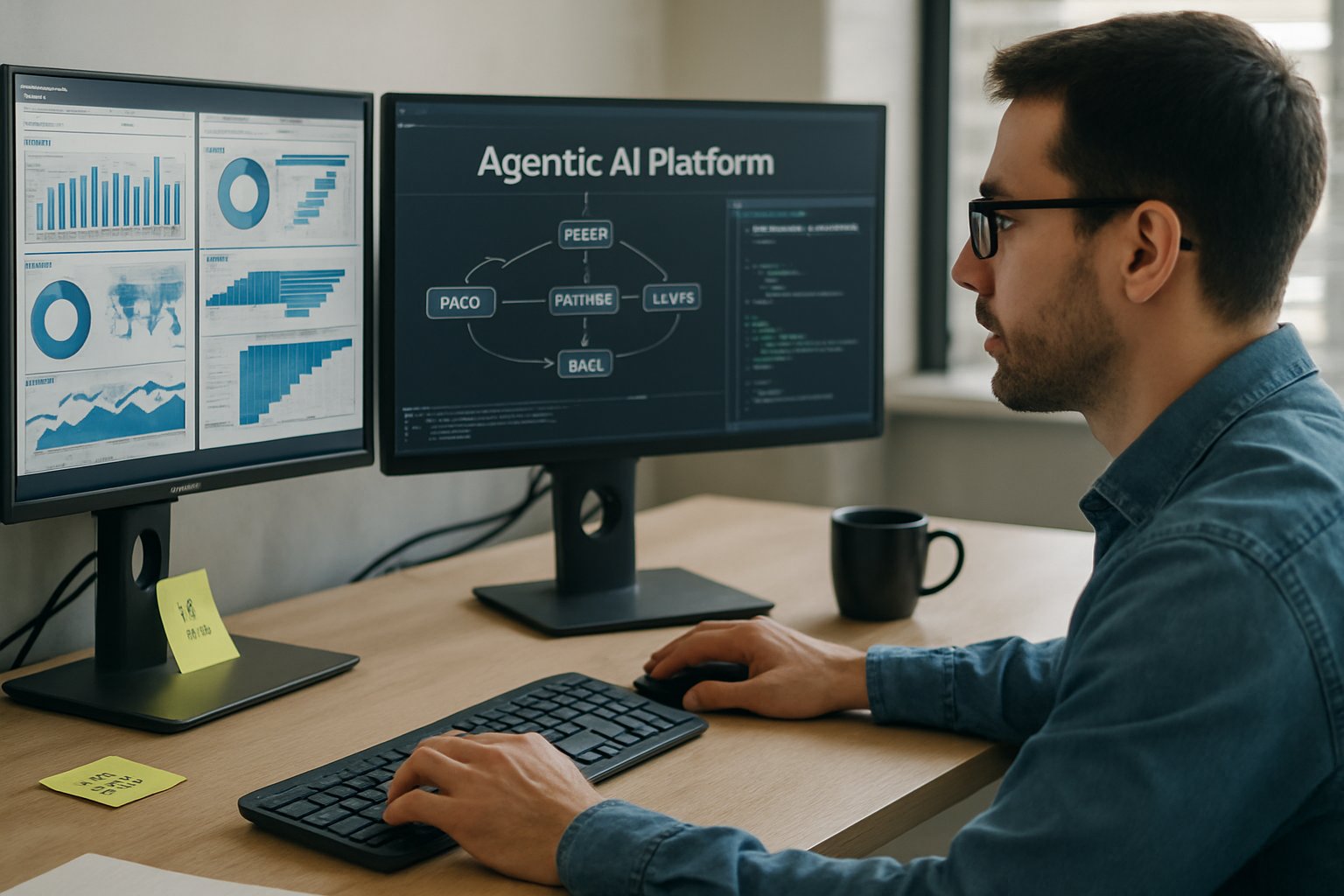
This FAQ answers both. It translates analyst research into practical guidance for HR, IT, and SaaS onboarding. Additionally, it maps recommendations to AdaptOps patterns used by Adoptify AI clients driving ai adoption and disciplined ai integration.
Moreover, the article highlights current security, governance, and measurement trends shaping 2026 budgets. Therefore, readers gain actionable checkpoints before green-lighting their next deployment.
Finally, we address funding, talent gaps, and the looming cancellation risk forecast by Gartner. Consequently, organizations leave with a proven roadmap rather than abstract theory.
Read on to learn how structured oversight converts experimental bots into sustainable enterprise scale business wins today.
Rapid Market Shift Forces
Every major vendor now ships built-in agents across collaboration, finance, and service platforms. Gartner predicts 40% of enterprise applications will include task agents by 2026. Moreover, Microsoft forecasts 1.3 billion agents running by 2028, driving unprecedented ai adoption budgets.
However, analysts also warn that over 40% of early projects could collapse without governance. Consequently, interest in control planes, identity, and observability exploded throughout 2025.
These forces create a dual imperative: accelerate ai integration while managing new operational risk. The following sections explain how enterprise teams can balance speed and safety.
Key takeaways: Market volume is rising fast, but cancellation rates remain high.
Next, we examine governance decisions that separate success from disaster.
Agentic AI Governance Essentials
Task agents execute one trigger, then stop. In contrast, agentic ai plans, chooses tools, and decides when goals are met. The difference between ai agents and agentic ai shapes risk profiles and compliance scope.
Therefore, AdaptOps frameworks recommend explicit classification gates. Enterprises label each capability as a narrow agent or a broader autonomous loop. Consequently, approval workflows, telemetry depth, and rollback plans vary by label.
Security leaders further insist on registries, machine identities, and cost monitors. Moreover, Microsoft’s Agent AI announcement showcased Entra Agent IDs and live action logs.
Key takeaways: Define autonomy levels early, attach matching controls, and document escalation paths.
With governance set, we can clarify the core vocabulary still confusing many teams.
Core Terminology Clarified Now
Conversation reveals frequent misuse of labels. Many vendors market simple workflow macros as agentic solutions. The difference between ai agents and agentic ai must remain precise to avoid scope creep.
Analysts describe three levels: reactive agents, goal-seeking agentic loops, and multi-agent systems. Reactive agents remain bounded by single prompts. Goal-seeking loops iterate plans while observing environment feedback.
Meanwhile, multi-agent systems coordinate specialized bots around complex workflows like procurement. Consequently, documentation should specify level, autonomy boundary, and human escalation rules.
Key takeaways: Precise language prevents over-promising and guides correct funding.
Next, we explore how operating models adapt to unlock sustainable value.
Operating Model Changes Required
Enterprise hierarchies evolved for deterministic software. However, agentic loops demand continuous observation and fast rollback capabilities. Therefore, new roles emerge, including agent product owners and orchestration engineers.
Adoptify AI clients embed AdaptOps stages into existing ITIL tickets. Discover, Pilot, Scale, and Embed checkpoints ensure measurable ai adoption progress. Moreover, intelligent user analytics show time saved and rework avoided.
Governance templates attach SLOs, kill switches, and budget guards to each fleet. Consequently, finance leaders gain transparency into token spending and impact realization.
Key takeaways: AdaptOps embeds governance and analytics into daily work, accelerating safe ai integration.
Now, let’s translate these concepts into a concrete execution playbook.
Implementation Playbook Key Steps
Successful teams start with outcome framing. They select two workflows with clear KPIs such as ticket resolution time.
The proven sequence follows:
- Define: Map desired KPI lift and responsible owners.
- Classify: Decide agent or agentic ai before coding.
- Instrument: Add telemetry, cost caps, and human escalation.
- Pilot: Run small experiments with live ROI dashboards.
- Scale: Expand only after gates show positive ai adoption impact.
Furthermore, aligning change champions with in-app guidance speeds employee confidence. A recent Adoptify rollout cut onboarding hours by 35% while doubling feature usage.
Key takeaways: A lightweight, gated process prevents budget overruns and accelerates value.
Next, we examine which metrics matter once agents reach production.
Metrics That Really Matter
Executives feel pressure to prove returns quickly. Therefore, dashboards must connect agent actions to business outcomes.
- Time saved per transaction
- Error reduction percentage
- User satisfaction delta
- Token cost versus baseline
- Incident escalation frequency
Moreover, AdaptOps surfaces these signals with intelligent alerts. Consequently, leaders adjust budgets instantly based on real evidence.
Key takeaways: Track outcome, quality, and cost simultaneously for balanced insights.
The final section looks ahead to evolving standards and opportunities.
Future Outlook And Roadmap
Industry consortia now draft runtime guardrail standards. NIST and ISO groups plan to release agentic guidelines within eighteen months. Enterprises that prepare early will influence these baselines.
Meanwhile, open-source runtimes like LangChain evolve toward plug-and-play registries. Therefore, governance tooling will commoditize while business design becomes the main differentiator.
Consequently, leaders should update roadmaps quarterly, revisiting the difference between ai agents and agentic ai as autonomy grows.
Key takeaways: Standards mature quickly, yet strategic planning remains a human task.
Consequently, final recommendations highlight why companies choose Adoptify for scale.
Conclusion
Enterprise leaders now understand the clear boundary between task agents and agentic ai. Governance, metrics, and operating models must evolve together to convert experiments into durable value. By following the playbook, HR, IT, and SaaS teams accelerate ai adoption and measurable ai integration securely.
Why Adoptify AI?
The AdaptOps platform delivers AI-powered digital adoption capabilities, interactive in-app guidance, intelligent user analytics, and automated workflow support.
Consequently, enterprises achieve faster onboarding, higher productivity, and secure scalability.
Explore more at Adoptify.ai.
Frequently Asked Questions
- What is the difference between AI agents and agentic AI?
AI agents execute single triggers while agentic AI plans, iterates, and makes autonomous decisions. Adoptify AI supports precise classification and controls to ensure safe, measurable AI integration. - How does AdaptOps enhance digital adoption and workflow intelligence?
AdaptOps embeds governance, in-app guidance, and ROI dashboards into existing processes, simplifying ITIL ticket integrations and accelerating secure AI adoption for measurable results. - What governance essentials are necessary for effective AI integration?
Key governance essentials include classification gates, telemetry, and rollback plans. With Adoptify AI, secure registries, monitoring, and cost controls ensure operational safety and scalability. - How do operating model changes support sustainable AI adoption?
New roles like agent product owners and orchestration engineers support dynamic workflows. Adoptify AI uses intelligent analytics and guided checkpoints to drive effective, scalable AI integration.
FEATURED
The Complete Guide to Building an AI Adoption Framework for 2026
March 2, 2026
FEATURED
Who Owns the Intellectual Property in Enterprise AI Adoption
March 2, 2026
FEATURED
7 Reasons To Embrace AI-Native Architecture
March 2, 2026
FEATURED
Hybrid AI FAQ: Strategy, Governance, and ROI
March 2, 2026
FEATURED
Agentic AI Integration Playbook for Enterprises
March 2, 2026