AI Enablement: Building an Enterprise Center of Excellence
Executives feel the AI race accelerating, yet many still drown in proof-of-concept confusion. Consequently, boards demand hard evidence that machine intelligence moves revenue, risk, and productivity needles. An ai enablement center of excellence offers a repeatable engine for that enterprise outcome. However, building such a hub involves more than hiring data scientists. It requires governance, financing discipline, workflow redesign, and relentless upskilling. This article delivers a pragmatic map drawn from McKinsey trends, Microsoft frameworks, and Adoptify findings. Readers will learn why ai adoption often stalls and how structured ai enablement fixes that pause. Furthermore, we outline concrete steps, roles, metrics, and technical guardrails for immediate execution. Each section ends with crisp takeaways to help teams brief executives fast. Let us begin your journey from AI curiosity to consistent enterprise gains.
Why Enterprises Need CoE
Enterprises often run dozens of isolated pilots that never meet production standards. As McKinsey notes, only a third reach scaled impact despite 88% experimenting. The gap stems from fragmented ownership, limited skills, and weak governance. Therefore, a centralized ai enablement center of excellence offers structure, speed, and accountability.
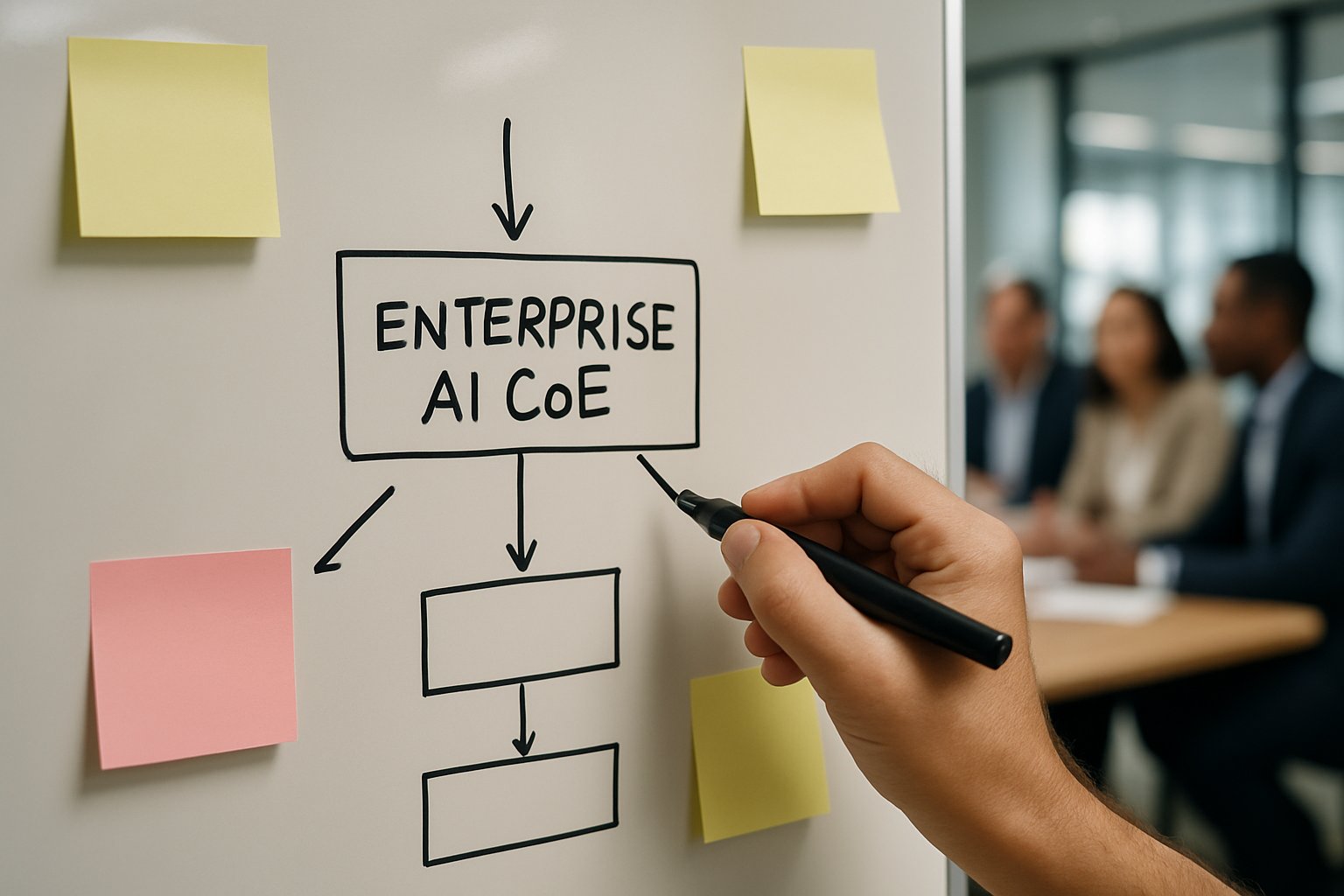
- Pilot purgatory blocks investment approvals.
- Compliance teams lack consistent evidence.
- HR struggles with rapid skill gaps.
- Finance wants clear, auditable ROI.
Furthermore, regulators such as the EU AI Act now demand lifecycle risk controls. Without a CoE, gathering those artifacts later becomes costly and politically painful. High performers instead fund a small, cross-functional nucleus that sets standards and reuses assets. That nucleus aligns executives, product owners, and platform engineers around shared measures such as Successful Session Rate. Consequently, successful teams exit pilot purgatory within ninety days, then scale with confidence. A CoE converts scattered pilots into governed, replicable products. This strategic anchor lays the foundation for disciplined growth. Next, secure the charter that makes that foundation real.
Charter And Sponsorship Basics
Every winning CoE starts with an explicit executive mandate. Moreover, that mandate must spell out scope, budget, and decision rights. Microsoft’s Cloud Adoption Framework stresses a three-layer steering committee covering business, IT, and risk. Include HR early because skills funding often derails progress later. Therefore, write a charter that aligns budget cycles to the AdaptOps phases. Assign an AI leader who reports to the digital transformation sponsor. Furthermore, define measurable objectives for the first year.
- Mission statement with success metrics.
- Initial 3–6 use case backlog.
- Governance authority and escape criteria.
- Funding model: ECIF Quick Start or similar.
Obtain signatures from finance, security, and legal within the kickoff month. Consequently, downstream arguments shrink because ground rules already exist. Strong sponsorship fuels momentum and protects teams when priorities shift. With the charter secured, attention turns to the operating model.
Operating Model Evolution Path
CoEs usually begin as centralized teams delivering hands-on builds for priority use cases. However, remaining a bottleneck kills momentum. Microsoft recommends moving to a hub-and-spoke advisory model after standards mature. Adoptify AI mirrors this shift through reusable playbooks and embedded coaching. In practice, an ai enablement center of excellence supports three engagement tiers.
- Build: The CoE codes, deploys, and trains.
- Coach: The CoE reviews designs and metrics.
- Govern: The CoE audits, certifies, and reports.
Teams graduate from tier one once they hit reliability and security thresholds. Consequently, the CoE’s workload stays manageable while ai adoption accelerates. Record each graduation in a shared registry to track organizational readiness. Operating models must evolve with capability growth. Next, we tackle governance that protects both customers and reputations.
Governance And Risk Controls
Regulators now expect AI lifecycle evidence, not after-the-fact policies. Therefore, bake governance gates into every AdaptOps phase. Adoptify AI automates risk scoring, fairness checks, telemetry collection, and audit trail storage. High-risk workflows trigger human review before release. Moreover, dashboards surface Successful Session Rate, drift alerts, and usage anomalies in near real time. An ai enablement policy pack should align with the EU AI Act and NIST RMF. Include model cards, data lineage, and TEVV artifacts in the pack. Consequently, audits become routine rather than emergencies. Embedded governance removes fear and speeds approvals. With risk contained, organizations can focus on people.
Talent Upskilling At Scale
Skills gaps derail many promising projects. Nevertheless, traditional classroom training rarely reaches frontline users in time. Adoptify AI solves this issue with role-based microlearning and in-app nudges. Furthermore, champion networks amplify reach by coaching peers during live tasks. Design curricula for data analysts, product managers, and HR partners separately. Include quick quizzes that unlock digital badges upon completion. That gamification drives sustained ai adoption through friendly competition. An annual skill inventory informs promotion and hiring plans. Consequently, the organization builds a resilient ai enablement workforce pipeline. Continuous, contextual learning unlocks value from technology investments. Now, leadership must prove that value financially.
Measurement Finance And ROI
CFOs want evidence before scaling any tool. Therefore, instrument every pilot with time-saved, error reduction, and net present value indicators. Adoptify AI’s ECIF Quick Start provides ready spreadsheets and dashboards. For example, a 200-user Copilot pilot reported 18% cycle-time savings within eight weeks. Moreover, Forrester TEI studies show triple-digit ROI when change management is included. Log financial metrics in the same governance repository used for risk artifacts. That linkage lets executives trace benefits back to specific controls. Consequently, the ai enablement center of excellence gains renewed budget each quarter. Evidence drives credibility and unlocks funding. Finally, technical foundations must support this expanding workload.
Tech Foundations And Reuse
Without solid plumbing, AI teams drown in rework. Therefore, start with a minimal MLOps stack that covers experiment tracking, CI/CD, and monitoring. Shared feature stores and prompt libraries prevent duplicate engineering. Adoptify AI distributes pre-approved prompts plus role-based guardrails through its hub marketplace. Moreover, standardized APIs simplify vendor integration and security reviews. Teams should tag every asset with metadata for domain, model type, and owner. That catalog boosts discovery and speeds new ai adoption waves. Consequently, each project reaches production faster and with lower risk. Good foundations slash operational debt. With infrastructure ready, we close with key takeaways and next steps.
Conclusion And CTA
Your ai enablement center of excellence now has a clear, actionable blueprint. Start with sponsorship, mature the model, embed governance, measure ROI, and automate learning. These actions position your organization for sustainable competitive advantage.
Why Adoptify AI? Our AI-powered digital adoption platform delivers interactive in-app guidance and intelligent user analytics. Automated workflow support drives faster onboarding, higher productivity, and measurable compliance. Enterprise-grade security and scalability mean you can innovate without sleepless nights. Visit Adoptify AI to unlock these benefits today. Take the next step and transform experiments into enterprise impact.
Frequently Asked Questions
- What is an AI Enablement Center of Excellence (CoE) and why is it essential?
An AI CoE centralizes isolated pilots with clear governance, measurable objectives, and reusable assets. It transforms experiments into scalable success, enhances productivity, and reduces risk, aligning with streamlined digital adoption. - How do governance and risk controls improve AI project outcomes?
Structured governance, automated risk scoring, and audit trails ensure compliance and consistency. These measures enable quicker approvals and lower risk, optimizing AI workflows while supporting robust digital adoption strategies. - How does talent upskilling impact digital adoption in enterprises?
Role-based microlearning, in-app nudges, and peer coaching accelerate skill development. This continuous upskilling supports smoother digital adoption and ensures teams are prepared to leverage AI tools effectively. - How does Adoptify AI enhance workflow intelligence and digital adoption?
Adoptify AI delivers interactive in-app guidance, intelligent user analytics, and automated support. These features drive faster onboarding, higher productivity, and improved compliance, effectively boosting overall workflow intelligence.
FEATURED
The Complete Guide to Building an AI Adoption Framework for 2026
March 2, 2026
FEATURED
Who Owns the Intellectual Property in Enterprise AI Adoption
March 2, 2026
FEATURED
7 Reasons To Embrace AI-Native Architecture
March 2, 2026
FEATURED
Hybrid AI FAQ: Strategy, Governance, and ROI
March 2, 2026
FEATURED
Agentic AI Integration Playbook for Enterprises
March 2, 2026