AI governance framework: Accelerating Enterprise Adoption
Boards worldwide crave generative AI in every workflow. Regulators, however, demand strict discipline. Bridging that tension defines 2025.
An AI governance framework sets rules that let innovation thrive yet remain accountable. Rapid AI adoption without guardrails can backfire.
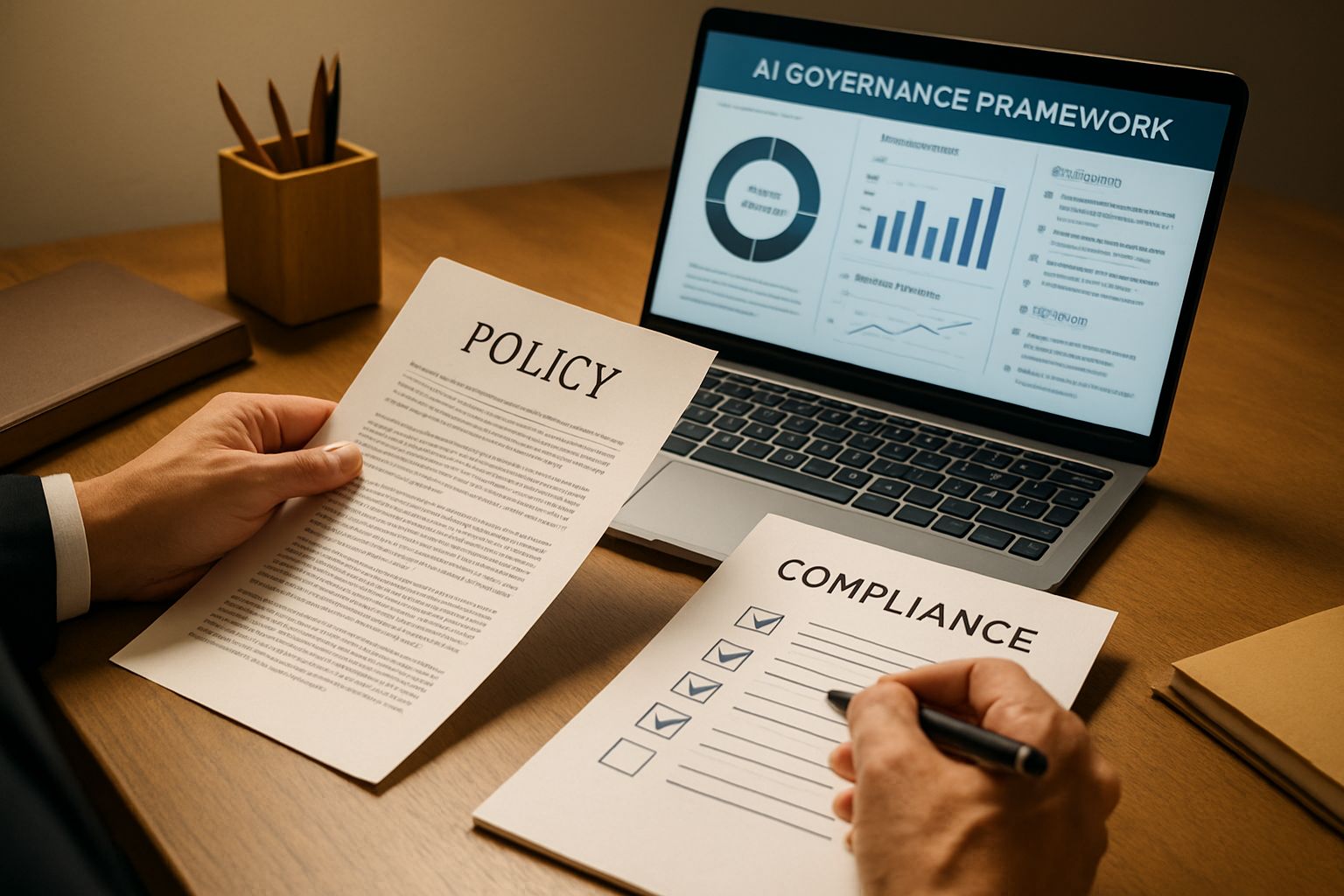
This article gives research-backed steps for HR leaders, SaaS teams, and digital transformation offices to govern without killing speed.
Governance Gap Reality
Enterprise AI adoption rates soared last year, yet scaling success still lags behind forecasts.
Surveys from OpenAI and McKinsey show most firms pilot many models but few reach enterprise scale.
The gap correlates with weak responsible AI governance structures, limited inventories, and slow approval cycles.
Consequently, incidents of shadow usage, data leakage, and stalled funding rise sharply.
Moreover, regulators now expect audit trails, risk classification, and transparent accountability for every model.
Scaling stalls when governance lags. Closing that gap requires measurable controls linked to value. Meanwhile, risk vectors keep multiplying.
Risk Landscape Expands
Agentic AI introduces autonomous actions that can email clients, move money, or push code.
Without scoped privileges, these agents may act beyond intent, creating fresh liability zones.
Therefore, teams require an AI risk assessment framework that maps actions, data sensitivity, and impact severity.
Equally important, AI data governance must enforce lineage, provenance, and DLP checks on every prompt.
- Privacy risk from unredacted personal data.
- Operational risk from incorrect automations.
- Reputational risk from biased outputs.
Risk surfaces now cover data, actions, and decisions. Structured assessment guides proportional controls. AdaptOps operationalizes that structure.
AI Governance Framework Gates
Every successful program defines gates within its AI governance framework before any code meets production.
First, discover and inventory models, scoring them with an AI risk assessment framework for exposure and impact.
Second, pilot in 50–200 user cohorts while sandboxing data using enterprise AI governance policies.
Third, scale only after ROI dashboards confirm at least 15% time saved and no critical incidents.
Finally, embed controls via policy-as-code and automate drift monitoring for AI audit readiness.
Clear stage gates stop surprises. Yet speed remains high because friction appears early. Designing pilots correctly secures that speed.
Pilot Design Essentials
High-velocity pilots operate as measurement engines, not vague experiments.
Adoptify’s playbook asks three questions: Which workflow, which risk tier, and which success metric?
Teams document expectations in an AI accountability framework that assigns owners, approvers, and escalation paths.
Responsible AI governance training briefs the cohort on acceptable prompts and approved data sources.
- Target 50–200 engaged users.
- Collect telemetry on minutes saved.
- Run simulated DLP checks weekly.
- Share findings with finance monthly.
Therefore, pilots create evidence for the broader AI governance framework without bogging teams in paperwork.
Pilots succeed when goals, risk, and accountability align. Structured evidence unlocks funding. Technology still must enforce policies at runtime.
Tooling For Control
Platforms such as Microsoft Purview and IBM watsonx automate lineage, DLP, and policy enforcement.
These tools integrate with the AI governance framework adopted earlier.
Moreover, Adoptify’s in-app nudges embed approved prompt templates that embody responsible AI governance.
Telemetry links model outputs to KPIs, proving value to finance while satisfying AI audit readiness requirements.
Consequently, security teams can express rules as code and push updates in hours, not quarters.
This continuous pipeline reflects enterprise AI governance in action, amplified by real-time dashboards.
Automated controls shrink gate times. Programmatic enforcement scales better than manual reviews. Yet people remain the adoption linchpin.
Human Factors Matter
Change succeeds only when employees trust the system.
Clear, plain-language policies turn worrying mandates into guidance felt as support.
Champion networks showcase quick wins and model safe behavior.
Additionally, micro-learning bursts within apps reinforce responsible AI governance at the moment of need.
Meanwhile, visible ROI dashboards celebrate saved minutes, which accelerates AI adoption and reduces resistance.
Employees interact daily with the AI governance framework through contextual nudges.
Culture amplifies technology. Invest in people for durable gains. Finally, prove readiness to auditors and the board.
Audit Ready Scaling
Regulators expect traceable lineage and documented decision rights.
Therefore, mature teams integrate AI data governance logs with SOC and privacy systems.
They also maintain an AI accountability framework that records model cards, incidents, and mitigation actions.
Regular tests against the AI risk assessment framework surface drift before damage occurs.
Importantly, each release cycle closes with an AI audit readiness review, co-signed by security and finance leaders.
This momentum embodies enterprise AI governance maturity.
Board confidence soars because the AI governance framework now demonstrates repeatable control.
Governance becomes evidence, not bureaucracy. This outcome completes the loop. Thus, the program is ready to scale profitably.
Conclusion
Modern enterprises win when risk controls accelerate, not restrict. A mature AI governance framework connects pilots, tooling, people, and dashboards into one controllable loop.
Why Adoptify AI? The platform delivers AI-powered digital adoption, interactive in-app guidance, intelligent user analytics, and automated workflow support. Consequently, teams onboard faster, raise productivity, and scale securely across the enterprise.
Experience streamlined deployment and unmatched insight. Visit Adoptify Ai to transform governance into growth.
Frequently Asked Questions
- What is an AI governance framework and why is it important?
An AI governance framework is a structured set of controls that balances rapid AI innovation with risk management, ensuring safe digital adoption, regulatory compliance, and secure scaling of enterprise workflows. - How does Adoptify AI support digital adoption and workflow intelligence?
Adoptify AI provides in-app guidance, intelligent user analytics, and automated workflow support. These features streamline onboarding, enhance productivity, and deliver real-time insights to secure and accelerate digital adoption. - Why are structured pilots essential in AI risk management?
Structured pilots validate AI models through controlled user cohorts, ensuring risk assessments and proper governance. They identify potential issues early while providing measurable outcomes that support secure and efficient digital adoption. - How can enterprises achieve AI audit readiness?
Enterprises achieve AI audit readiness by integrating comprehensive data governance, automated controls, and real-time dashboards. This approach ensures audit trails, meets regulatory demands, and supports scalable and secure digital adoption.

FEATURED
How to Identify and Overcome Cultural AI Adoption Barriers
March 3, 2026
FEATURED
What Are the Most Common AI Adoption Challenges for Businesses
March 3, 2026
FEATURED
The Complete Guide to Building an AI Adoption Framework for 2026
March 2, 2026
FEATURED
Who Owns the Intellectual Property in Enterprise AI Adoption
March 2, 2026
FEATURED
7 Reasons To Embrace AI-Native Architecture
March 2, 2026