AI Implementation Demo: Proving Value in 90 Days
Enterprises feel the heat to operationalize generative AI, yet most remain stuck in pilot limbo. However, stakeholders want proof that investments will deliver measurable, near-term business value. The pressure intensifies across HR, IT, and L&D as workforce expectations climb. Consequently, leaders search for an ai implementation roadmap that balances speed with control. Moreover, recent McKinsey data shows 88% of firms test AI, while only one-third scale it. Meanwhile, executives fear the widening performance gap between pioneers and laggards. Adoptify AI’s AdaptOps operating model directly tackles this gap by aligning people, process, and platforms. Furthermore, the framework promises quantified ROI inside 90 days. That promise drives many digital leaders to book ai adoption demo sessions immediately. This article explains how the live demo reveals the proven path from pilot to enterprise impact. You will gain insights, best practices, and concrete metrics to justify next-step action. Finally, you will learn why AdaptOps delivers repeatable success across industries.
Market Urgency Moves Fast
Global surveys confirm AI experimentation reached mainstream status during the past year. However, broad experimentation rarely converts into scaled financial impact. McKinsey reports only one-third of organizations extend pilots beyond isolated teams. Meanwhile, executives increase budgets despite elusive EBIT gains, fueling the so-called ROI paradox.
Deloitte echoes that sentiment, citing governance and measurement shortfalls as root causes. Consequently, CFOs now demand airtight business cases before approving fresh licenses. Enterprise buyers refuse slideware; they insist on seeing AdaptOps dashboards during live sessions. Moreover, Microsoft’s Copilot funding accelerates interest because it lowers initial cost barriers.
Yet program owners still ask, “Will this ai implementation survive compliance reviews?” Adoptify AI answers by showcasing policy guardrails and tenant security assessments in every demo. In contrast, many vendors show ungoverned prototypes that scare risk officers. That contrast widens the trust gap and propels prospects toward AdaptOps. Section takeaway: Market urgency is real; proof and governance decide winners. Next, we explore the core barriers blocking scale.
Barriers Still Block Scaling
Organizations stumble when pilots lack measurable baselines. Moreover, scattered teams adopt tools differently, muddying productivity metrics. ISG notes only 31% of prioritized use cases reach production. Consequently, sponsors struggle to argue for budget at scale.
Governance shortfalls create another choke point. However, policy frameworks often appear after incidents, not before. Security leaders then freeze expansion until controls mature. Meanwhile, workforce change management receives minimal attention, fueling resistance.
Therefore, role-based enablement and certifications become critical success levers. AdaptOps counters each barrier with an ai adoption playbook and audited evidence. Specifically, the ai implementation framework embeds baseline surveys, ROI dashboards, and guardrail templates starting day one. Section takeaway: Measurement, governance, and adoption gaps explain stalled programs. Up next, we reveal how AdaptOps resolves them.
Framework Rapidly Drives ROI
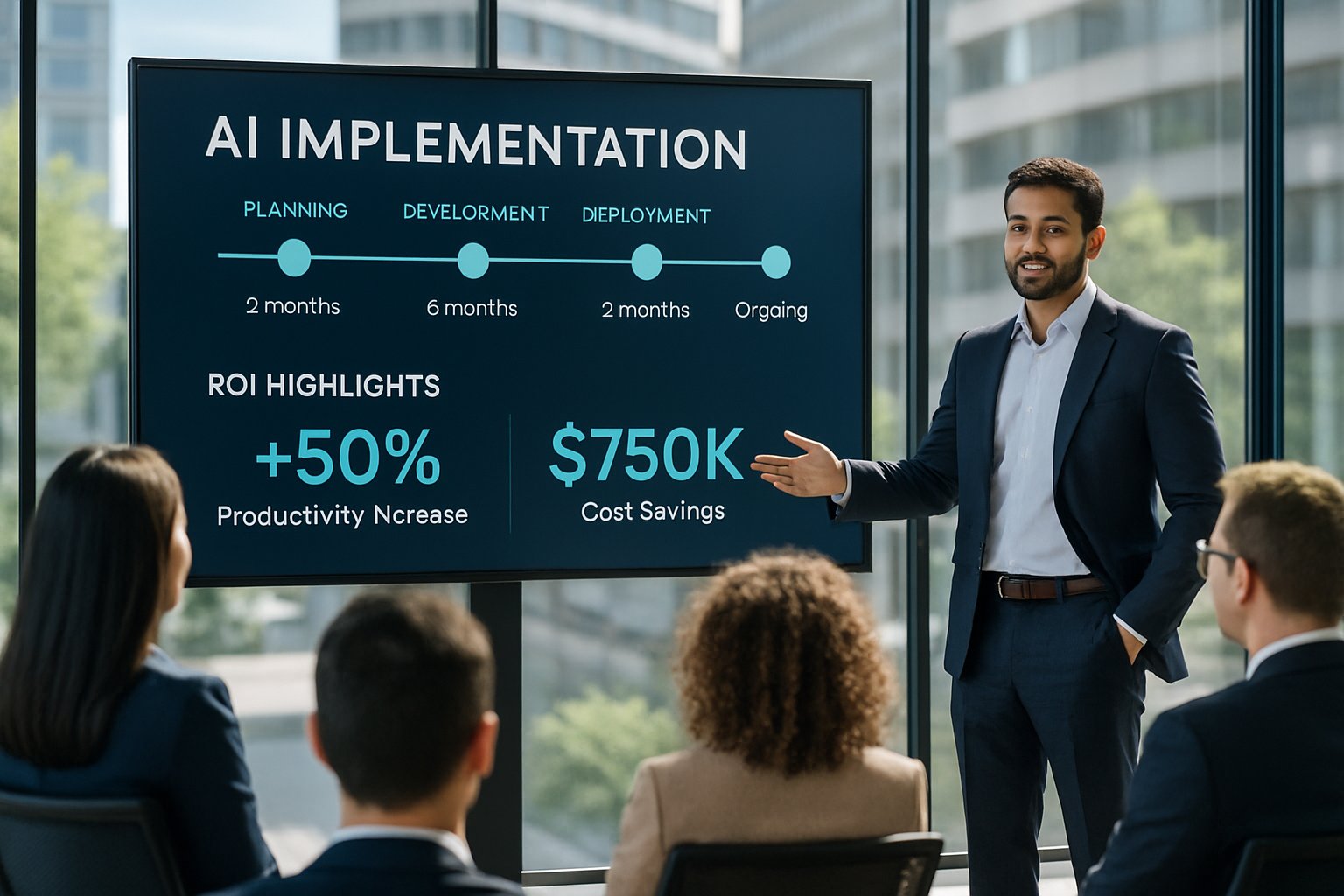
AdaptOps follows a phased, outcome-first journey. Initially, teams run a two-week readiness assessment that scores data, culture, and licensing gaps. The assessment populates a prioritized use-case backlog. Subsequently, a 6-8 week pilot validates value for 50-200 users.
Baseline time-in-tool metrics feed a live ROI dashboard visible to executives. Moreover, governance templates activate guardrails before any agent or copilot goes live. Executive coaching sessions track adoption commitments weekly. Afterward, successful pilots graduate into enterprise transformation sprints that integrate CRM, ERP, and SharePoint systems.
- Readiness Assessment – two weeks
- Pilot Acceleration – six weeks
- Enterprise Transformation – twelve weeks
- Continuous Optimization – quarterly loops
Each sprint updates the same dashboard, preserving metric continuity. Consequently, sponsors defend budget requests with concrete productivity gains, not conjecture. This ai implementation lifecycle repeats quarterly, feeding a continuous improvement loop. Section takeaway: AdaptOps links readiness, pilot proof, scale, and governance in one measurable cycle. Next, we highlight the demo artifacts that bring this cycle to life.
Demo Assets Showcase Impact
Seeing AdaptOps in action converts curiosity into conviction. During the live session, consultants display five high-impact artifacts. First, the Readiness Scorecard quantifies data hygiene, license status, and cultural alignment. Second, the Use-Case Backlog ranks automation candidates by ROI and technical risk.
Third, the Pilot Plan outlines weekly objectives and stakeholder checkpoints. Fourth, the real-time ROI Dashboard shows modeled and actual savings, such as 60 minutes daily. The ai implementation demo also visualizes compliance workflows in real time. Fifth, Governance Playbooks map policies to technical controls and escalation flows.
Moreover, sample champions-program collateral reveals how change agents accelerate workforce engagement. Attendees can manipulate inputs inside the ROI calculator to test scenarios relevant to their budgets. Consequently, finance leaders exit the demo with personalized payback projections. Prospects repeatedly state that this depth is why they book ai adoption demo follow-ups on the spot. Section takeaway: Tangible assets make the value story unmistakable. Our next section presents proven performance evidence.
Proven Success Metrics Matter
Numbers influence executive decisions more than slogans. For example, Adoptify AI’s sample Copilot assessment shows 5.1 hours saved per user each month. That translates into a modeled 177%–1,170% ROI range, depending on licensing assumptions. Moreover, published pilots report 20% operational cost reduction within 90 days.
Healthcare cohorts reduced administrative workload by 40%, freeing staff for patient engagement. Consequently, boards gain evidence that strategic investment beats ad-hoc tinkering. McKinsey further validates the strategy, noting top performers integrate AI into core workflows, not side projects. In contrast, laggards average lower EBIT growth and widening efficiency gaps.
Decision makers therefore align quickly once the ai implementation metrics appear on screen. Section takeaway: Hard numbers accelerate consensus and unlock budget. Finally, we outline next steps for ready organizations.
Next Steps Move Forward
Preparation magnifies the impact of any engagement. Therefore, gather baseline productivity data and define at least three high-value processes before your session. Bring security, finance, and HR leads so questions receive immediate answers. Moreover, confirm eligibility for Microsoft ECIF funding to offset pilot costs.
Doing so often secures executive commitment early. Subsequently, book ai adoption demo time through the Adoptify AI calendar. The team tailors content to your industry, size, and integration landscape. Consequently, you exit the call with a draft 90-day execution plan.
This ai implementation roadmap leaves no ambiguity around ownership. That plan includes dates, responsibilities, and projected savings tied to each sprint. Our clients appreciate the clarity and act quickly. Section takeaway: Preparation plus a focused demo accelerates decision speed. We conclude with a concise value recap.
Conclusion And CTA
Structured execution, quantified evidence, and disciplined governance turn experimentation into profit. Therefore, the AdaptOps model offers the most reliable ai implementation blueprint on the market. You saw how readiness assessments, pilots, and dashboards connect into a self-reinforcing improvement loop. Leaders who embrace this approach secure faster wins and sustained competitiveness.
Meanwhile, Adoptify AI amplifies results through its AI-powered digital adoption platform. Interactive in-app guidance, intelligent user analytics, and automated workflow support speed onboarding and boost productivity. Moreover, enterprise scalability and security ensure seamless rollout across thousands of users. Ready to elevate ai adoption across your stack? Visit Adoptify AI now, book ai adoption demo, and ignite measurable transformation.
Frequently Asked Questions
- What is AdaptOps and how does it drive ROI in AI adoption?
AdaptOps aligns people, process, and platforms to expedite AI adoption. It delivers rapid ROI through readiness assessments, pilot accelerations, and live ROI dashboards supported by in-app guidance and intelligent user analytics. - How do AI adoption demos accelerate enterprise transformation?
AI adoption demos showcase tangible assets like live ROI dashboards, use-case backlogs, and compliance workflows. They offer personalized payback projections and expert coaching, enabling faster, measurable scale with integrated automated support. - How does digital adoption improve workflow intelligence?
Digital adoption leverages interactive in-app guidance and intelligent user analytics to streamline workflows. It simplifies AI integration, driving workflow intelligence that ensures rapid adoption and significant productivity gains. - How does Adoptify AI ensure secure and governed AI implementation?
Adoptify AI integrates policy guardrails, tenant security assessments, and governance playbooks to ensure a secure AI implementation. This structured approach delivers automated support and compliance for risk-managed, scalable digital adoption.
FEATURED
The Complete Guide to Building an AI Adoption Framework for 2026
March 2, 2026
FEATURED
Who Owns the Intellectual Property in Enterprise AI Adoption
March 2, 2026
FEATURED
7 Reasons To Embrace AI-Native Architecture
March 2, 2026
FEATURED
Hybrid AI FAQ: Strategy, Governance, and ROI
March 2, 2026
FEATURED
Agentic AI Integration Playbook for Enterprises
March 2, 2026