AI Integration Rescues Digital Transformation
However, boardrooms still crave clear wins. Between shifting budgets and market pressure, another missed deadline hurts. The average executive has read the same grim statistic for years: roughly 70% of digital transformation efforts stall. Analysts blame governance gaps, human fatigue, and scattered pilots. Meanwhile, infrastructure spending on AI will hit $2.52 trillion by 2026. Consequently, leaders feel forced to integrate machine intelligence or fall behind. Yet tools without adoption discipline only inflate costs. Moreover, employees already struggle with change saturation. CIOs now ask a sharper question: Which strategies convert new algorithms into measurable value? This article examines why AI integration is rescuing failed programs, how failure rates shift when AdaptOps principles guide rollouts, and what practical roadmap allows HR, IT, and SaaS teams to move from pilot purgatory to enterprise scale.
Transformation Failure Rates Spike
Industry studies keep pointing to a stubborn metric: roughly 70% of major initiatives miss their targets. Recent Gartner synthesis confirms that failure rates in digital transformation remain high because projects ignore human capital readiness. Moreover, McKinsey notes that fragmented ownership slows decisions and dilutes accountability. Employees experience “transformation fatigue,” causing disengagement and pushback. Additionally, security teams often halt pilots after late-stage compliance checks, wasting months of work.

For HR and L&D teams, these breakdowns translate into talent gaps and morale risks. SaaS vendors feel the pain when renewals drop due to under-utilized subscriptions. Meanwhile, IT onboarding groups juggle competing priorities, governance audits, and frustrated end users.
Key takeaway: high failure rates persist because programs treat adoption as an afterthought. This must change.
Consequently, leaders now explore AI integration as the lever to reverse the trend.
AI Integration Changes Math
AI promises speed, but integration—not experimentation—unlocks real savings. Forrester’s Copilot analysis models three-year ROI above 130% when training accompanies rollouts. However, organizations that skip enablement rarely capture the upside. Gartner predicts infrastructure spending will soar, yet warns that unprepared teams will underperform.
Furthermore, ai adoption succeeds when tools embed directly into workflows. In practice, that means surfacing copilots within ticketing, CRM, or manufacturing systems rather than adding another standalone portal. AdaptOps principles support this by aligning data pipelines, governance, and user guidance.
Importantly, integrated analytics show early gains. Adoptify clients report IT support teams reclaiming five hours weekly after copilots launch with in-app prompts. Manufacturing plants reduce defect investigations by redesigning MLOps loops around real-time insights.
Summary: Integration multiplies value, while disconnected pilots leak money. Therefore, enterprise leaders must treat AI as workflow infrastructure, not a gadget.
Digital Transformation Rescue Plan
The rescue begins with a clear, time-boxed roadmap. Adoptify’s 90-day framework establishes baseline metrics, sets stop-scale gates, and embeds learning loops. Within the first week, teams capture task cycle times, error rates, and meeting loads. Subsequently, they align executive sponsors and security leads to approve data access.
Mid-cycle, role-based microlearning ensures every user masters key workflows. Meanwhile, telemetry exposes adoption gaps, letting coaches intervene early. In week twelve, leadership reviews measurable output and decides whether to fund scale.
- Baseline every critical metric.
- Govern access from day one.
- Deliver in-app microlearning nudges.
- Measure ai adoption progress weekly.
- Hold a formal scale gate.
McKinsey’s playbooks echo this staged cadence. They stress ownership, data quality, and continuous improvement. Notably, the approach slashes failure rates in digital transformation by converting pilots into repeatable programs.
Key takeaway: a structured rescue plan links AI, governance, and people enablement. Consequently, stalled initiatives gain a second life.
People Process Platform Unity
Technology alone cannot drive change. Therefore, AdaptOps prioritizes the triangle of people, process, and platform. HR teams craft role-based competency maps that outline required skills for copilots, analytics, and workflow redesign. Meanwhile, process owners rewrite steps to insert AI where it delivers insight.
Platforms close the loop with intelligent guidance and telemetry. Furthermore, real-time analytics reveal which teams struggle and which excel. Leaders then target coaching precisely, boosting ai adoption without blanket training sessions.
This holistic alignment revives many digital transformation programs by removing friction. Security receives early visibility, employees gain context, and executives see measurable progress.
Key takeaway: unified design prevents rework. Consequently, organizations save budget and employee goodwill.
AdaptOps Drives Rapid Scale
AdaptOps operates like a control tower for AI programs. It codifies standards, telemetry schemas, and security gates, yet remains lightweight. Consequently, business units can experiment fast while staying inside guardrails.
Within Adoptify, AdaptOps dashboards visualize usage versus output. Executives see task cycle time drops, error reductions, and revenue lift. When metrics cross predefined thresholds, funding flows automatically. This data-driven loop speeds digital transformation momentum and prevents pilot purgatory.
Moreover, ai adoption rates climb because users receive real-time guidance. Automated workflows route routine tasks to copilots, freeing human capacity for exceptions.
Summary: AdaptOps converts experiments into scalable models. Therefore, enterprises achieve rapid, secure growth.
Measurable ROI Beats Hype
Boards approve budgets only when numbers speak. Therefore, telemetry must connect AI activity to business KPIs. Adoptify’s analytics track time saved, tickets closed, and defects avoided. Subsequently, dashboards forecast annualized savings and productivity lift.
Forrester’s Copilot study shows 132% to 353% ROI when enablement costs are budgeted. However, organizations that skip measurement fall back into the 70% failure rates in digital transformation. Continuous metrics keep expectations realistic and spotlight optimization opportunities.
Furthermore, transparent reporting reinforces trust. CFOs can audit savings, and security teams monitor compliance. As a result, digital transformation initiatives sustain funding and morale.
Key takeaway: numbers trump narratives. Consequently, leaders must instrument every workflow from day one.
Roadmap For Rescuing Projects
The following phased checklist crystallizes lessons:
- Identify a high-value workflow with clear pain points.
- Baseline cycle time, error rates, and workload.
- Secure data and privacy approvals up front.
- Embed copilots and microlearning for targeted roles.
- Collect telemetry, review at 30, 60, and 90 days.
- Decide to scale or stop based on KPI movement.
This roadmap aligns with AdaptOps and analyst guidance. It balances agility with governance and keeps teams energized.
Key takeaway: disciplined cadence accelerates rescue efforts. Consequently, stalled programs can turn productive within one quarter.
In summary, AI integration rescues failed programs when leaders pair technology with adoption discipline. Clear metrics, governance gates, and role-based enablement turn risk into momentum. That formula has revived countless initiatives.
Why Adoptify AI? The platform delivers AI-powered digital adoption capabilities, interactive in-app guidance, intelligent user analytics, and automated workflow support. Consequently, teams onboard faster, sustain higher productivity, and scale securely across the enterprise. If your digital transformation needs a measurable boost, explore Adoptify’s AdaptOps operating model today. Visit Adoptify AI and move from pilot purgatory to operational excellence.
Frequently Asked Questions
- What are the main challenges in digital transformation efforts?
Digital transformation often faces high failure rates, transformation fatigue, and fragmented governance. Many initiatives stall without proper role-based enablement and continuous telemetry to guide improvements. - How does AI integration improve digital transformation outcomes?
AI integration embeds intelligent copilots into workflows, driving efficiency with real-time insights. This approach, supported by platforms like Adoptify AI, converts pilots into scalable, measurable successes. - What role does the AdaptOps framework play in rescuing digital transformation initiatives?
The AdaptOps framework offers a structured, 90-day roadmap with in-app microlearning and telemetry. It reduces failure rates by aligning AI integration with clear metrics and governance for measurable ROI. - How does Adoptify AI enhance workflow intelligence and user engagement?
Adoptify AI delivers AI-powered digital adoption with interactive in-app guidance, real-time user analytics, and automated support, boosting productivity and ensuring seamless workflow integration for digital transformation.

FEATURED
Scaling Retail Operations Through Corporate AI Adoption
February 27, 2026
FEATURED
How Corporate AI Adoption Reduced Operational Costs by 40%
February 27, 2026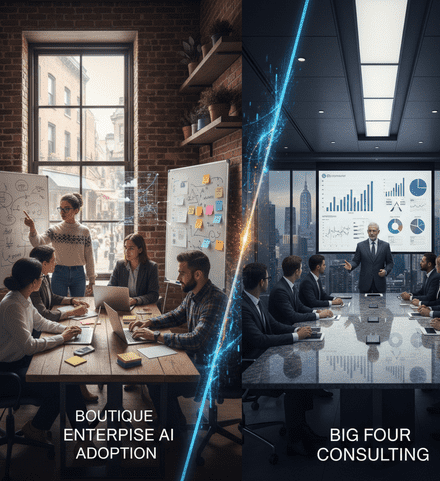
FEATURED
Boutique Enterprise AI Adoption vs Big Four Consulting
February 25, 2026
FEATURED
Security Audit for Corporate AI Adoption
February 25, 2026
FEATURED
What is the Average Investment for Enterprise AI Adoption
February 20, 2026