Automated AI Data Pipeline: Foundation for Scalable Enterprise AI
Enterprises chase tangible AI returns, yet most projects stall after pilot.
A resilient ai data pipeline often marks the difference between hype and scalable value.
This article explains why.
We draw on recent observability trends, feature store patterns, and governance frameworks.
Additionally, we map each insight to AdaptOps capabilities from Adoptify.ai.
Successful ai adoption demands more than model tuning.
Readers will leave with actionable steps that shorten pilot-to-production cycles.
Before diving deep, consider one sobering fact.
BCG reports 74% of firms struggle to scale AI.
Consequently, data pipelines, not models, emerge as the real bottleneck.
The following sections show how to remove that bottleneck fast.
Let’s explore the critical pipeline pillars.
First, we identify common failure modes.
Why AI Data Pipeline Fails
Manual scripts still glue many production workflows.
However, manual glue breeds fragile dependencies and silent drifts.
Engineers spend days hunting schema changes instead of improving models.
Poor visibility magnifies the pain.
When ingestion breaks, downstream dashboards mislead leaders for weeks.
Meanwhile, support tickets spike and trust erodes.
Economic studies estimate trillions lost to bad data yearly.
Moreover, every hour of outage inflates cloud costs and staff overtime.
Pipeline debt quickly becomes business risk.
In short, brittle pipelines block AI scale and destroy confidence.
Next, we see how observability repairs that trust.
Observability Powers Reliable AI
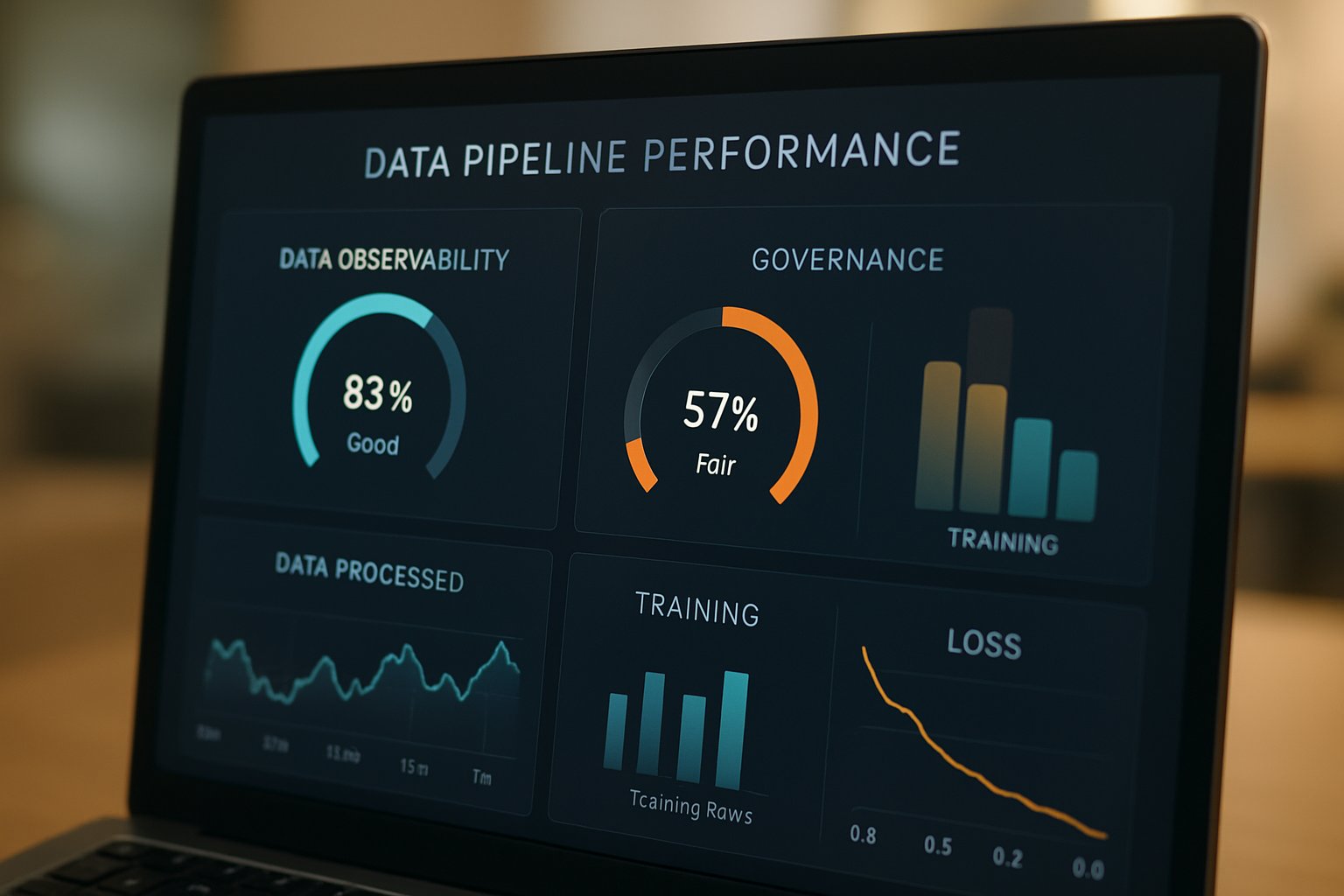
Data observability unifies monitoring across ingestion, transformation, and model outputs.
Therefore, teams gain real-time lineage and freshness snapshots.
Monte Carlo and cloud vendors now bundle agent observability for GenAI workloads.
Modern platforms now automate ai data pipelines with serverless orchestration and agentic builders.
Unified tracing lets stakeholders pinpoint which upstream table poisoned a chatbot answer.
Consequently, mean time to resolution drops from days to minutes.
Without an ai data pipeline wired for observability, blind spots multiply.
Adoptify.ai extends this view with ROI dashboards tied to AdaptOps exit gates.
Leaders see both technical health and dollar impact in one place.
Observability turns reactive firefighting into proactive assurance.
Next, we examine how feature stores reinforce that assurance.
Feature Stores Prevent Drift
Training-serving skew kills model accuracy faster than data drift alone.
Feature stores present a governed contract between pipelines and models.
They version features and automate point-in-time correctness.
Additionally, backfills run automatically when raw data changes.
This design defuses late surprises during audits.
Tecton and Databricks both highlight feature stores as core infrastructure.
Similarly, AdaptOps documents lineage so users apply features responsibly.
Feature stores sit inside the ai data pipeline and constantly validate point-in-time accuracy.
By aligning features, companies cut drift and cut support tickets.
Governance now becomes the next frontier.
Governance Built Into Flow
Regulated industries demand policy gates at every stage.
Masking, DLP checks, and access controls must trigger automatically.
Programmatic governance stops non-compliant datasets before training begins.
Therefore, security teams sleep easier while data scientists maintain speed.
Policies must automate ai data pipelines instead of relying on manual checklists.
Auditors now expect every ai data pipeline to document lineage automatically.
AdaptOps embeds these gates and requires ROI thresholds before scale.
Moreover, telemetry proves compliance during board reviews.
Automated governance balances agility with safety.
We still need people to drive cultural change.
People Enable Lasting Scale
Technology fixes nothing without engaged operators and learners.
BCG’s 74% figure traces largely to human process gaps.
Operators must understand how the ai data pipeline reacts during incidents.
Role-based microlearning and in-app guidance close those gaps quickly.
Furthermore, they reduce mistakes during on-call rotations.
Adoptify.ai delivers contextual lessons alongside live workflows.
Consequently, onboarding times shrink and morale rises.
Culture change fuels sustained ai adoption across functions.
Skilled teams convert automated pipelines into sustainable advantage.
Finally, let’s review concrete implementation moves.
Implement Proven Pipeline Practices
Successful teams treat pipelines as products with defined SLAs.
Therefore, each SLA ties back to business KPIs.
Track Quick Success Metrics
Dashboards should surface cost saved, incidents prevented, and cycle time improved.
Additionally, share those numbers during quarterly business reviews.
- Automate schema and data contracts in CI/CD.
- Embed freshness, drift, and quality monitors from day one.
- Link telemetry to ROI gates before scaling pilots.
- Deliver role-based microlearning for every operator persona.
- Continuously improve with post-incident reviews and backlog grooming.
Adoptify.ai’s AdaptOps framework accelerates every step above.
It also helps enterprises automate ai data pipelines without extra headcount.
The result is an ai data pipeline that self-documents and self-heals.
Implementing these practices hardens reliability and quantifies value.
Now, we measure success fast.
Automated observability, feature stores, governance, and microlearning together unlock dependable AI scale.
By aligning technology, metrics, and people, enterprises finally bridge pilot-to-production gaps.
A disciplined ai data pipeline underpins every success story shared above.
Why Adoptify AI?
Adoptify AI’s AI-powered digital adoption suite weaves interactive in-app guidance and intelligent user analytics.
Furthermore, automated workflow support accelerates onboarding and boosts productivity.
Meanwhile, intelligent user analytics surface friction points before users file tickets.
Therefore, teams iterate quickly and deliver delightful experiences.
Enterprise-grade security and scalability remain baked into every AdaptOps deployment.
Interactive guidance also shortens onboarding for new SaaS modules and workflows.
Consequently, productivity rises across HR, IT, and line-of-business teams.
Adoptify AI accelerates responsible ai adoption for global teams.
Start your journey at Adoptify.ai today.
Frequently Asked Questions
- How can enterprises scale AI with resilient data pipelines?
Enterprises can scale AI by building robust, automated data pipelines that leverage real-time observability, reliable feature stores, and embedded governance. This minimizes manual errors and accelerates the transition from pilot to production. - How does observability contribute to reliable AI pipelines?
Observability provides a unified view of data ingestion, transformation, and model outputs. With automated alerts and ROI dashboards, teams can quickly diagnose issues, reduce downtime, and cut support tickets. - How do feature stores and automated governance support AI accuracy?
Feature stores create governed data contracts that prevent drift, while automated governance enforces compliance across pipelines. Together, they preserve model accuracy, reduce risks, and accelerate scalable AI adoption. - How does Adoptify AI improve digital adoption and workflow efficiency?
Adoptify AI integrates in-app guidance, intelligent user analytics, and automated support to boost digital adoption. This platform simplifies onboarding, quickly identifies friction points, and streamlines operations across various teams.
FEATURED
The Complete Guide to Building an AI Adoption Framework for 2026
March 2, 2026
FEATURED
Who Owns the Intellectual Property in Enterprise AI Adoption
March 2, 2026
FEATURED
7 Reasons To Embrace AI-Native Architecture
March 2, 2026
FEATURED
Hybrid AI FAQ: Strategy, Governance, and ROI
March 2, 2026
FEATURED
Agentic AI Integration Playbook for Enterprises
March 2, 2026