Building a Cross-Functional Adoption Strategy
Executives want AI results yesterday. However, many AI adoption projects stall before value reaches end users.
The solution starts with a precise adoption strategy that unites every function behind shared outcomes.
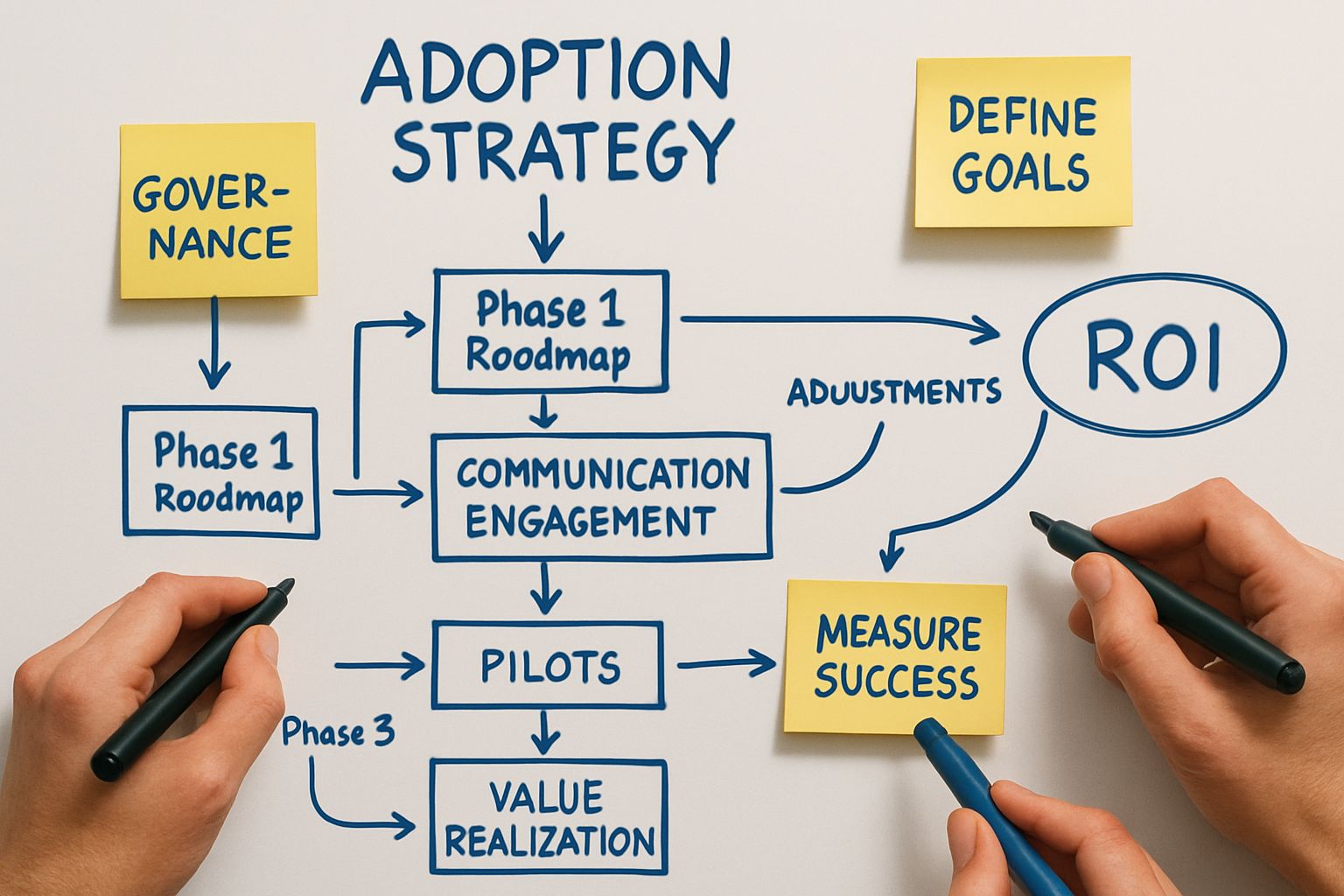
Consequently, enterprises that embed cross-functional design from day one scale faster and reduce pilot failure.
McKinsey data shows top performers pair data science, operations, and compliance in integrated pods.
Meanwhile, 60% of firms still lack clear measurement frameworks, leaving pilots stranded in executive limbo.
This article offers a practical roadmap for HR, IT, and product leaders facing that challenge.
Along the way, we anchor recommendations in Adoptify.ai’s AdaptOps model and the latest NIST governance guidance.
Read on to learn which roles matter and how to measure ROI in 90 days.
Finally, discover why continuous upskilling seals long-term gains for every team.
Team-Led Adoption Strategy
Great ideas die when nobody owns delivery. Therefore, a team-led lens keeps plans concrete and accountable.
The structure starts with a charter that links business cases to technical feasibility. Consequently, scope creep reduces because the team negotiates trade-offs early.
Mature organizations also embed finance partners who validate benefit models before coding begins. Subsequently, budget approvals flow faster, and executive confidence increases.
Finally, cross-functional rituals—standups, demos, retros—maintain rhythm and expose blockers quickly. Each ritual must highlight user feedback, risk findings, and next-step actions.
In summary, a clear charter, shared rituals, and early finance review unlock disciplined delivery. The next section shows how AdaptOps operationalizes those disciplines at scale.
Adoptify AdaptOps Blueprint
Adoptify.ai designed the AdaptOps operating model to move AI from pilot to production reliably. Furthermore, the model maps five stages: Discover, Prove, Scale, Embed, and Govern.
Each stage packages templates, role guides, and time-boxed sprints. Consequently, teams stop reinventing checklists and start executing a repeatable adoption strategy.
Quick Start audits finish in four weeks and deliver governance artifacts and prioritized use-case maps. Meanwhile, AdaptOps dashboards link minutes saved per role to finance KPIs, securing sponsorship.
Role-based certifications and champion networks reinforce behavior change beyond the initial pilot cohort. Moreover, AdaptOps offers managed services that run adoption sprints when internal capacity is limited.
AdaptOps supplies a proven scaffold, reducing friction and time to value. Next, we examine why cross teams amplify those benefits.
Why Cross Teams Matter
Research from Gartner reveals 70% of CDAOs own AI operating models. However, without cross teams, that ownership rarely converts into scaled outcomes.
Cross-functional pods blend data talent with business SMEs and compliance watchdogs. Consequently, design decisions reflect reality, and audit questions meet answers on day one.
McKinsey reports that integrative pods accelerate time-to-value by multiples over siloed squads. That lift grows when the pod follows the adoption strategy endorsed by finance.
Adoptify customers mirror this trend; minutes-saved data often doubles once pods mature. Subsequently, executives unlock budget for wider ai adoption waves.
Simply put, cross teams translate technical novelty into operational gain. With roles clear, governance becomes enforceable, as the next section outlines.
Core Team Roles Explained
A high-performing pod assigns clear responsibilities. Therefore, confusion vanishes when incidents strike.
- Executive sponsor: secures funding and removes blockers.
- Product owner: defines outcomes and backlog priority.
- Data engineer: ensures pipelines, quality, and controls.
- ML engineer: owns deployment, monitoring, and drift response.
- Security lead: embeds least-privilege access and logging.
- Compliance counsel: maps regulations and risk mitigations.
- L&D specialist: drives training and certification.
- Finance analyst: maintains ROI dashboards and forecasts.
- Frontline champion: gathers feedback and boosts usage.
Additionally, many firms appoint a change lead who choreographs communications and stakeholder cadence. That role becomes vital during large cross-functional ai adoption strategy expansions.
When each seat owns explicit outputs, the whole engine runs smoothly. Now, let us see how governance frameworks cement those outputs.
Governance With NIST Guide
Governance turns enthusiasm into sustained trust. Moreover, NIST’s AI RMF offers a pragmatic map: Govern, Map, Measure, Manage.
Teams should assign each function to a named role, preventing gaps during audits. Consequently, the cross-functional ai adoption strategy receives regulatory clearance sooner.
AdaptOps templates align with the RMF and provide decision logs, risk gates, and SLA checklists. Therefore, every adoption strategy stage closes with evidence rather than promises.
Legal and security leads also embed red-teaming and privacy impact reviews into CI/CD pipelines. Subsequently, production releases move fast without sacrificing control.
In brief, mapped controls free the team to innovate while staying compliant. Next, we explore pilots and ROI measurement.
Pilot Fast, Measure ROI
Ideas gain credibility only after measurable wins. Hence, AdaptOps prescribes 90-day prove-value pilots supported by telemetry.
Baseline minutes per task, cycle time, and error rates before coding begins. Afterwards, dashboards show real savings that finance trusts.
Organizations following this cadence move from pilot to scaled ai adoption twice as fast. Crucially, the data feeds back into the adoption strategy business case.
Executives then approve new pods with confidence built on hard evidence. Consequently, momentum compounds rather than stalling.
Short pilots with tight metrics convert skeptics and unlock funding. Upskilling keeps that momentum alive, as we discuss next.
Upskilling For Lasting Change
Technology shifts alter roles faster than job descriptions. Therefore, continuous learning becomes the heart of durable change.
BCG warns that AI is outpacing workforce plans, yet L&D budgets lag. Adoptify solves this gap with role-based courses, assessments, and champion networks.
Learners complete micro-modules inside workflows, reinforcing habits with immediate practice. Consequently, each cross-functional ai adoption strategy maintains fresh skills as tools evolve.
Organizations that invest here report higher retention and faster feature adoption. Equally important, new hires ramp quickly because curricula match real scenarios.
This reinforcement loop safeguards the adoption strategy against knowledge drift.
In summary, training debt destroys scale, while structured programs future-proof talent. Finally, let us review the key points.
Conclusion
A disciplined adoption strategy powered by cross teams, governance, measurement, and learning turns AI ambition into profit. Follow NIST guidance, run 90-day pilots, and track minutes saved to secure ongoing funding.
Consequently, ai adoption accelerates across functions without sacrificing safety. When leaders maintain a cross-functional ai adoption strategy, they break silo walls for good.
Why Adoptify AI? The platform blends interactive in-app guidance, intelligent user analytics, and automated workflow support. Consequently, teams achieve faster onboarding, higher productivity, and enterprise-grade scalability and security. Visit https://www.adoptify.ai/ to amplify your next AI rollout.
Frequently Asked Questions
- What is the Adoptify AdaptOps model?
AdaptOps is Adoptify.ai’s structured model that guides AI adoption from pilot to production using time-boxed sprints, role guides, and interactive in-app guidance. - How do cross-functional teams accelerate digital adoption?
Cross-functional teams blend technical, business, and compliance skills to ensure rapid, compliant AI rollouts, reducing pilot failures and enabling measurable workflow intelligence. - How does Adaptify AI support effective ROI measurement?
Adaptify AI provides intelligent user analytics and dashboards that track key metrics like minutes saved, empowering 90-day pilots and clear financial validations. - Why is continuous upskilling essential for digital adoption?
Continual upskilling through role-based courses and micro-modules ensures teams stay current, maintain productivity, and drive sustainable digital and AI adoption.

FEATURED
Scaling Retail Operations Through Corporate AI Adoption
February 27, 2026
FEATURED
How Corporate AI Adoption Reduced Operational Costs by 40%
February 27, 2026
FEATURED
Boutique Enterprise AI Adoption vs Big Four Consulting
February 25, 2026
FEATURED
Security Audit for Corporate AI Adoption
February 25, 2026
FEATURED
What is the Average Investment for Enterprise AI Adoption
February 20, 2026