Copilot for Finance: Blueprint for Governing AI Success
Finance leaders feel mounting pressure to close books faster while safeguarding compliance. Therefore, many have their eyes on Copilot for Finance to accelerate insight without adding risk. Moreover, AI Financial Analysis promises real-time anomaly detection and smoother reconciliations that traditional macros never delivered.
Yet surveys reveal a stubborn gap between enthusiasm and enterprise-scale execution. Consequently, only 59% of finance functions report productive AI usage, according to Gartner. McKinsey, meanwhile, estimates $200-$340 billion in potential annual value still untapped. Therefore, the question shifts from “Why AI?” to “How do we scale responsibly?”
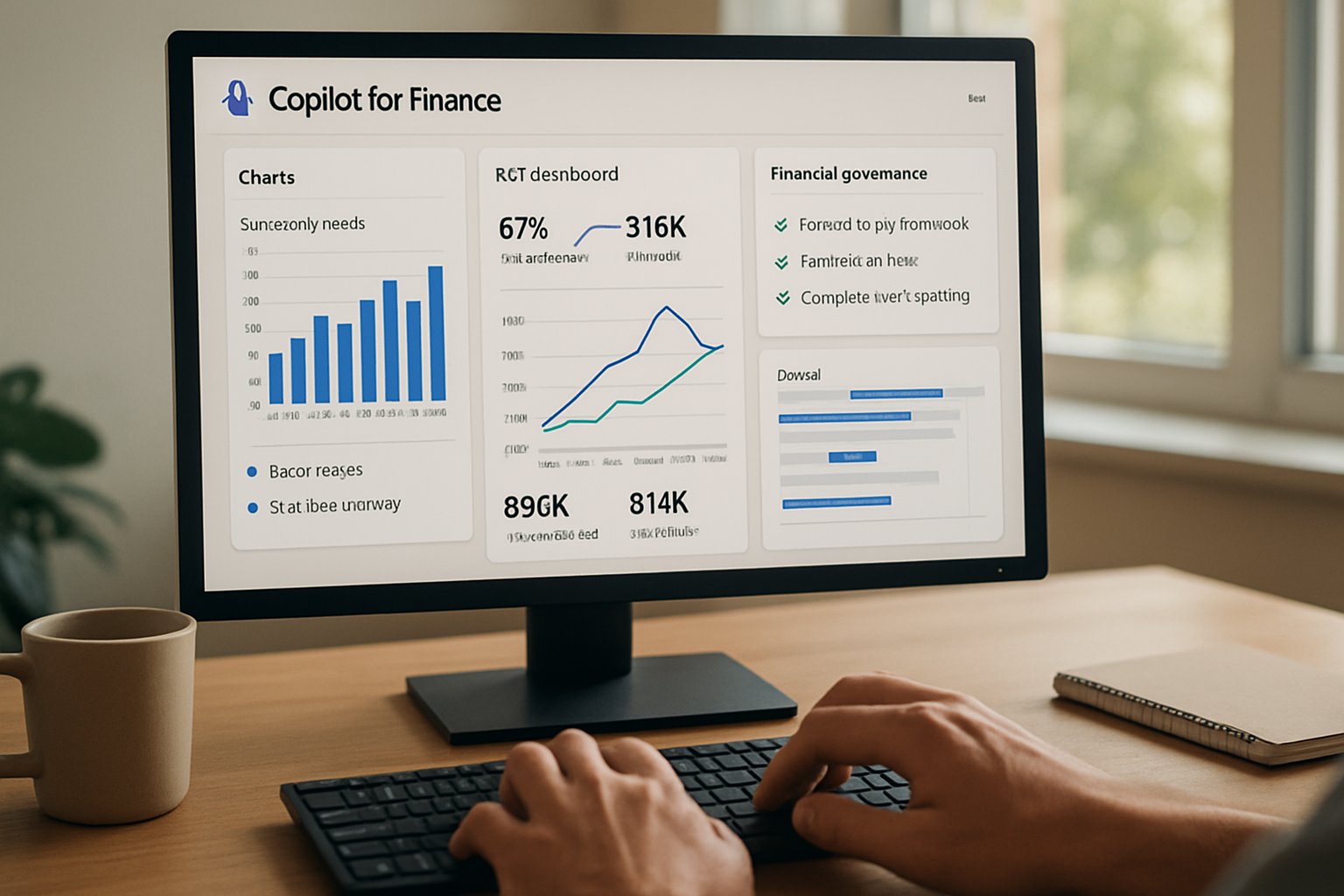
This article dissects Microsoft’s latest finance solution and shows how an AdaptOps blueprint drives governed adoption. Along the way, we map critical steps, pitfalls, and metrics that HR, IT, and SaaS leaders require. Consequently, you will leave with a clear plan to unlock value within 90 days. Copilot for finance teams can finally move from demo buzz to audited production. Let’s examine the path. Firstly, we review the market signals pushing CFOs toward automation. Secondly, we outline a governance-first deployment playbook that aligns with AdaptOps.
Copilot for Finance Impact
Microsoft’s October 2025 release matured the Finance solution in Microsoft AI Copilot. Financial analysts can now query ERP data, reconcile ledgers, and generate variance stories inside Excel. Furthermore, Microsoft Copilot for Financial Analysis removes manual cube building by auto-preparing pivot-ready data. Consequently, close cycles shorten and audit trails improve.
McKinsey quantifies the upside at up to 4.7% of banking revenue. Gartner, in contrast, warns that productivity gains stall without disciplined operating models. Therefore, microsoft copilot adoption must pair technology with governance, data quality, and change programs. When deployed correctly, Copilot for Finance reduces close cycles by 35%.
Adoptify AI’s early benchmarks show 27% faster loan approvals when AI Financial Analysis is embedded in workflows. Moreover, the platform’s ROI dashboards visualize hours saved per reconciliation run. These insights keep executive sponsors engaged and budgets flowing. In summary, the technical foundation is solid, yet results hinge on structured rollout. Next, we inspect market forces shaping adoption momentum.
Finance AI Market Shift
Global finance teams confront shrinking margins, volatile rates, and heavier reporting mandates. Consequently, demand for AI Financial Analysis surges as leaders chase speed and accuracy. ResearchAndMarkets expects generative-AI solutions in banking to top $21.5 billion by 2034.
Meanwhile, only 8% of banks develop gen-AI systematically, the IBM 2025 survey notes. Therefore, early adoption of Microsoft Copilot still sits on the S-curve, offering late movers room to leapfrog. Microsoft Copilot for accounting, audit, and treasury functions lowers the entry barrier through familiar Excel experiences.
However, regulators demand evidence of robust controls before approving AI financial analysis Microsoft Copilot deployments. FT coverage of recent stress tests signals forthcoming scrutiny on model drift and fraud. Copilot fraud detection finance scenarios hence gain executive attention.
Consultancies such as KPMG now offer agent catalogs built on Microsoft’s AI stack. Moreover, Microsoft Copilot for Financial Analysis is pre-integrated, reducing custom code requirements. Consequently, program leads can redirect budgets from development to change enablement. Still, CFOs must establish clear guardrails before procurement teams sign statements of work.
To capitalize, enterprises must remove internal barriers that still slow pilots. We address those obstacles next.
Common Adoption Barriers
Most finance data lives across ERP, spreadsheets, and shadow databases. Consequently, reconciliation consumes up to 30% of analyst time. Poor lineage also weakens AI outputs and raises audit flags.
Governance gaps create a second hurdle. Without role-based controls, fraud detection modules may surface confidential records. Moreover, passive change management leaves end users confused about license, prompts, and policies.
Skills scarcity rounds out the list. Gartner shows finance AI usage rising, yet only 40% measure impact effectively. Therefore, AI financial analysis Microsoft Copilot pilots often fail to scale.
The top blockers include:
- Data readiness and lineage
- Governance and access control
- Change management discipline
- Measurement and KPI gaps
Yet Copilot for Finance will misfire without cleansed, lineage-rich data. In brief, data, governance, and skills create the classic adoption roadblocks. High-value pilot cases overcome these limits, as the next section explains.
High-Value Pilot Cases
Early success demands tight scope and clear metrics. Therefore, leaders start with reconciliation automation, variance analysis, and close-process support. A focused Copilot for Finance pilot should lock scope on one measurable pain point.
Microsoft Copilot for accounting already surfaces unreconciled lines and suggests tie-outs. Furthermore, Copilot for finance teams can draft variance commentaries in Outlook for controller review. Advanced analytics then flag unexpected swings using standard deviation thresholds.
Another quick-win pilot tackles supplier invoice coding. Microsoft Copilot for accounting extracts header data, suggests GL codes, and flags duplicates. AI financial analysis Microsoft Copilot then ranks risk based on amount, vendor history, and date proximity. Therefore, AP teams spend minutes, not hours, on verification.
Key performance indicators should be baseline-captured before pilot kickoff:
- Month-end close duration (days)
- Manual reconciliation hours
- Variance commentary cycle time
- Error rate in journal entries
With KPIs defined, teams can prove value in six weeks and secure funding. Governance remains the linchpin, addressed below.
Governance First Approach
Regulators expect traceability, segregation of duties, and auditable logs. Therefore, AdaptOps prescribes governance tasks from day one. Governance steps ensure Copilot for Finance outputs stay traceable and compliant.
Data Control Checklist Steps
Firstly, whitelist approved agents and connectors inside Microsoft 36 tenant settings. Secondly, align Copilot roles with existing ERP access groups to prevent privilege creep. Thirdly, enable prompt logging with write-back approvals for high-risk journals.
Moreover, Adoptify AI’s governance starter kit packages these controls alongside policy templates and DLP rules. Consequently, audit readiness improves without lengthy consulting cycles.
Effective governance also covers model drift monitoring. Teams schedule quarterly reviews to assess prediction accuracy, prompt performance, and fraud detection recall. Furthermore, Copilot fraud detection finance metrics feed continuous improvement loops managed by AdaptOps. Such discipline satisfies auditors and boosts stakeholder trust.
In summary, built-in guardrails protect data and reputation. Next, we tackle the human element.
Upskilling Finance Talent
Technology alone cannot unlock AI dividends. Finance analysts must learn prompting, data validation, and exception handling.
Change Champion Network Plan
Adoptify AI trains change champions inside each business unit through AdaptOps Foundation courses. Furthermore, microsoft copilot adoption accelerates when champions deliver micro-demos and floor support. Microsoft Copilot for Financial Analysis tutorials embedded in Excel provide just-in-time reinforcement.
AI financial analysis Microsoft Copilot skill badges align with HR upskilling goals. Moreover, Copilot for finance teams benefit from executive coaching that keeps priorities aligned with strategy.
Learning journeys should not end after certification. Consequently, Adoptify AI pushes micro-surveys to check confidence levels and identify new feature needs. Next, the platform recommends fresh tutorial cards directly within Excel or Outlook. Such nudges maintain engagement and expand feature adoption over time.
In effect, talent readiness transforms pilots into sustainable capabilities. We now examine measurement discipline.
Measuring Copilot ROI
ROI transparency determines whether CFOs expand funding or pause programs. Consequently, AdaptOps embeds telemetry across usage, prompt categories, and outcome metrics.
Dashboards correlate manual hours saved to financial impact, simplifying board reporting. Furthermore, Copilot fraud detection finance alerts feed incident numbers into the same cockpit. Microsoft Copilot for accounting supply real write-back counts, closing the loop. Dashboards then isolate Copilot for Finance contributions to hard cost savings.
AI Financial Analysis, Microsoft Copilot for Financial Analysis, and classic BI can share one scorecard for clarity. Therefore, microsoft copilot adoption decisions become data-driven rather than anecdotal.
In short, visible ROI keeps momentum alive. Let us conclude with action steps.
Conclusion: Copilot for Finance fuses ERP context with generative reasoning to slash close times, highlight anomalies, and narrate numbers. However, success depends on data quality, governance rigor, skilled people, and transparent metrics. Adoptify AI stands out because it layers AI-powered digital adoption capabilities atop Microsoft’s stack. Interactive in-app guidance walks analysts through every Copilot step. Intelligent user analytics reveal adoption gaps instantly. Automated workflow support removes repetitive clicks. Therefore, organizations enjoy faster onboarding and higher productivity without sacrificing security. Enterprise scalability and strict tenant controls come baked in. Ready to turn pilots into profit? Explore AdaptOps Quick Starts at https://www.adoptify.ai/ and transform your workflows today.
Frequently Asked Questions
- How does Microsoft Copilot for Finance accelerate financial operations?
Microsoft Copilot for Finance speeds up reconciliation and variance analysis by automating data processing, improving audit trails, and reducing manual errors—boosting efficiency and risk mitigation. - How does Adoptify AI support digital adoption in finance?
Adoptify AI leverages in-app guidance, intelligent user analytics, and automated workflow support to simplify digital adoption, ensuring a smooth Microsoft Copilot rollout while maintaining strong governance and compliance. - Why is robust governance essential for Copilot adoption?
Robust governance with role-based controls, data logging, and clear audit trails is vital for Microsoft Copilot adoption, reducing risk and enhancing ROI through structured, compliant digital transformation. - How do high-value pilot cases enhance AI Financial Analysis?
High-value pilot cases targeting reconciliation and supplier invoice coding demonstrate quick ROI, leveraging AI Financial Analysis to reduce manual errors and drive scalable, informed digital adoption.

FEATURED
Artificial intelligence adoption: Inbox zero with Copilot
February 3, 2026
FEATURED
Artificial intelligence adoption: myths leaders must crush
February 3, 2026
FEATURED
Establishing Ethical Artificial Intelligence Adoption Guidelines
February 3, 2026
FEATURED
Artificial Intelligence Adoption: Models, Skills, ROI
February 3, 2026
FEATURED
20-Point Artificial Intelligence Adoption Readiness Checklist
February 3, 2026