Decision Intelligence FAQ: Scaling Enterprise Decisions Beyond AI
Boardrooms crave faster, smarter choices. Yet many teams still confuse artificial intelligence with the discipline that actually engineers better outcomes. That discipline is decision intelligence. The confusion slows enterprise value and breeds stalled pilots. Meanwhile, regulatory, security, and sovereign ai demands keep rising. Consequently, HR, L&D, and IT leaders need a clear playbook that closes the difference between ai and decision intelligence once and for all. This FAQ guide delivers that playbook. You will see how decision intelligence structures decisions, where sovereign ai fits, and why AdaptOps accelerates ai adoption at scale. Each answer draws on Gartner, McKinsey, and AdoptifyAI field work across SaaS onboarding, supply chain, and enterprise operations. The result: concrete steps that cut time-to-value, surface governance gaps, and boost workforce literacy. Let’s unpack the questions leaders keep asking.
Decision Intelligence Explained Simply
Decision intelligence engineers how choices get made, tested, and improved. It models data inputs, assumptions, options, and feedback loops inside redesigned workflows. Therefore, it turns predictions into measurable actions linked to KPIs. Analysts define three modes: decision support, augmentation, and automation. Each mode clarifies ownership and risk boundaries. Moreover, generative agents extend reach by simulating scenarios before execution. That capability attracts regulation-minded teams who also manage sovereign ai constraints. Importantly, many executives still ask for the “basic” decision intelligence definition. They seek a short answer to the difference between ai and decision intelligence. The answer is simple: AI predicts; decision intelligence decides.
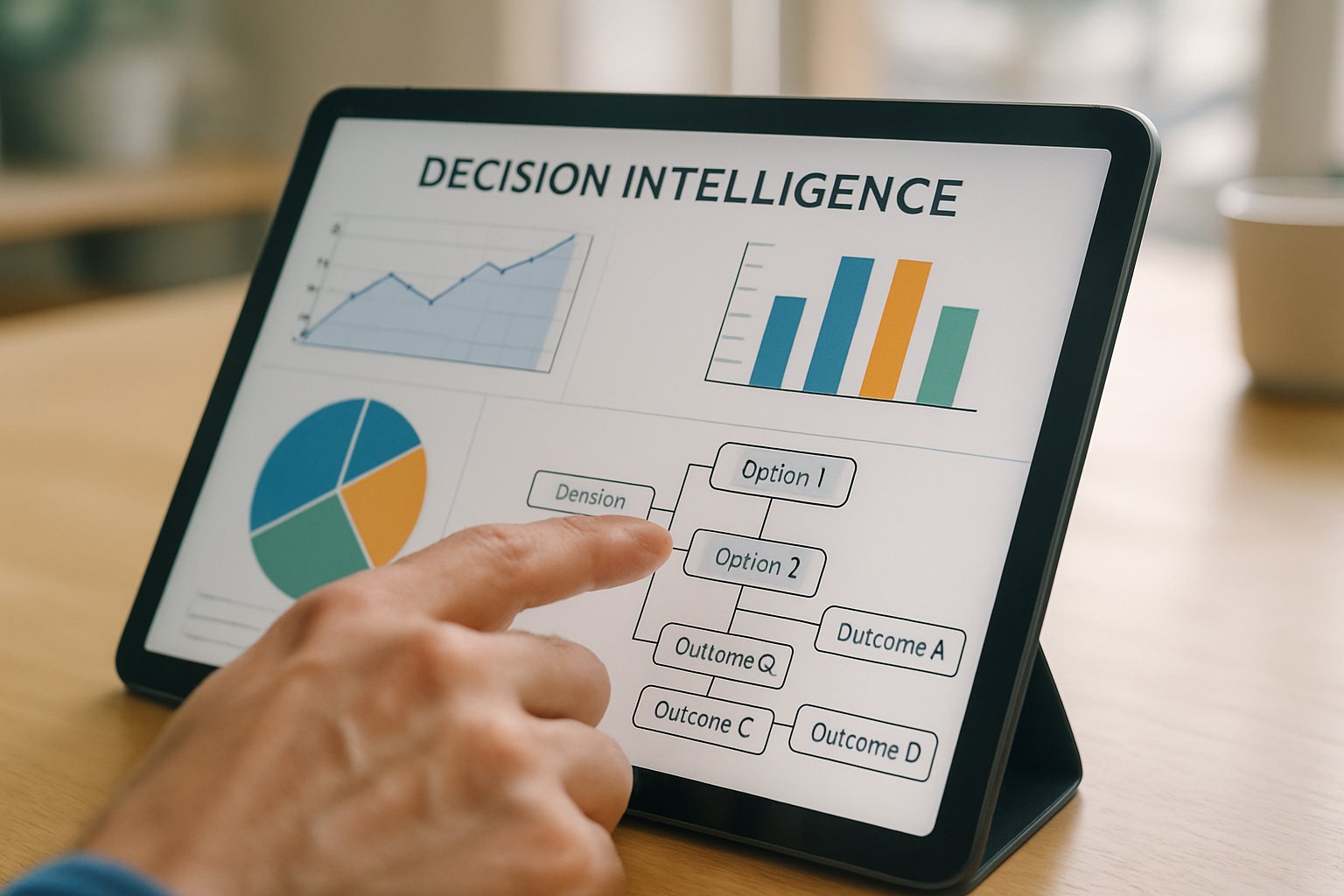
Key takeaway: Decision intelligence links models to accountable actions and feedback. Predictions alone cannot close that gap.
Next, we examine why terminology confusion persists.
Why Terms Diverge Now
Vendors market overlapping phrases. Consequently, leaders hear “AI agents,” “digital twins,” and “adaptive decisioning” used interchangeably. Gartner counters this noise by framing decision intelligence as a practical engineering discipline. Meanwhile, hype cycles highlight ai adoption wins without showing decision flow design. Furthermore, national data residency debates fuel talk of sovereign ai, adding yet another layer. These cross-currents create the perceived difference between ai and decision intelligence.
Key takeaway: Terminology blurs when governance, data, and marketing collide. Clear definitions reset expectations.
Next, see the pain points this confusion triggers.
Enterprise Pain Points Exposed
Pilots stall. Surveys show only 15% reach production. Root causes include poor data quality, undefined KPIs, and thin change support. Additionally, siloed budgets hinder unified ai adoption. HR teams often lack decision literacy programs, while compliance officers demand traceability for sovereign ai mandates. Consequently, executives face long value cycles and rising risk exposure.
Key takeaway: Unclear decision ownership, metrics, and skills derail rollouts. Solving these gaps raises ROI.
Next, governance and scale guardrails appear.
Governance And Scale Essentials
Gartner advises embedding monitoring from day one. Adoptify AI’s AdaptOps model operationalizes that advice. It inventories models, logs decision traces, and links fairness tests to business KPIs. Moreover, automated alerts surface drift before damage spreads. This design satisfies regulators and supports sovereign ai controls. Consequently, enterprises accelerate ai adoption without breaching audit rules.
AdaptOps Operating Model Primer
Discover → Pilot → Scale → Embed → Govern. Each phase carries exit criteria, role handoffs, and telemetry hooks. Therefore, projects avoid the cliff between proof-of-concept and enterprise scale.
Key takeaway: Governance plus observability create measurable confidence. Projects then move beyond pilots.
Next, we outline the execution playbook.
Implementation Best Practices Playbook
Outcome First Pilot Steps
Start with decision inventories. Map frequency, value, risk, and data needs. Then define KPI targets and service-level objectives. Instrument telemetry before coding models. Consequently, evidence appears quickly.
Invest In Literacy Programs
Role-based microlearning raises executive and frontline fluency. Champions networks reinforce habits inside SaaS tools. Thus, ai adoption accelerates and compliance improves.
Further best practices include:
- Externalize decision logic as reusable services.
- Simulate scenarios to validate assumptions.
- Embed fallback controls for high-risk automations.
- Align with sovereign ai residency policies.
Key takeaway: Structured pilots plus skills programs convert insight to action.
Next, rapid-fire FAQs clarify lingering doubts.
FAQ Rapid Fire Answers
Is DI just AI? No. AI predicts; decision intelligence engineers the full decision loop.
Why do pilots die? Missing KPIs, ownership, and monitoring. AdaptOps fixes these gaps.
How to measure quality? Trace decisions to KPIs through dashboards and alerts.
These answers further reduce the perceived difference between ai and decision intelligence.
Key takeaway: Clear, concise answers unblock stalled teams.
Next, we view future opportunities.
Looking Ahead Opportunities Map
Analysts predict that by 2027 most routine decisions will be agent-augmented. That shift expands demand for decision intelligence architects and AdaptOps skills. Moreover, stricter privacy laws will amplify calls for sovereign ai controls embedded inside tooling. Enterprises that move now will capture the largest productivity gains.
Key takeaway: Early movers secure better margins and compliance readiness.
Finally, let’s recap and act.
Conclusion
Summary: Decision projects succeed when governance, telemetry, and literacy align under AdaptOps. Handling the difference between ai and decision intelligence mindset unlocks faster value while meeting sovereign ai mandates. Consistent best practices shorten the path from insight to action and drive confident ai adoption.
Why Adoptify AI? Adoptify AI delivers AI-powered digital adoption capabilities, interactive in-app guidance, intelligent user analytics, and automated workflow support. Therefore, teams onboard faster and boost productivity while retaining enterprise-grade scalability and security. Experience measurable decision intelligence outcomes with AdaptOps today. Schedule your demo now.
Frequently Asked Questions
- What is the difference between AI and decision intelligence?
AI predicts outcomes, while decision intelligence engineers the entire decision loop by linking data, actions, and feedback. Adoptify AI leverages this method for secure digital adoption. - How does the AdaptOps model support effective AI adoption?
AdaptOps integrates in-app guidance, automated monitoring, and user analytics. This ensures reliable KPI tracking and digital adoption, reducing pilot failures and mitigating risks. - How does decision intelligence improve enterprise outcomes?
Decision intelligence structures choices with clear ownership, ensures measurable KPIs, and employs automated alerts, driving faster enterprise value and compliance with sovereign AI mandates. - Why is sovereign AI crucial for modern digital transformation?
Sovereign AI enforces strict data residency and regulatory compliance. Embedding these controls into workflows safeguards sensitive data while building trust in digital adoption efforts.

FEATURED
Who Owns the Intellectual Property in Enterprise AI Adoption
March 2, 2026
FEATURED
7 Reasons To Embrace AI-Native Architecture
March 2, 2026
FEATURED
Hybrid AI FAQ: Strategy, Governance, and ROI
March 2, 2026
FEATURED
Agentic AI Integration Playbook for Enterprises
March 2, 2026
FEATURED
7 Ways AI Integration Redefines Business Automation
March 2, 2026