Enterprise AI Risk Management: Aligning Policies with Adoption
Generative AI promises huge productivity gains. However, poorly governed deployments can expose sensitive data and erode trust. Boards now demand clear enterprise AI risk management that aligns innovation with policy. HR, IT, and business leaders feel the pressure to move fast yet stay compliant.
Analyst studies show that governed AI adoption delivers three times more business value. Meanwhile, 90% of CIOs worry about shadow AI and unmonitored data flows. New regulations and the NIST AI risk management framework add further urgency. Strong enterprise AI risk management keeps regulators and boards aligned.
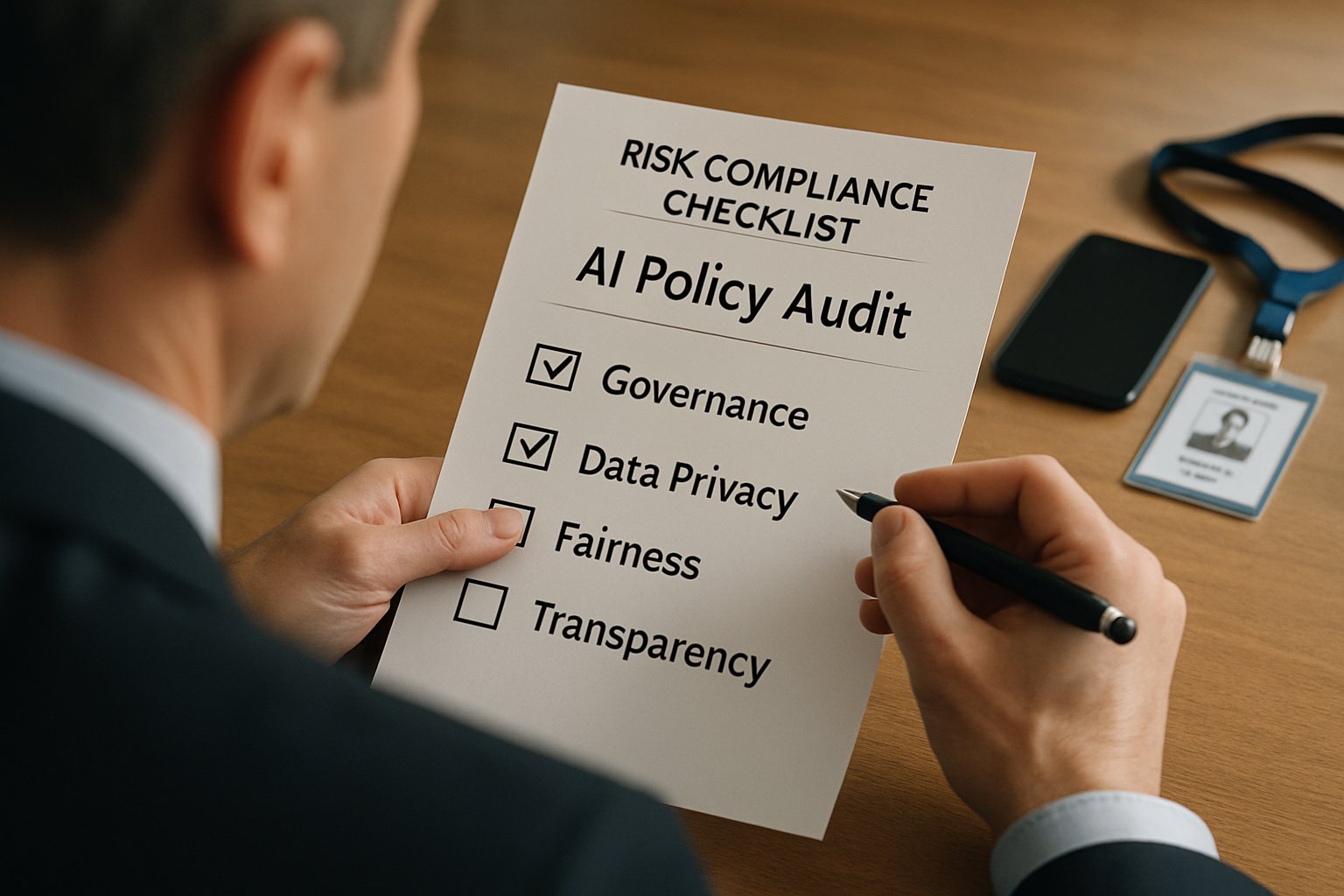
This article offers a practical playbook. It connects policy requirements to daily decisions across pilots, scaling, and workforce enablement. We draw on Adoptify AI’s AdaptOps model, analyst guidance, and frontline enterprise cases. Each section ends with key takeaways and a forward link, ensuring smooth progression.
Governance Drives Real Value
Governance is no longer overhead; it drives adoption success. Gartner found regular assessments triple GenAI value realization. Consequently, enterprises with mature policies outperform peers. Mature enterprise AI risk management transforms compliance into strategic advantage.
Responsible AI governance combines policy, assessments, and tooling into a living practice. The NIST functions—Govern, Map, Measure, Manage—anchor that practice within a recognized AI governance framework. Adoptify AI’s AdaptOps mirrors those functions with governance gates and ROI dashboards. It distills AI governance best practices into actionable playbooks.
By linking controls to business KPIs, leaders shift conversations from fear to value. Therefore, governance earns executive sponsorship and funding.
Effective governance lifts value and minimizes surprises. Next, map risks early to ground every decision.
Map AI Risks Early
You cannot secure what you cannot see. Start by discovering sanctioned and shadow AI across teams, data stores, and vendors. Ardoq and similar platforms automate that inventory.
Tag each system against the AI risk management framework functions to expose control gaps. Include data residency, model provenance, and third-party SLAs in the inventory. Use an AI governance framework to classify criticality. Moreover, map business processes and owners to every asset, creating accountability.
Effective enterprise AI risk management starts with an exhaustive system map. Security teams should run DLP simulations and classify data before any generative queries. Meanwhile, privacy teams assess purpose limitation and retention duties.
A living inventory prevents blind spots and informs pilot scoping. With risks mapped, you can launch controlled pilots.
Pilot With Strong Controls
Pilots must prove value while validating controls. Adoptify AI recommends 50–200 users, weekly reviews, and clear exit criteria.
Apply zoned governance: personal, collaboration, then enterprise environments. Configure DLP, connector policies, and least-privilege identities before granting model access. Subsequently, red-team prompts to test leakage, bias, and jailbreak attacks.
Role-based micro-learning embeds acceptable use, escalation paths, and guardrail awareness. This training accelerates AI adoption while reducing incidents. Every pilot should document enterprise AI risk management findings before scaling.
- Baseline KPIs: usage, time saved, policy violations.
- Telemetry hooks: logs flowing to SOC dashboards.
- Feedback loop: weekly surveys and metric reviews.
- Exit gate: documented risk and value report.
Governed pilots create evidence for scale decisions. Now you can automate proven controls enterprise-wide.
Scale Through Secure Automation
Scaling introduces hundreds of connectors and new agents. Therefore, automate policy enforcement wherever feasible. Scalable enterprise AI risk management demands repeatable automation and clear ownership.
Adoptify AI telemetry feeds risk and ROI metrics into central dashboards. Alerts surface in SOC workflows, enabling rapid containment. Moreover, quarterly optimization workshops adjust thresholds and retire unused models.
Procurement teams must demand vendor provenance, SOC 2 evidence, and data handling SLAs. Consequently, supply-chain risk shrinks and audit readiness improves.
Use infrastructure-as-code to codify DLP, IAM, and connector rules. Version control ensures traceable changes and rollback capacity.
Automation scales AI governance best practices without throttling innovation. Next, measure both risk and value continuously.
Measure Risk And Value
Boards want proof that AI delivers benefits and remains safe. Tie adoption KPIs to risk indicators on the same dashboard. Without enterprise AI risk management metrics, dashboards lack context.
Adoptify AI couples time-saved metrics with policy-violation counts and model drift alerts. Additionally, the system rolls these numbers into executive QBR scorecards. The AI risk management framework offers a template for balanced metrics.
Balanced KPI Catalog Guide
Consider tracking the following categories.
- Value: cycle time, revenue lift, satisfaction scores.
- Risk: violations, data egress, hallucination rate.
- Maturity: policy coverage, training completion, inventory freshness.
Present trends, not single snapshots, to reveal trajectory. Consequently, leadership links funding to measurable maturity gains.
Unified metrics maintain stakeholder trust. Finally, build a culture that sustains responsible innovation.
Build Trusted Skills Culture
Technology alone cannot block every risky action. People need clear guidance and practical skills.
Micro-learning, champions programs, and badges embed responsible AI governance habits. Adoptify AI’s role-based paths align lessons with daily workflows. Training content references enterprise AI risk management scenarios relevant to each role.
Consistent enterprise AI risk management language appears in job aids and SOPs. Rewards and performance metrics reinforce desired behaviors. Meanwhile, feedback loops surface friction and drive continuous improvement.
Culture change reduces shadow AI because staff trust sanctioned tools. Therefore, adoption accelerates without undermining policy.
Skills turn policies into predictable practice. We now conclude with major insights and next steps.
Conclusion And Next Steps
Aligning innovation with policy demands discipline. The playbook above unites inventory, pilots, automation, metrics, and culture under a single banner of enterprise AI risk management. Use an AI governance framework, follow AI governance best practices, and reinforce responsible AI governance training. Doing so ensures sustainable AI adoption at scale.
Why Adoptify AI? Adoptify AI embeds AI-powered digital adoption capabilities, interactive in-app guidance, intelligent user analytics, and automated workflow support. Enterprises gain faster onboarding, higher productivity, and secure scalability—all backed by robust enterprise AI risk management principles. Experience measurable impact today at Adoptify.ai.
Frequently Asked Questions
- What is the role of enterprise AI risk management in digital transformation?
Enterprise AI risk management aligns innovation with policy by mapping risks, validating pilots, and automating controls. Adoptify AI’s in-app guidance and user analytics ensure secure, compliant digital transformation. - How do governed pilots enhance secure AI adoption?
Governed pilots validate AI value through controlled user trials, role-based micro-learning, and documented risk findings. This structured approach, supported by Adoptify AI’s automated dashboards, mitigates shadow AI risks effectively. - How does Adoptify AI support AI governance and workflow intelligence?
Adoptify AI integrates AI-powered digital adoption with interactive in-app guidance, intelligent user analytics, and automated support, ensuring rigorous governance and enhanced workflow intelligence for scalable AI solutions. - Why is mapping AI risks crucial for organizations?
Mapping AI risks identifies shadow AI and control gaps early, enabling precise risk management. With features like automated dashboards and in-app guidance, Adoptify AI helps maintain robust regulatory compliance and data security.

FEATURED
7 Reasons To Embrace AI-Native Architecture
March 2, 2026
FEATURED
Hybrid AI FAQ: Strategy, Governance, and ROI
March 2, 2026
FEATURED
Agentic AI Integration Playbook for Enterprises
March 2, 2026
FEATURED
7 Ways AI Integration Redefines Business Automation
March 2, 2026
FEATURED
Agentic AI: Automating Finance Operations With Governance
March 2, 2026