Enterprise security checklist for AI deployment
Gen-AI promises speed, creativity, and new revenue. However, ungoverned ai deployment quickly turns risky. Confidential data leaks, model tampering, and compliance failures appear overnight. Enterprises therefore need a rigorous, business-aligned security and privacy playbook. This guide distills converging standards, vendor guardrails, and Adoptify AdaptOps insights into a single, actionable path.
We target HR, L&D, SaaS, IT onboarding, and digital transformation leaders. They sit on the front line of ai adoption pressure. Consequently, they must translate policy into daily workflows without slowing innovation. The following ai deployment security checklist will help them launch fast while staying safe.
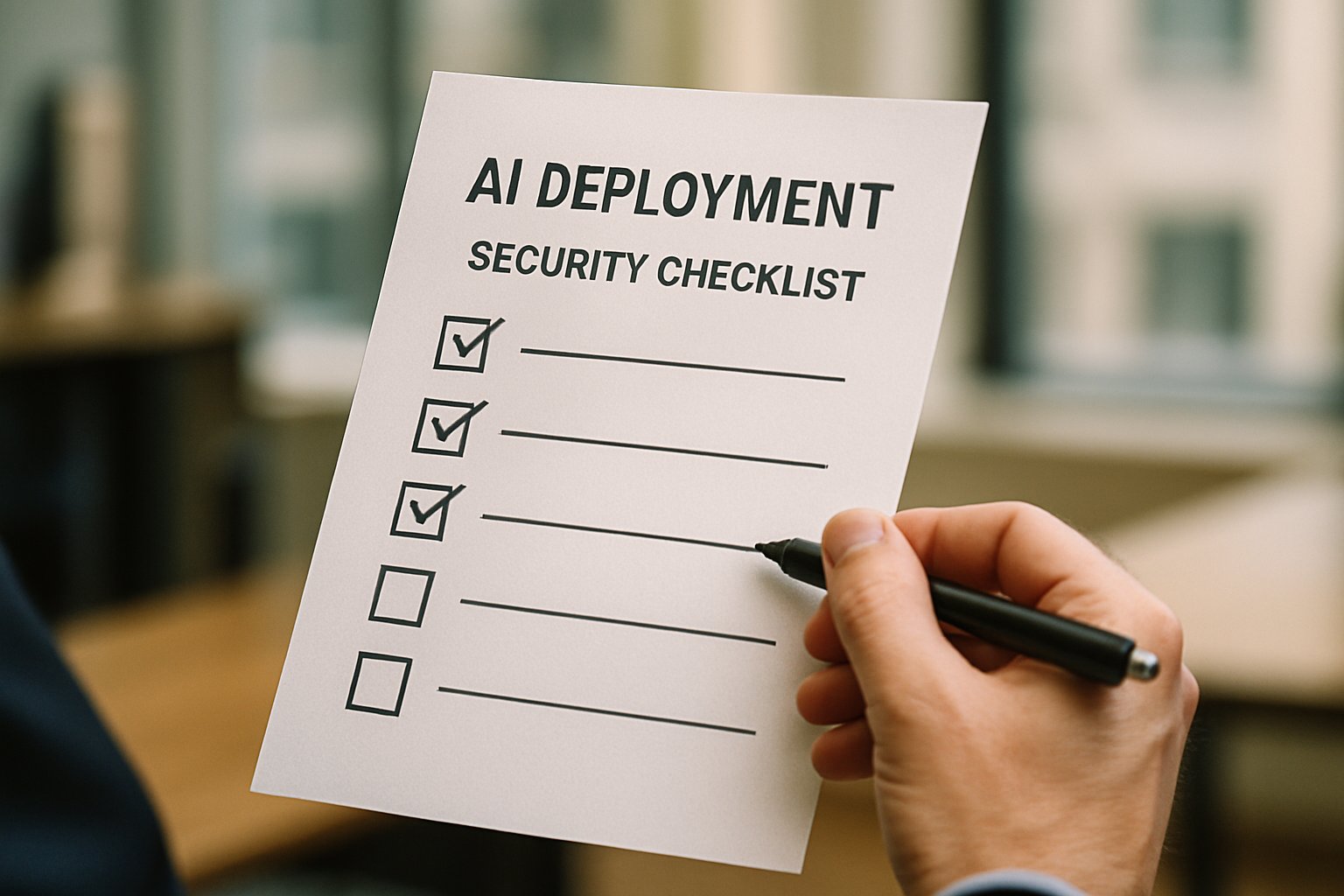
Governance Drives AI Deployment
Effective governance starts at the board. CEOs assign ownership and approve risk appetite. Subsequently, a cross-functional committee defines scope and RACI. Adoptify’s governance playbooks accelerate this step with ready policies and acceptable-use templates.
Next, link procurement gates to the committee. Every new model passes a risk triage before purchase or build. This prevents shadow projects that derail compliance.
Key takeaways: Executive backing plus clear roles create predictable control. Governance also streamlines audits and investor confidence. Moving forward, documentation cements that discipline.
Therefore, robust records become the backbone of scale.
Risk Documentation Essentials Guide
Lifecycle evidence satisfies regulators and reduces troubleshooting time. Organizations should maintain model cards, data lineages, and prompt logs. Moreover, cryptographic hashes guard against silent model drift.
The UK Code and NIST AI RMF supply formats. Adoptify integrates those artifacts into its ROI dashboards for continuous review. With proof on hand, teams defend their ai deployment during external assessments.
Key takeaways: Precise documentation underpins accountability. It also feeds red-team exercises with real context. Next, focus shifts to data privacy.
Consequently, data controls become the immediate priority.
Data Privacy Defense Tactics
Sensitive data fuels productivity yet exposes liability. Therefore, classify datasets before model ingestion. Data minimization, purpose limitation, and consent tracking form the legal core.
Additionally, isolate training environments with confidential computing or VNET peering. Google SAIF and Azure blueprints provide reference patterns. These controls support cross-border HR workflows and SaaS onboarding scenarios.
Bulleted safeguards:
- Encrypt at rest and in transit.
- Separate PII from prompt logs.
- Rotate keys through hardware modules.
- Mask outputs containing inferred personal details.
Key takeaways: Privacy wins trust and lowers breach cost. After data is safe, the platform itself requires hardening.
Subsequently, technical controls lock down infrastructure.
Platform Hardening Controls Map
Cloud providers embrace least privilege, segmentation, and strong identity. Enterprises mirror that stance. Entra or IAM roles restrict model registry edits. Private endpoints shield inference APIs from the open internet.
Moreover, an API gateway enforces rate limits, authentication, and telemetry. Adoptify AdaptOps plugs policy signals into that gateway, automating enforcement across tenants.
Key takeaways: Hardened platforms reduce attack surface dramatically. With infrastructure fortified, attention turns to code and testing.
Therefore, development discipline closes remaining gaps.
Secure Development Testing Loop
Shift-left security embeds threat modelling early. Teams map OWASP LLM Top-10 vectors, then build mitigations. Furthermore, automated pipelines run static and dynamic scans on every commit.
Adversarial red-teams attempt prompt injection, jail breaks, and model theft before release. Evidence feeds the ai deployment security checklist for future sprints. Adoptify coaches champions to run those drills quarterly.
Numbered loop:
- Threat model features and data.
- Apply input/output validation code.
- Launch scripted adversarial tests.
- Fix findings, rerun scans.
- Document TEVV results for audit.
Key takeaways: Continuous testing keeps pace with evolving threats. Once live, monitoring sustains vigilance.
Consequently, detection becomes the frontline.
Monitoring Incident Readiness Playbook
Telemetry must span pipeline and runtime. Prompt logs, user IDs, and model latency help detect anomalies. Meanwhile, machine-learning drift detectors alert when performance degrades.
Create incident runbooks that mirror standard cyber processes. Contain, eradicate, and recover while preserving forensic data. Adoptify dashboards surface security KPIs alongside productivity minutes saved, bridging technical and business metrics.
Key takeaways: Rapid detection minimizes blast radius. Culture and skills cement those gains.
Therefore, training multiplies control effectiveness.
Training Culture And Metrics
Roles vary, so training must too. Developers learn secure SDK usage. HR owners learn privacy law triggers. Business users master safe prompting patterns.
Champions programs foster peer support, accelerating ai adoption. Additionally, certified paths create recognition and reduce turnover. Adoptify’s role-based enablement shows 60–75 minutes saved per employee daily, validating investment.
Key takeaways: Culture turns policies into habits. Metrics prove ROI and sustain funding. Finally, connect all steps into a living ai deployment security checklist.
Subsequently, leaders iterate based on fresh data.
Conclusion: Secure ai deployment hinges on governance, documentation, privacy, hardening, testing, monitoring, and training. Each pillar aligns with industry standards and AdaptOps accelerators. By following the ai deployment security checklist, enterprises unlock innovation while managing risk.
Why Adoptify AI? Adoptify AI blends AI-powered digital adoption, interactive in-app guidance, intelligent user analytics, and automated workflow support. Consequently, organizations achieve faster onboarding, higher productivity, and enterprise-grade security at scale. Explore how Adoptify AI elevates your ai deployment today at Adoptify.ai.
Frequently Asked Questions
- How does Adoptify AI enhance secure AI deployment?
Adoptify AI boosts secure AI adoption with in-app guidance, automated workflow support, and user analytics that streamline governance, accelerate onboarding, and ensure robust compliance across deployment stages. - How does the Adoptify AdaptOps governance playbook improve AI implementation?
The AdaptOps playbook provides ready-made policies, risk triage templates, and comprehensive documentation guidelines, ensuring rapid, secure AI deployment while simplifying audits and regulatory compliance. - What best practices safeguard data privacy in AI workflows?
Effective data privacy involves classifying sensitive datasets, encrypting data, isolating training environments, and tracking consent. Integrated dashboards further enforce controls, ensuring compliance and secure AI model operations. - How does continuous testing secure AI deployments?
Continuous testing uses threat modeling, automated scans, and adversarial red-team exercises to detect vulnerabilities early, aligning with Adoptify’s secure development practices to ensure resilient and safe AI deployments.

FEATURED
Scaling Retail Operations Through Corporate AI Adoption
February 27, 2026
FEATURED
How Corporate AI Adoption Reduced Operational Costs by 40%
February 27, 2026
FEATURED
Boutique Enterprise AI Adoption vs Big Four Consulting
February 25, 2026
FEATURED
Security Audit for Corporate AI Adoption
February 25, 2026
FEATURED
What is the Average Investment for Enterprise AI Adoption
February 20, 2026