Escaping Pilot Purgatory: AI Adoption At Scale
Most enterprises dabble with pilots yet struggle to push artificial intelligence into daily operations. The gap between proof-of-concept and scaled impact drains budgets and executive patience. Escaping that gap demands a structured approach to AI Adoption, not another isolated experiment. This article outlines a pragmatic, evidence-backed roadmap for leaders in HR, IT, and SaaS onboarding. Follow these steps and turn promising models into business value within months, not years. We synthesize McKinsey data, MLOps best practices, and Adoptify’s AdaptOps operating model. Furthermore, we tackle AI adoption challenges like governance, infrastructure costs, and change fatigue head-on. By the end, you will hold a repeatable playbook that accelerates Enterprise AI adoption without compromising security. Consequently, your teams can deliver measurable productivity lifts and fresh revenue streams earlier than competitors.
Enterprise AI Adoption Pathways
McKinsey reports 88% of firms use AI somewhere, yet just one-third scale programs company-wide. This mismatch defines the core AI adoption challenges plaguing global enterprises. Technically, pilots lack observability, secure data pipelines, and reusable deployment artifacts. Organizationally, unclear ownership and thin budgets hinder Enterprise AI adoption beyond the lab. Consequently, value stalls, stakeholders lose faith, and AI transformation challenges escalate. Successful leaders view pilots as stepping-stones toward an integrated AI scaling framework, not end goals.
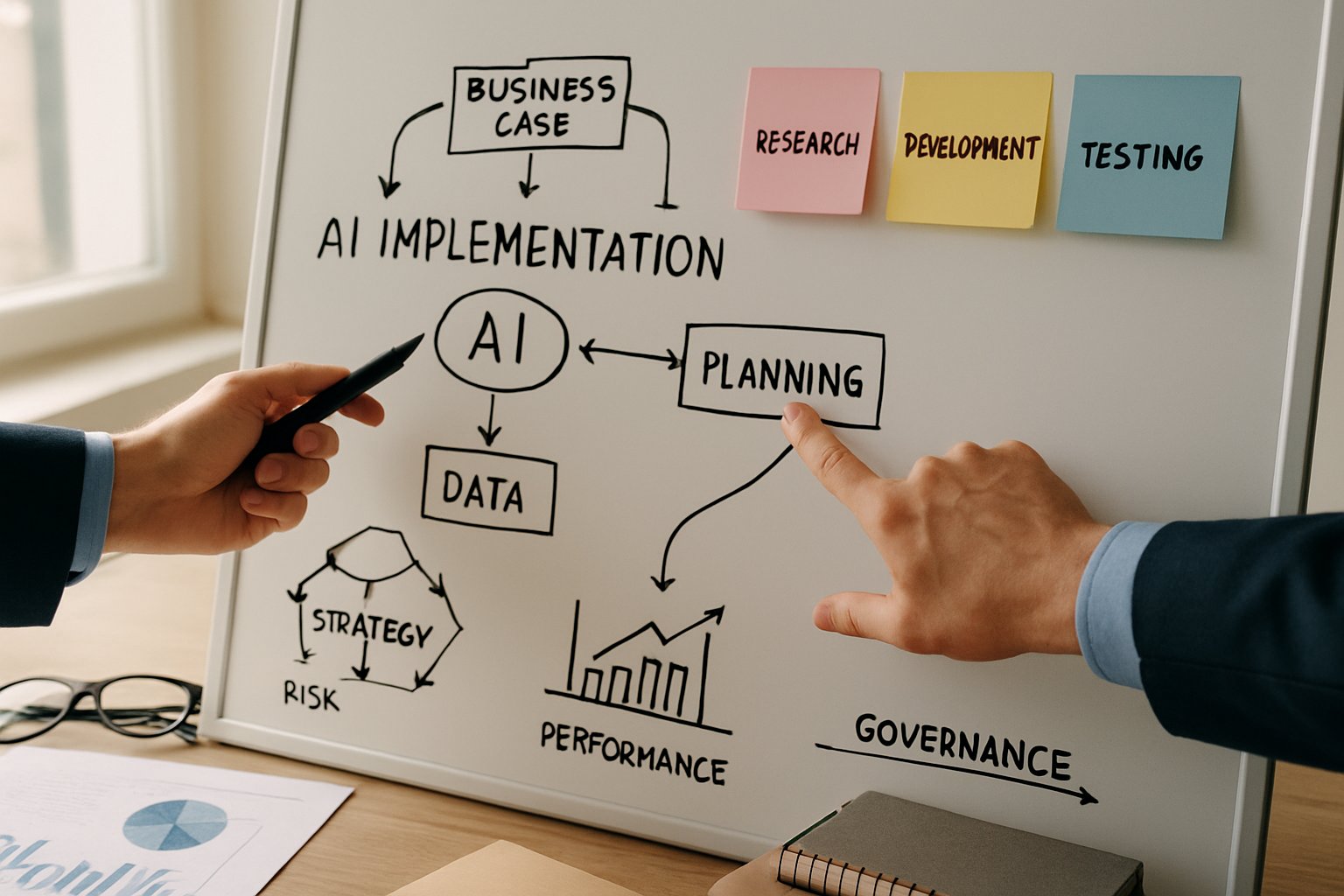
In short, the pilot purgatory problem blends technical, financial, and cultural barriers. However, a disciplined pathway converts those barriers into momentum for rapid scale.
Next, we assess readiness and align outcomes before writing a single line of code.
Readiness Assessment First Steps
Before any model runs, teams must clarify desired business value, data readiness, and executive sponsorship. Adoptify’s readiness assessment scores each use case on data quality, risk, and expected ROI. Moreover, this step sharpens your AI deployment strategy by linking metrics to accountable owners. Include KPIs like cycle time, error rates, or revenue share so progress stays visible. Parallel governance workshops address regulatory needs early, reducing later AI transformation challenges.
Early alignment de-risks budgets and builds trust across L&D, HR, and IT groups. Therefore, you enter pilots with clear goals and a funded escalation path.
With readiness locked, we can prove value quickly and visibly.
Prove Value Fast Pilots
Short, 6-8 week pilots let teams validate technical fit and business impact with minimal spend. Adoptify targets a 90-day ROI, which executives can interpret within existing financial cadences. Furthermore, Microsoft ECIF funding offsets cloud costs, smoothing Enterprise AI adoption decisions. Each pilot must embed observability, rollback scripts, and a repeatable AI scaling framework template. Track metrics live on ROI dashboards so stakeholders witness AI Adoption producing tangible outcomes. Keep scope tight; for example, 200 service agents using retrieval-augmented chat for policy answers.
Fast pilots validate models and reveal integration gaps early. Consequently, they build momentum and secure executive capital for production hardening.
The next phase strengthens the technical backbone for scale.
Harden The Production Stack
Once pilots succeed, engineering teams containerize services, automate CI/CD, and deploy observability hooks. This phase follows AI adoption best practices and treats models as versioned products with strict SLAs. Additionally, drift thresholds trigger automated retraining pipelines, cutting mean time to recovery. A robust monitoring stack is central to any effective AI deployment strategy. Meanwhile, security teams enforce access controls, masking sensitive fields and logging all decisions. These controls mitigate ongoing AI transformation challenges and protect compliance posture. Without this discipline, AI Adoption deteriorates as silent failures accumulate.
Production hardening scales reliability, security, and cost efficiency together. Therefore, leaders maintain stakeholder confidence during wider rollout.
Now, we must ensure humans embrace the new workflows.
Enable People For Continuity
Technology alone fails when users lack confidence or context. Role-based training, in-app guidance, and certification embody AI change management done right. Adoptify 365 surfaces contextual tips, while AdaptOps certification builds internal champions. Moreover, usage analytics feed coaching loops, another pillar of AI adoption best practices. HR and L&D monitor sentiment surveys to spot AI adoption challenges before they spread. Link adoption KPIs to leadership scorecards so Enterprise AI adoption endures beyond project teams. Consequently, talent pipelines align with future automation roadmaps. Sustained AI Adoption depends on embedding these habits into quarterly performance reviews.
Upskilled users transform isolated tools into standard workflows. Subsequently, productivity gains scale smoothly across departments.
Finally, we govern and iterate expansion responsibly.
Govern, Secure And Scale
Central governance boards approve templates, data contracts, and agent privileges. Standard patterns, documented in an AI scaling framework, prevent each unit from reinventing basics. Moreover, executives monitor ROI dashboards that integrate technical, financial, and AI change management indicators. Continuous audit logs answer regulators and accelerate cross-border deployments. With disciplined governance, AI Adoption grows across regions while staying compliant. Furthermore, infrastructure teams right-size compute, keeping budgets predictable. Repeatable AI deployment strategy blueprints let new teams launch features in days. Therefore, momentum compounds and leadership sees enduring value.
Governance elevates trust, security, and velocity simultaneously. Consequently, organizations avoid costly backtracking during scale.
Let us recap the critical moves.
Key Takeaways And Recap
Leaders often request a concise cheat-sheet.
- Start with readiness to tackle AI adoption challenges early.
- Design a funded pilot as your AI deployment strategy.
- Embed observability and governance into every AI scaling framework template.
- Invest in people using proven AI adoption best practices.
- Link executive KPIs to structured AI change management outcomes.
Together, these actions form a battle-tested runway from concept to company-wide impact.
Next, explore how Adoptify 365 accelerates the journey.
Moving from pilot purgatory to productive scale demands discipline across people, processes, and platforms. Follow the roadmap above and your AI Adoption initiatives will convert experimentation into recurring value.
Why Adoptify 365? The platform delivers AI Adoption at speed with interactive guidance, intelligent analytics, and automated workflows. Furthermore, enterprises enjoy faster onboarding, higher productivity, and secure, scalable deployments. Ready to transform work? Visit Adoptify 365 and schedule your AdaptOps discovery session.
Frequently Asked Questions
- How does Adoptify 365 accelerate enterprise AI adoption?
Adoptify 365 speeds up AI adoption by guiding fast pilots, ensuring readiness, and automating workflows. Its in-app guidance and intelligent analytics convert isolated experiments into secure, scalable, and measurable business value. - What role does a readiness assessment play in AI adoption?
A readiness assessment clarifies business value, data quality, and risk. It de-risks budgets and sets clear KPIs, ensuring AI adoption initiatives align with enterprise goals and transform pilots into scaled, impactful solutions. - How do fast pilots and production hardening contribute to secure AI deployment?
Fast pilots validate technical fit with minimal spend, while production hardening through CI/CD, observability hooks, and automated retraining pipelines ensures reliable, secure, and efficient AI deployment across enterprise systems. - How does Adoptify 365 support user training and digital workflow intelligence?
Adoptify 365 enhances user adoption with role-based training, in-app guidance, and real-time analytics. This approach builds user confidence, boosts productivity, and transforms digital workflows into standard, scalable practices.

FEATURED
Who Owns the Intellectual Property in Enterprise AI Adoption
March 2, 2026
FEATURED
7 Reasons To Embrace AI-Native Architecture
March 2, 2026
FEATURED
Hybrid AI FAQ: Strategy, Governance, and ROI
March 2, 2026
FEATURED
Agentic AI Integration Playbook for Enterprises
March 2, 2026
FEATURED
7 Ways AI Integration Redefines Business Automation
March 2, 2026