Executive AI Project Management Success Checklist for 2025
Boards now demand rapid returns from AI investments. Consequently, executives must master AI project management or risk falling behind competitors. This guide translates market research and Adoptify field practice into a practical success checklist for senior leaders.
Escaping AI Pilot Purgatory
Gartner warns that 30% of generative pilots will be abandoned by 2025. However, failure is avoidable. Executives should insist on a production path before a single sprint begins. Define measurable business outcomes, aligned KPIs, and a 90-day telemetry plan. Moreover, size pilots between 50 and 200 champions to contain risk while still proving scale potential.
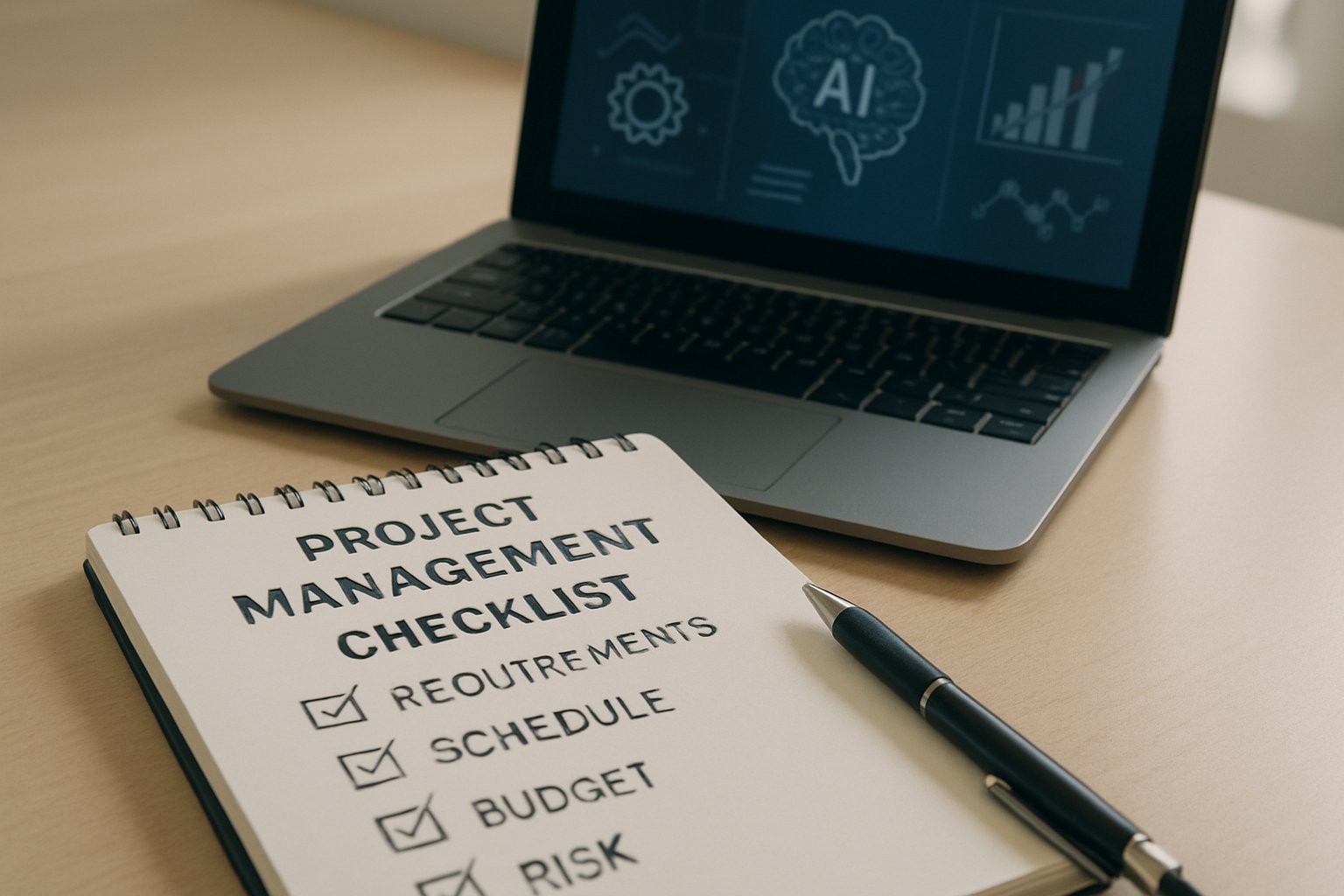
Weekly dashboards must surface minutes saved, error reductions, and sentiment scores. Therefore, leadership can approve or kill work based on facts, not hype. Adoptify documents average savings of 26 minutes per user daily; those numbers motivate finance teams to unlock budget. Without such data, pilots drift until enthusiasm fades. For sustained momentum, tie every milestone to a go/no-go gate owned by the sponsor.
Key takeaway: start small, measure fast, and link gates to funding. Management focus breaks the cycle of stalled proofs. Next, you need firm governance.
Governance Must Lead First
Regulators now treat AI risks as operational duties. Consequently, pre-pilot governance chops matter as much as model accuracy. Adoptify’s Purview simulations reveal permission leaks before code ships. Furthermore, policy-as-code gates block unsafe expansions automatically.
Executives should embed the following controls on day one:
- Simulated DLP and data classification sweeps.
- Automated policy gates tied to executive approvals.
- Continuous telemetry for compliance and cost alerts.
- Documented NIST AI RMF risk assessments.
This checklist keeps passive voice minimal and accountability clear. Importantly, it strengthens AI project management by aligning legal, security, and finance teams early. Moreover, it shortens approval cycles because evidence replaces opinion.
Key takeaway: build trust with automated governance, not slide decks. The conversation now shifts to data readiness.
Robust Data Foundations Matter
McKinsey notes that data work can consume 70% of AI schedules. Therefore, leaders must budget accordingly. Start with a data contract that lists sources, owners, refresh rates, and semantic indexing requirements. Additionally, score each source for quality and permissions.
Adoptify readiness checks flag broken links, stale columns, and missing metadata before pilots launch. Consequently, engineering rework drops later. Meanwhile, vector indexes or knowledge bases need integration plans and cost models. FinOps dashboards should show storage, compute, and inference spend in real time.
When data foundations are firm, AI project management shifts from firefighting to value creation. Teams then focus on prompt design, workflow integration, and user experience. Without solid data, even brilliant models will hallucinate.
Key takeaway: invest early in data contracts and observability. Once data flows, people become the next success factor.
Empowered People Drive Adoption
Technology alone never changes work habits. LinkedIn Learning reports stronger adoption where upskilling aligns with career growth. Therefore, executives should fund role-based microlearning, in-app prompts, and a champion network.
Adoptify AI places guidance directly inside Microsoft AI, so users learn while doing tasks. Moreover, telemetry tracks feature usage and sentiment, enabling targeted reinforcement. Managers receive cohort reports that spotlight lagging teams. Consequently, support arrives before frustration spreads.
This people-centric layer boosts AI project management outcomes because workers trust tools that mirror their context. Additionally, champions share quick wins that accelerate cultural shift. Remember, governance without adoption still equals zero ROI.
Key takeaway: train in flow of work, reward champions, and measure skills. Finally, we connect all elements with a repeatable loop.
AdaptOps Loop Ensures Execution
Adoptify formalizes Discover → Pilot → Scale → Embed. This AdaptOps loop makes decisions data-driven and cyclical. Initially, discovery benchmarks processes and readiness. Subsequently, pilots test hypotheses under governance guardrails. Scale expands only when telemetry proves value and risks stay controlled.
Continuous ROI Measurement Cadence
After embedding solutions, quarterly reviews refresh KPIs, prompt libraries, and controls. Moreover, finance teams recalibrate consumption budgets. This cadence entrenches disciplined AI project management across portfolios.
Executives should require one dashboard that surfaces productivity gains, security incidents, and cost trends. Consequently, strategy conversations stay grounded in numbers, not narratives.
Key takeaway: iterative loops and single-pane telemetry keep initiatives aligned with evolving business goals.
Overall transition: when leaders escape pilot purgatory, govern first, fortify data, empower people, and recycle learnings, success scales predictably.
Industry spending forecasts amplify the urgency. Gartner estimates AI outlays will hit $1.5 trillion next year. Nevertheless, budgets shrink fast when projects stall. Disciplined AI project management keeps shareholder confidence high because results arrive quickly and risks stay visible.
McKinsey quantifies up to $4.4 trillion in annual upside from generative AI. Yet, the firm cautions that process redesign and workforce enablement unlock the gains. Therefore, an AdaptOps loop that integrates design thinking, change management, and telemetry is non-negotiable.
Furthermore, regulatory timelines intensify pressure. The EU AI Act sets strict documentation demands for high-risk systems. By operationalizing gates and audits inside the loop, organizations stay compliant automatically.
Final takeaway: disciplined governance, data excellence, people focus, and adaptive loops deliver sustainable advantage. The last piece is selecting the right partner.
Adoptify couples governance-first services with in-app guidance to accelerate AI project management maturity. Enterprises gain proven templates, ROI dashboards, and security controls from day one. Consequently, time-to-value compresses and pilot purgatory disappears.
Transition: you now have the checklist; next, see why Adoptify AI elevates execution.
Conclusion
Executives told us they need faster wins, lower risk, and proof they can trust. This article outlined a clear, actionable roadmap. Follow the AdaptOps loop, embed governance, prioritize data readiness, upskill people, and measure relentlessly. These steps ensure AI project management delivers repeatable value.
Why Adoptify AI? Adoptify AI combines AI-powered digital adoption, interactive in-app guidance, intelligent user analytics, and automated workflow support. Consequently, teams onboard faster and achieve higher productivity. Enterprise scalability and security stay central through governance-first design. Discover how Adoptify AI streamlines AI project management and boosts ROI by visiting Adoptify.ai today.
Frequently Asked Questions
- What are the key steps to successful AI project management?
Successful AI project management starts with outlining measurable outcomes, establishing governance controls, ensuring robust data readiness, and using digital adoption tools like in-app guidance, user analytics, and automated support. - How does governance improve AI project outcomes?
Governance enhances AI project outcomes by instituting policy-as-code gates, continuous telemetry, and compliance checks. This clear structure reduces risk and drives faster ROI. - Why is data readiness crucial for AI projects?
Data readiness is vital because it prevents costly rework and model inaccuracies. Establishing strong data contracts and real-time FinOps dashboards ensures clear metrics and reliable in-app support. - How does Adoptify AI enhance workflow intelligence?
Adoptify AI refines workflow intelligence by combining interactive in-app guidance, real-time user analytics, and automated support. This integration accelerates digital adoption while streamlining AI project management and ROI.

FEATURED
Artificial intelligence adoption: Copilot consulting ROI math
February 4, 2026
FEATURED
Microsoft Copilot Consulting: Bulletproof Security Configuration
February 4, 2026
FEATURED
Where Microsoft Copilot Consulting Safeguards Data
February 4, 2026
FEATURED
Microsoft Copilot Consulting: Automate Executive Presentations
February 4, 2026
FEATURED
Microsoft Copilot Consulting Slashes 15 Weekly Hours
February 4, 2026