Executive Alignment for Successful Enterprise AI Rollout
Every board now pushes for an enterprise ai rollout that delivers real value. However, misaligned leaders, unclear metrics, and governance gaps still derail many programs.
Consequently, executives need a precise roadmap that links strategy to measurable gains. This article offers that map, grounded in Adoptify.ai research and AdaptOps practice.
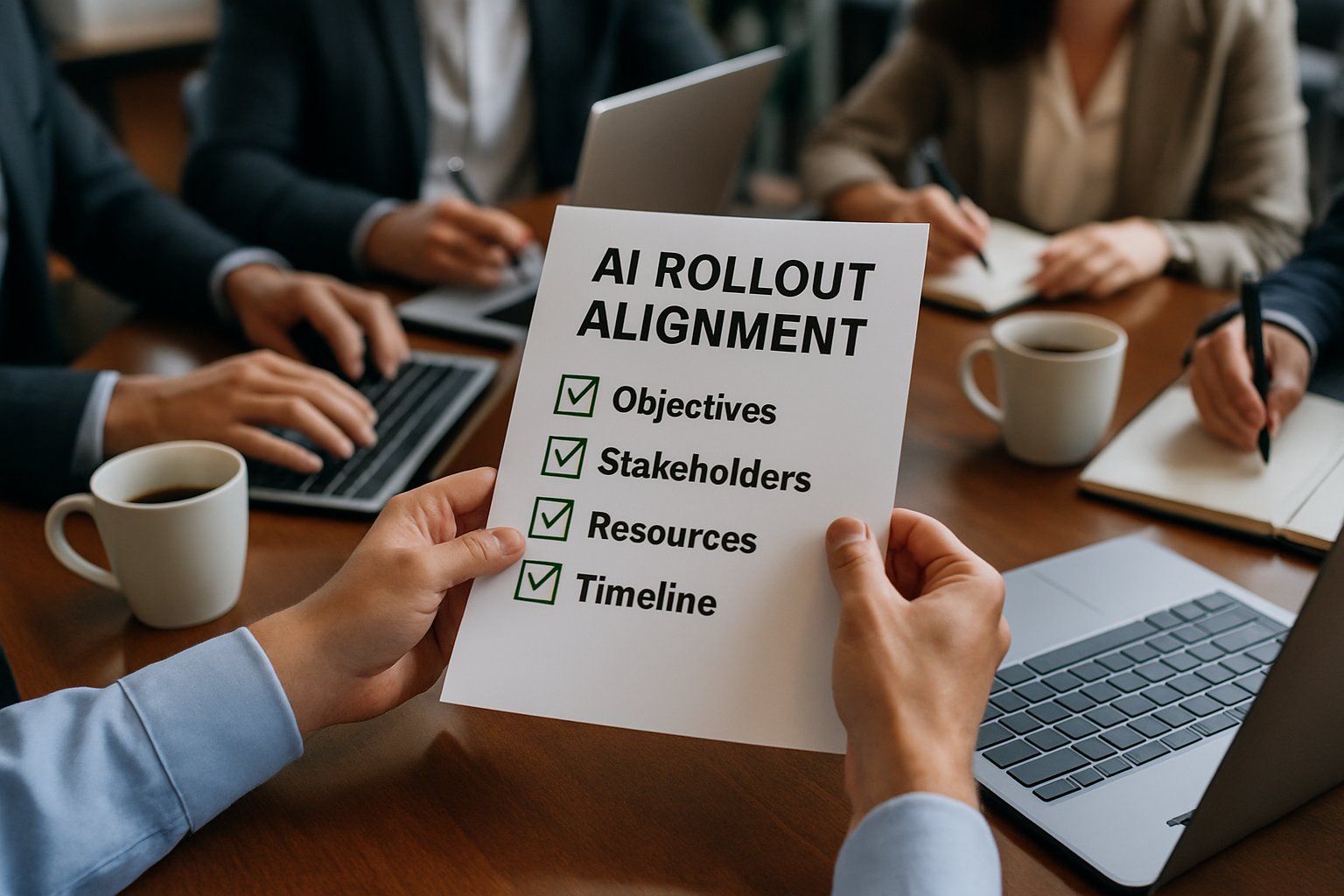
Why Alignment Truly Matters
McKinsey reports 88% of firms use AI somewhere, yet only one-third scale. Moreover, just 39% see bottom-line impact.
High performers share one trait: unified leadership ownership. Therefore, alignment is not soft politics; it is the growth engine.
In contrast, fragmented ownership breeds pilot purgatory and wasted spend. The lesson is clear.
Key takeaway: Unified sponsorship accelerates scale and profit. Now, let’s examine misalignment risks.
Common Misalignment Risks Now
C-suite surveys from EY and NTT DATA reveal rising optimism but thin governance depth. Meanwhile, CISOs complain of unclear policies.
Additionally, Gartner finds 80% of boards feel unprepared for AI oversight. Regulatory pressure magnifies that anxiety.
Shadow AI compounds risk. Without telemetry, leaders cannot see rogue tools or data leaks.
Key takeaway: Misalignment exposes compliance, security, and financial liabilities. Next, discover how to secure the rollout.
Secure Enterprise AI Rollout
A secure enterprise ai rollout demands controls from day zero. AdaptOps prescribes a Discover → Govern flow with stage gates.
Furthermore, readiness audits and ModelOps monitoring detect drift and hallucinations early. Finance models translate risks into dollars.
Consequently, sponsors gain evidence to approve or pause expansion.
Key takeaway: Security and finance lenses must guide every gate. We now unpack the framework.
AdoptOps Framework Key Steps
The AdaptOps model structures AI change into five clear phases.
Discover And Prioritize
Teams inventory processes, shadow AI, and regulatory duties. Baseline KPIs capture current cycle times.
Pilot With Control
Timeboxed pilots enroll 50–200 users plus a control group. Weekly ROI checks track minutes saved.
Scale With Evidence
Only pilots meeting ROI and risk targets unlock scale funding. Moreover, dashboards convert usage into FTE equivalents.
Embed Into Workflows
Interactive guidance, certifications, and manager coaching hard-wire new behaviors.
Govern For Trust
Quarterly reviews refresh metrics, budgets, and compliance proof.
Key takeaway: A phased path prevents chaos and funds winners. Let’s dive into the checklist itself.
Executive Checklist Core Items
The following ten actions form the definitive stakeholder alignment checklist for AI leaders.
- Appoint Sponsor + Owner. Issue a board memo naming roles and KPIs.
- Charter AI Council. Include CFO, CIO, CISO, CHRO, Legal, and product heads.
- Set Finance Metrics. Agree minutes saved, margin lift, and go/no-go thresholds.
- Run Readiness Audit. Map data risks, shadow AI, and regulatory scope.
- Fund Controlled Pilot. Allocate budget, baselines, and control cohorts.
- Add Governance Gates. Review privacy, bias, and model drift at weeks 4-8-12.
- Translate Results. Convert usage into FTE value and EBIT impact.
- Enable Change. Deliver leader coaching and role-based AI CERTs.
- Secure Compliance. Obtain privacy and legal sign-offs before scaling.
- Plan Quarterly Reviews. Refresh KPIs and funding every 90 days.
Key takeaway: The list assigns ownership, evidence, and authority. Measurement now becomes simple.
Measurement Governance Essentials Now
Government Copilot trials show 19–26 minutes saved daily, yet variance is high. Therefore, pilots need control groups and telemetry.
Additionally, ModelOps dashboards surface drift, cost trends, and incident alerts. Finance trusts data it can audit.
Moreover, board summaries must link AI usage to margin levers and risk posture.
Key takeaway: Robust measurement turns anecdotes into funding. Finally, let’s see the growth path.
Scaling Success Pathways Ahead
Once pilots hit targets, expand seats in waves. Meanwhile, sustain coaching and certification momentum to protect culture.
Consequently, organizations move from 200 early users to thousands without chaos.
McKinsey notes high performers commit 20% of digital budgets to AI. That investment is justified because metrics stay transparent.
Key takeaway: Evidence-based scaling multiplies value and confidence. Time to summarize actions.
Action Plan Summary Next
Executives should embed the stakeholder alignment checklist into every strategic review. Furthermore, they must revisit it whenever scope or regulation changes.
Aligned leaders, clear metrics, and disciplined gates transform ai adoption from hype to EBIT impact.
Ultimately, a disciplined enterprise ai rollout powers innovation, savings, and risk control.
Frequently Asked Questions
- What is an enterprise AI rollout and why is alignment important?
An enterprise AI rollout is a phased implementation ensuring unified leadership and clear ownership. Proper alignment minimizes risks, enhances compliance, and drives measurable ROI through real-time analytics and automated support. - How does Adoptify AI assist with digital adoption?
Adoptify AI accelerates digital adoption with in-app guidance, automated support, and real-time user analytics. Its workflow intelligence helps teams execute controlled pilots and secure scalable AI rollouts. - What role does governance play in AI adoption?
Governance sets clear KPIs, runs readiness audits, and enforces regular reviews. This disciplined approach ensures compliance and risk control, while leveraging automated support and user analytics for data-driven decisions. - How can digital tools enhance enterprise AI scalability?
Digital tools like interactive in-app guidance and automated support streamline workflows and boost engagement. Combined with robust user analytics, they enable continuous improvement and secure, scalable AI deployment.

FEATURED
How to Identify and Overcome Cultural AI Adoption Barriers
March 3, 2026
FEATURED
What Are the Most Common AI Adoption Challenges for Businesses
March 3, 2026
FEATURED
The Complete Guide to Building an AI Adoption Framework for 2026
March 2, 2026
FEATURED
Who Owns the Intellectual Property in Enterprise AI Adoption
March 2, 2026
FEATURED
7 Reasons To Embrace AI-Native Architecture
March 2, 2026