Future-Proof AI Systems Integration in ERP and CRM
Enterprises feel growing pressure to connect AI assistants directly with the business engines of record. Consequently, leaders now treat AI systems integration as a board-level priority. The move promises faster close cycles, smarter service, and real-time decisions. However, reality shows most firms still wrestle with tangled connectors, siloed data, and unclear governance. McKinsey notes 88% of companies run AI pilots yet few scale value. Meanwhile, Gartner predicts 40% of enterprise applications will embed task agents by 2026. Therefore, organizations that master integration early will outpace rivals. ERP AI integration challenges sit at the center of this race. This article maps current forces, best practices, and an AdaptOps playbook that drives reliable results.
Market Forces Driving Integration
Analyst research paints an urgent picture. Gartner, Microsoft, and SAP all advance embedded assistants within ERP and CRM workflows. Moreover, platform releases now land quarterly, not yearly. Successful AI systems integration will decide which platforms win.
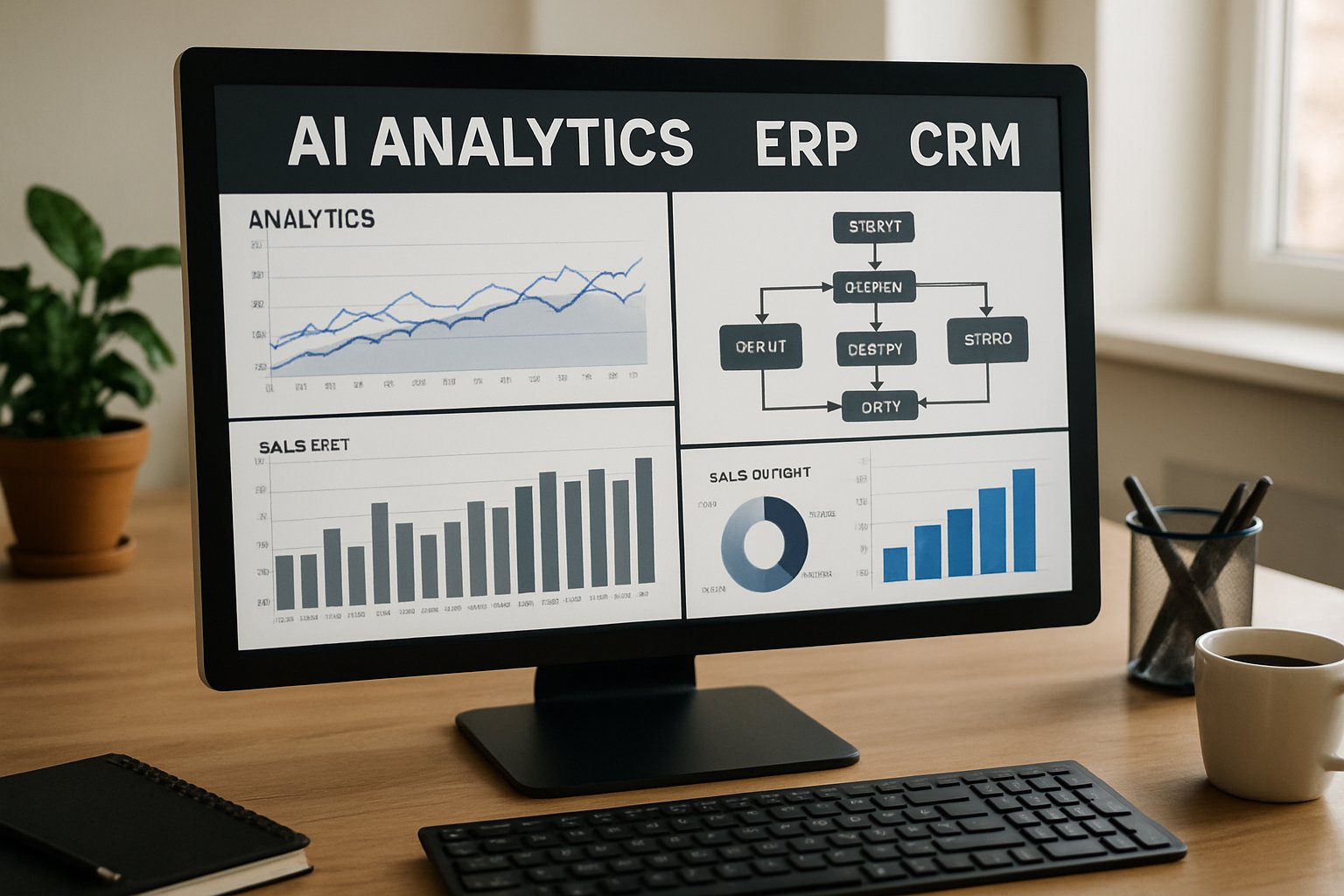
Microsoft’s Finance Copilot went GA in 2025 and links Dynamics or SAP data to close books faster. Similarly, Salesforce’s Agentforce strategy harnesses MuleSoft to let agents act across CRM and external APIs. These moves signal vendor commitment to production use.
However, integration, governance, and data quality remain the chief blockers to scaled value. Surveys show 80% of IT leaders list integration as the top obstacle. Demand for skills and battle-tested patterns therefore rises.
Platform momentum is clear and relentless.
Yet integration pain still limits ROI.
Next, we examine how the shift toward embedded agents changes the playbook.
AI Systems Integration Shift
Enterprises historically ran isolated AI proofs, separate from ERP or CRM data. Now, executive sponsors demand assistants that trigger journal entries, update opportunities, and monitor risk in one motion. This shift forces architecture teams to link models, agent frameworks, and orchestration layers with governed APIs. Consequently, ERP AI integration becomes both a technical and operating-model challenge. Organizations progressing fastest follow a staged AdaptOps path: Discover, Pilot, Scale, then Embed.
Embedded agents collapse context and action into one interface.
However, only composable integration unlocks that promise.
Solid data foundations must therefore come next.
Building Critical Data Foundations
LLMs and agents produce insight only when fed clean, timely records. Data teams should implement master data management, zero-copy fabrics, and canonical APIs before coding prompts. Vector stores with provenance metadata support retrieval-augmented generation and auditability.
- Adopt a federated data fabric connecting ERP and CRM sources without duplication.
- Establish a single customer and product master with strict stewardship rules.
- Expose fine-grained, versioned APIs for real-time access by agents.
- Embed telemetry hooks to track data freshness and usage patterns.
Together, these steps create the substrate for seamless AI systems integration across applications. Moreover, they reduce downstream rework and model drift.
Clean, governed data forms the integration bedrock.
Skipping this work risks costly failures later.
Governance controls reinforce these foundations.
Governance And Risk Controls
AI expands the attack surface and regulatory exposure. Therefore, organizations must design policy gates, automated audits, and human reviews into each agent workflow. Role-based access, data masking, and prompt injection defenses stop unwanted leakage.
Gartner recommends platform-agnostic governance spanning multiple vendors and clouds. Embedding dashboards that link policy violations to business KPIs strengthens executive support. Without disciplined controls, AI systems integration stalls during security reviews. ERP AI integration teams should align with risk, legal, and compliance staff from the first workshop.
Governance turns theoretical value into trusted production outcomes.
Security alignment early prevents late-stage delays.
Orchestration layers operationalize these controls across flows.
Orchestration Platform Readiness Path
iPaaS and orchestration vendors now ship agent-aware connectors for Dynamics, SAP, and Salesforce. Workato One and MuleSoft update flows using natural language and agent call patterns. Enterprises should prioritize platforms that support MCP protocols and low-code guardrails.
This choice accelerates ERP AI integration while preserving audit trails. Furthermore, clear CI/CD pipelines keep connectors tested against evolving APIs. With these elements, AI systems integration becomes a repeatable commodity service.
Agent-ready orchestration shrinks build time and maintenance effort.
It also provides visibility that governance teams demand.
Yet integration success depends on people, not only tools.
Change Management For Adoption
Technology fails without confident users. Adoptify recommends in-app guidance, micro-learning, and certification to build muscle memory. Champion networks share wins and surface friction early.
User telemetry pinpoints feature gaps and feeds rapid iterations. Consequently, ERP AI integration programs sustain momentum beyond the pilot phase. In many cases, AI systems integration success is measured by habit change, not code quality.
People-centric enablement converts technology potential into productivity gains.
Data-driven insights sustain those gains over time.
Metrics then inform the scaling strategy.
Measure Iterate Then Scale
AdaptOps urges leaders to track productivity hours recovered, error rates, and cycle times. ROI dashboards validate hypotheses within 90 days and guide further investment. Executives expand scope only when telemetry and governance artifacts show readiness.
Moreover, phased rollouts by region or business line reduce disruption. Teams should codify lessons learned into reusable playbooks.
Measurement closes the AdaptOps loop.
Evidence turns pilots into enterprise standards.
We close with key takeaways and an Adoptify perspective.
Conclusion
AI assistants will only deliver sustainable value when data, governance, orchestration, and people align. This article showed how market forces, data foundations, robust controls, and AdaptOps practices unlock that alignment.
Why Adoptify AI? Our platform embeds AI systems integration best practices into every step of your rollout. We supply interactive in-app guidance, intelligent user analytics, and automated workflow support that shorten onboarding and lift productivity. Moreover, our governance-first templates and enterprise-grade security scale confidently across global tenants. Experience faster time-to-value today by visiting Adoptify AI.
Frequently Asked Questions
- How does AI systems integration improve enterprise productivity?
AI systems integration streamlines enterprise productivity by automating financial and operational processes. It reduces manual errors, accelerates decision-making, and fosters efficient data updates, ultimately supporting digital adoption through in-app guidance and intelligent user analytics. - Why is clean data crucial for ERP AI integration?
Clean data is crucial for ERP AI integration, ensuring accurate insights and reducing operational risks. Robust master data management and versioned APIs enable reliable retrieval-augmented generation and seamless workflow automation, driving higher ROI and data governance. - How does Adoptify AI facilitate digital adoption and change management?
Adoptify AI facilitates digital adoption through in-app guidance, micro-learning, and real-time user analytics. Its automated support and adaptive workflows ensure smooth change management while aligning technology with business needs, shortening onboarding and boosting productivity. - What role do governance and orchestration play in successful AI integration?
Robust governance and efficient orchestration are pillars of successful AI systems integration. Secure API management, role-based access, and automated audits maintain compliance, while agent-aware connectors streamline workflows and ensure reliable performance in enterprise environments.

FEATURED
How to Identify and Overcome Cultural AI Adoption Barriers
March 3, 2026
FEATURED
What Are the Most Common AI Adoption Challenges for Businesses
March 3, 2026
FEATURED
The Complete Guide to Building an AI Adoption Framework for 2026
March 2, 2026
FEATURED
Who Owns the Intellectual Property in Enterprise AI Adoption
March 2, 2026
FEATURED
7 Reasons To Embrace AI-Native Architecture
March 2, 2026