Mastering AI Adoption Through Targeted Workforce Training
AI Adoption now decides whether organisations win or lag in 2025. Investors, boards, and employees expect fast productivity gains, yet talent gaps persist. Consequently, leaders must build reliable skill pathways, not just launch shiny tools.
Evidence backs this urgency. EY reports 40% of potential gains vanish when education lags deployment. PwC links AI skills to a 56 percent wage premium and huge revenue density.
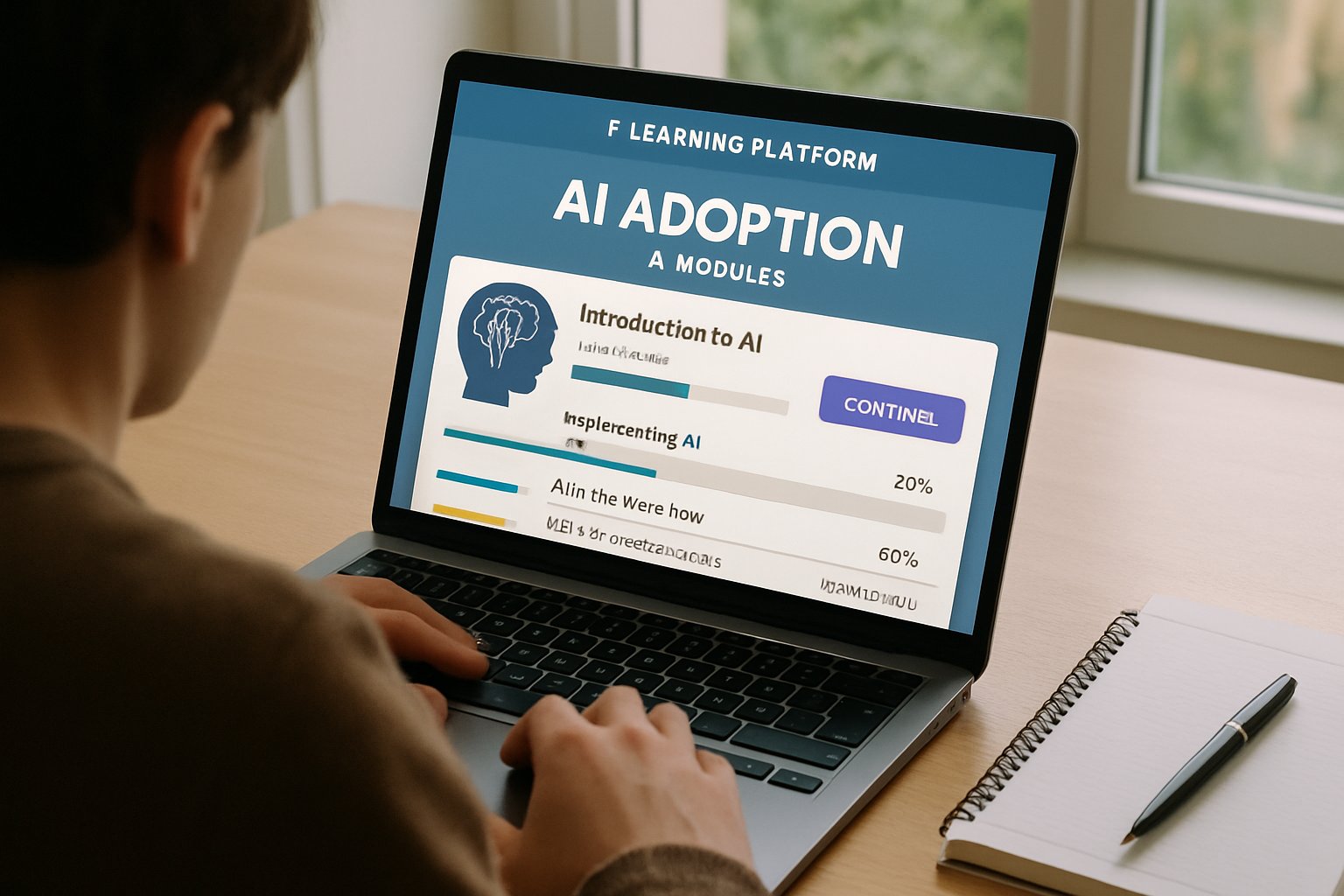
Therefore, we unpack a proven roadmap for AI literacy in the workforce at scale. We draw on AdaptOps pilots, microlearning, and governance templates to close the AI skills gap. Use this guide to transform curiosity into confident, compliant usage across every role.
Workforce AI Value Imperative
Boards cite ROI figures from Forrester, reaching 300% for Copilot pilots. Yet many teams still lack AI workforce readiness to exploit those gains.
Successful AI Adoption depends on pairing change management with hands-on enablement. Moreover, Cisco data shows 78% of ICT roles now request applied AI expertise.
Without structured AI literacy training, employees fall back to ad-hoc experiments and shadow tools. Adoptify research reveals that clear KPIs, plus coaching, improve uptake by 40% within 90 days.
Key Takeaways: Demand for talent is exploding, while readiness lags. Leaders must treat skills as core infrastructure. Next, we examine how to close the gap.
Closing The Skills Gap
The AI skills gap remains stubborn despite countless webinars and lunch-and-learn sessions. However, AdaptOps frames the challenge as a process, not an event.
Improved AI workforce readiness starts with transparent skill inventories. Targeted AI literacy in the workforce surveys reveal baseline fears and misconceptions.
Step one maps priority use cases, baseline minutes per task, and risk exposure. Subsequently, week-four reviews decide whether to extend, pivot, or exit the pilot.
This discipline converts training spend into an early business case for scaled results. Consequently, progress stays transparent and fundable.
Key Takeaways: Diagnose gaps early and measure progress often. Structured discovery sustains executive trust. Now, let’s detail the pilot pathway.
Pilot To Scale Playbook
Successful organisations embrace short, data-rich pilots. They launch with an executive sponsor, an L&D owner, and measurable hypotheses.
Additionally, each pilot bundles AI literacy training with governance templates and sandbox practice. AdaptOps suggests the following 30-90 day cadence:
- Week 0: Readiness scan and KPI baseline.
- Week 2: Hands-on labs inside real workflows.
- Week 4: ROI checkpoint and risk review.
- Week 6: Scale decision and funding gate.
This rhythm keeps momentum high while shrinking the AI skills gap. This alignment cements AI adoption and workforce skills within daily processes.
Key Takeaways: Timeboxes create urgency and reveal early value. Moreover, they protect budgets from endless experimentation. Next, we tailor learning to personas.
Role Specific Learning Paths
One-size training fails because roles differ widely. Frontline staff need prompt patterns; executives need decision dashboards.
Therefore, Adoptify builds persona maps linking AI adoption and workforce skills to job KPIs. Workshops on security and ethics strengthen AI literacy in the workforce across departments.
Managers enroll in microcourses that emphasise feedback loops and scorecards. Meanwhile, power users enter sandboxes to secure the muscle memory of advanced prompting.
This blended approach strengthens AI workforce readiness and builds confidence. Recognition and certification give employees tangible career currency.
Key Takeaways: Match content to daily work, and confidence grows. In turn, certification rates climb without force. The following section shows how governance accelerates trust.
Governance Meets Agile Upskilling
Policy documents alone rarely change behaviour. However, integrating guardrails inside the training flow does.
Adoptify embeds Purview simulations and DLP tips in each AI literacy in the workforce session. This way, learners practice safe prompts while measuring ROI impact.
Consequently, shadow AI incidents decline and compliance confidence rises. Adoptify also pairs governance reviews with AI literacy training refreshers to reinforce standards.
Key Takeaways: Governance must live within clicks, not slide decks. Therefore, safety aligns naturally with performance. We now explore how to quantify results.
Measuring AI ROI Fast
Executives fund programs that defend margins. Thus, AdaptOps captures pre-pilot baselines like minutes saved per task.
Dashboards correlate certification completions with adoption curves and revenue per employee. Forrester TEI methods then translate insights into NPV and payback months.
Teams see how AI Adoption improves productivity, retention, and risk posture. Enhanced AI workforce readiness connects learning metrics directly to P&L levers.
This evidence further narrows the AI skills gap across business units. Consequently, scaling decisions become objective.
Key Takeaways: Measurement validates budgets and guides reinvestment. Moreover, it helps L&D defend future funding. Our final section focuses on sustaining gains.
Driving Rapid AI Adoption
Sustained momentum demands ongoing nudges, community, and recognition. Adoptify 365 supplies in-app walkthroughs that trigger when users miss a best practice.
Additionally, champion networks share wins, while manager academies coach laggards. Continual nudges steadily shrink the AI skills gap.
Regular pulse checks refresh AI literacy training and celebrate new efficiencies. As a result, AI adoption and workforce skills stay aligned with strategic goals.
Key Takeaways: Reinforcement turns pilots into culture. Therefore, value compounds quarter after quarter. We conclude with next steps and a proven platform.
Conclusion
AI Adoption succeeds when skill, governance, and measurement advance together. This article showed how AdaptOps pilots, role-specific microlearning, and in-flow guidance close gaps fast. By linking dashboards to business KPIs, leaders unlock full ROI while safeguarding sensitive data. Moreover, the approach preserves psychological safety and fuels career growth.
Why Adoptify 365? The AI-powered digital adoption platform delivers interactive in-app guidance, intelligent user analytics, and automated workflow support. Consequently, teams onboard faster, work smarter, and scale securely with enterprise-grade controls. Experience the difference today by exploring Adoptify 365 at Adoptify.ai.
Frequently Asked Questions
- What is the importance of structured AI literacy training?
Structured AI literacy training empowers teams to confidently adopt AI by addressing skill gaps with tailored microlearning and in-app guidance, ensuring measurable ROI and safer, compliant practices. - How does Adoptify 365 secure rapid AI adoption?
Adoptify 365 integrates interactive in-app guidance, automated workflow support, and intelligent user analytics to drive rapid AI adoption, ensuring secure, compliant, and measurable digital transformation. - How do role-specific learning paths enhance workforce readiness?
Adoptify 365 tailors AI training to different roles with role-specific microlearning and sandbox practices, boosting user confidence, accelerating skill development, and directly impacting job KPIs. - What measurable benefits do short pilots offer for AI adoption?
Short, data-rich pilots provide early ROI by establishing baseline KPIs, conducting risk reviews, and enabling scalable improvements, reinforcing trust and aligning training with operational goals.

FEATURED
Scaling Retail Operations Through Corporate AI Adoption
February 27, 2026
FEATURED
How Corporate AI Adoption Reduced Operational Costs by 40%
February 27, 2026
FEATURED
Boutique Enterprise AI Adoption vs Big Four Consulting
February 25, 2026
FEATURED
Security Audit for Corporate AI Adoption
February 25, 2026
FEATURED
What is the Average Investment for Enterprise AI Adoption
February 20, 2026