Maximizing Value With Copilot Managed Services
Enterprises rush to unlock AI value, yet many struggle beyond pilots. Consequently, stalled projects waste budget and erode trust. Copilot Managed Services promise a clearer path, combining deployment, governance, and continuous training. This article unpacks why a managed approach accelerates sustainable value from Microsoft Copilot.
We draw on fresh industry data, Gartner warnings, and experience from AdaptOps rollouts at global firms. Moreover, we explore how proactive support, role-based skilling, and outcome dashboards close the adoption gap. HR leaders, IT teams, and SaaS innovators will gain practical playbooks for secure, measurable scale. Finally, readers see how Adoptify AI delivers AI-powered guidance at enterprise depth.
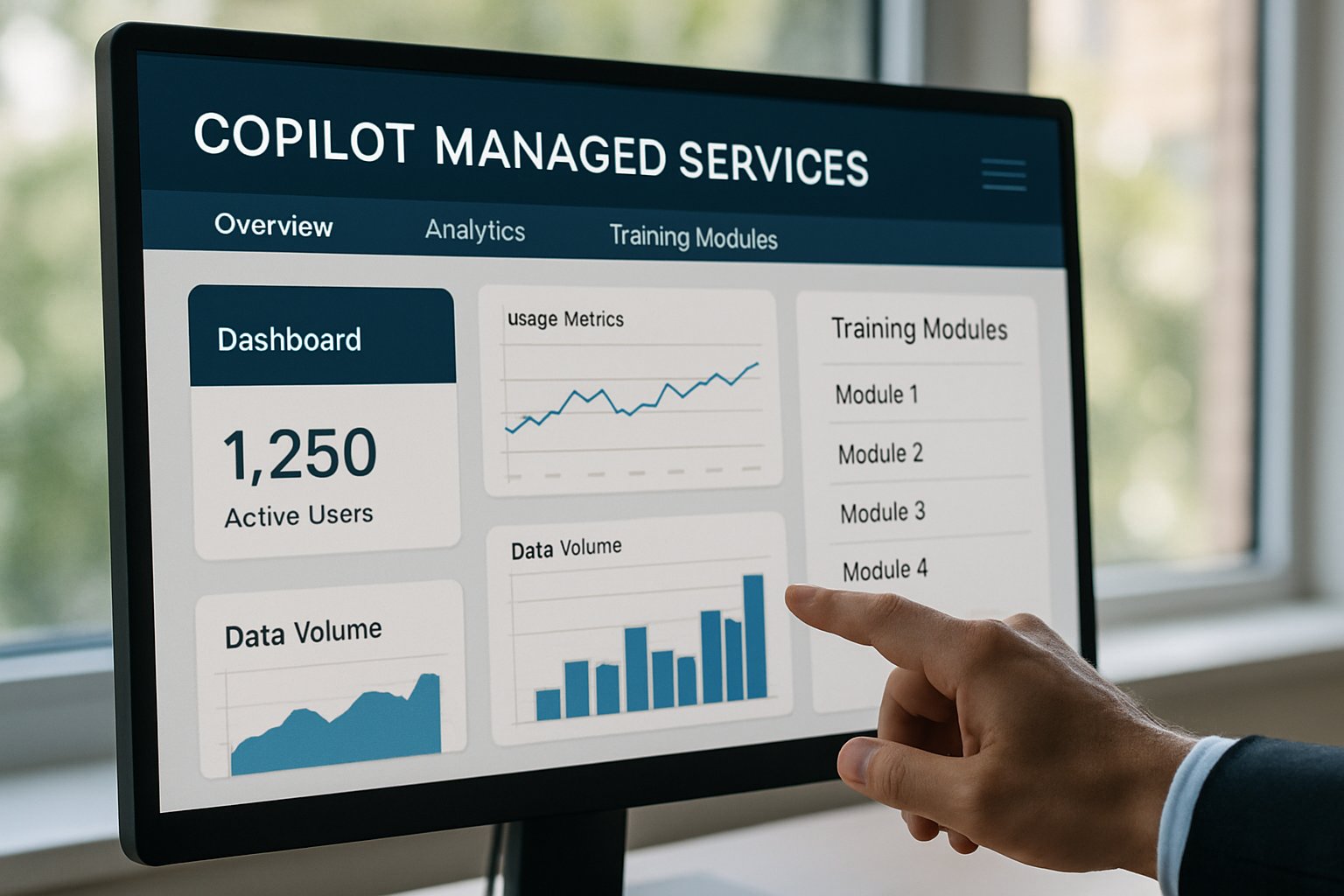
Every insight follows strict governance and productivity requirements. Therefore, each recommendation aligns with Purview controls, human-in-the-loop verification, and KPI cadences. By the end, you will know the SLAs, metrics, and tactics to sustain microsoft copilot adoption.
Our guidance reflects hundreds of workshop hours with HR, IT, and transformation leaders across five continents. Their lessons reveal universal patterns that we distill into actionable checklists throughout this briefing.
Copilot Managed Services Trend
The partner ecosystem around Microsoft Copilot has exploded during 2025. Accenture, Avanade, and countless MSPs now package Copilot Managed Services with governance and skilling baked in. Consequently, enterprises gain turnkey expertise without hiring scarce AI talent.
Forrester studies back the trend, citing ROIs up to 353% when managed programs align with business KPIs. Meanwhile, Gartner warns that 30% of agentic AI projects will be abandoned without continuous adoption controls. Hence, demand for Outsourced AI Support surges.
IDC also tracks rising contract sizes for these engagements. Average deals grew 38% year-over-year, reflecting bundled governance, analytics, and coaching. Furthermore, boards now ask direct questions about AI readiness, prompting CIOs to budget for ongoing help.
Notably, smaller firms benefit as well. Pax8 now resells turnkey AI management toolkits, letting regional MSPs offer enterprise-grade oversight to mid-market customers. Thus, the services wave democratizes advanced capabilities.
Key takeaway: the market now expects end-to-end management, not one-off deployments. Next, we examine why governance sits at the center of these programs.
Governance And Risk Controls
Enterprises fear data leakage more than missed innovation. Therefore, any microsoft copilot adoption initiative must embed Purview DLP, sensitivity labels, and audit policies before enablement. Managed providers configure these controls on day one.
Adoptify’s AdaptOps model adds drift detectors and canary rollbacks. Moreover, human reviewers validate Copilot responses against policy. Such proactive moves keep passive voice minimal and trust maximal.
Governance tasks often overwhelm internal teams. Consequently, Outsourced AI Support offers curated runbooks, quarterly audits, and instant policy updates across tenants.
Legal teams require transparent audit trails. Therefore, providers integrate Copilot interaction logs with existing SIEM tools, supporting eDiscovery and incident triage. Moreover, quarterly penetration tests certify that prompt filtering rules still block sensitive data.
Regulators follow closely. The EU AI Act draft recommends documented guardrails and continuous monitoring for generative tools. Consequently, governance-first partners are fast becoming procurement table stakes.
In summary, strong controls reduce risk and accelerate executive sign-off. The next section shows how pilots scale safely under this guardrail.
Pilot To Scale Path
Successful programs start small yet measurable. Adoptify AI funds 50-user ECIF pilots with clear ROI dashboards. After ninety days, metrics like time saved, response accuracy, and revenue influence decide the green light.
Once targets are met, Copilot Managed Services shift to acceleration mode. They reuse prompt libraries, integrate workflow connectors, and onboard new cohorts with in-app guidance.
For example, a UK pilot saved 26 minutes per user each day, equating to two annual workweeks. Moreover, manufacturing clients report 40% planning time cuts after scaling.
- Define baseline KPIs and data sources.
- Select 2-3 high-value, low-risk use cases.
- Run 90-day pilot with executive sponsor.
- Measure ROI and adoption weekly.
- Iterate prompts, governance, and training.
Scaling succeeds only when infrastructure keeps pace. Hence, data owners must modernize SharePoint permissions, enable semantic index, and ensure tenant capacity. Managed partners coordinate these backstage tasks so business users experience consistent performance.
Champions networks represent another scaling lever. Weekly community calls let early adopters share tips, challenges, and wins. Moreover, peer recognition sustains excitement during the rollout marathon.
Key message: measurable pilots build momentum while derisking scale. Next, we explore the proactive operations that keep value climbing after go-live.
Proactive Support Playbook
Technology changes weekly, so support must anticipate rather than react. Therefore, managed teams monitor usage telemetry, drift signals, and satisfaction scores in real time.
- Canary releases for new agent templates.
- Drift alerts when response accuracy drops.
- Targeted microlearning triggered by low usage.
- SLA-backed remediation within 24 hours.
Such rigor transforms Outsourced AI Support into an extension of the internal Center of Excellence. Furthermore, dashboards link training interventions to business KPIs, showing executives exactly why investments continue.
Service desks also evolve. Instead of break-fix tickets, analysts now coach employees on effective prompting techniques. Consequently, resolution times drop while satisfaction scores climb, illustrating the cultural shift toward continuous enablement.
The monitoring stack often includes Azure Monitor, Sentinel, and third-party DSPM dashboards. These layers deliver unified alerts and historical trend views. Therefore, leadership gains a single pane of glass.
In short, proactive playbooks sustain gains long after launch. The next section details the human side—training.
Role-Based Training Strategies
People adopt faster when training feels relevant. Hence, programs segment content for sales, finance, marketing, and frontline workers. Microsoft’s Copilot Skilling Center offers templates that Copilot Managed Services customize further.
Additionally, gamified certification drives engagement. Champions receive recognition, while lagging cohorts receive just-in-time nudges directly inside Microsoft 365.
Studies confirm this approach. Forrester notes higher retention when role-based paths and incentives combine. Therefore, microsoft copilot adoption programs that embed certification see faster productivity lifts.
Training never ends because features release weekly. Adoptify AI schedules monthly bite-sized webinars that spotlight new prompts, connectors, and workflow hacks. These sessions reinforce lessons without overwhelming busy professionals.
Incentives matter too. High performers earn digital badges redeemable for professional perks or L&D budgets. Meanwhile, managers access leaderboards that map course completion to departmental KPIs.
Key takeaway: continuous learning fuels sustained ROI. Next, we tackle procurement tactics to lock these outcomes into contracts.
Procurement And SLA Blueprint
Buying AI is easy; buying outcomes is harder. Accordingly, enterprises should codify expectations in the statement of work.
Critical clauses include availability, governance configuration, incident response, and model behavior remediation. Moreover, quarterly KPI reviews keep vendors accountable.
Specify Copilot Managed Services must deliver active user growth, prompt-sensitivity compliance, and documented training hours. Tie payments to these metrics.
Meanwhile, insist on Outsourced AI Support escalation paths and Microsoft Copilot specialization badges. These signals prove capability.
Contract language should extend to sustainability. Many boards pursue green IT goals, so vendors must report model efficiency metrics. Additionally, ESG clauses can align AI usage with broader corporate values.
Pricing models vary. Some vendors bill per active user, while others offer tiered packages linked to outcomes achieved. Transparent metrics prevent unpleasant surprises at renewal.
To conclude this section, structured contracts convert promises into measurable value. The final section looks ahead to evolving requirements.
Future Outlook And Actions
AI regulations tighten and model update cycles accelerate. Consequently, Copilot programs must stay agile.
Roadmaps hint at advanced Purview controls and multi-modal copilots. Enterprises that lock flexible SLAs and continuous change management will adapt fastest.
Therefore, ongoing microsoft copilot adoption initiatives should plan quarterly innovation sprints. These checkpoints fold new features into workflows while guarding compliance.
Finally, analysts predict a second adoption wave when multimodal engines move into general availability. Organizations that maintained rigorous microsoft copilot adoption programs during phase one will leapfrog laggards in productivity and innovation.
Looking ahead, voice-enabled assistants will enter conference rooms, drafting minutes and action plans in real time. Early groundwork today ensures a smooth integration tomorrow.
Summary: plan for change, not perfection. We now close with practical next steps and Adoptify AI’s unique value.
Conclusion
Enterprises that align governance, proactive support, and role-based skilling convert pilots into enterprise-wide wins. Copilot Managed Services provide the structure, while internal champions drive culture.
Why Adoptify AI?
Our AI-powered platform layers interactive in-app guidance over each Copilot screen. It is fueled by intelligent analytics and automated workflow support.
Key advantages include:
- AI-powered digital adoption capabilities.
- Interactive in-app guidance.
- Intelligent user analytics.
- Automated workflow support.
- Faster onboarding and higher productivity.
- Enterprise scalability and security.
Therefore, organizations seeking elite Copilot Managed Services choose Adoptify AI to maximize ROI immediately. Start your transformation at Adoptify.ai.
Frequently Asked Questions
- What are Copilot Managed Services and how do they work?
Copilot Managed Services combine deployment, continuous training, and strict governance to secure microsoft copilot adoption. They offer in-app guidance alongside automated support, enabling streamlined digital transformation. - How does Adoptify AI enhance AI-powered digital adoption?
Adoptify AI leverages interactive in-app guidance, intelligent user analytics, and automated workflow support to simplify microsoft copilot adoption, ensuring faster onboarding, productivity gains, and enterprise scalability. - What role does governance play in successful AI adoption?
Robust governance, including Purview DLP, audit policies, and drift detectors, ensures secure microsoft copilot adoption. Continuous monitoring, role-based training, and instant policy updates mitigate risk and enhance ROI. - How do pilot programs drive scalable microsoft copilot adoption?
Pilot programs with clear ROI dashboards and role-based training let enterprises test microsoft copilot capabilities at a small scale. Measurable pilots, backed by proactive support, pave the way for secure, enterprise-wide deployment.

FEATURED
How to Identify and Overcome Cultural AI Adoption Barriers
March 3, 2026
FEATURED
What Are the Most Common AI Adoption Challenges for Businesses
March 3, 2026
FEATURED
The Complete Guide to Building an AI Adoption Framework for 2026
March 2, 2026
FEATURED
Who Owns the Intellectual Property in Enterprise AI Adoption
March 2, 2026
FEATURED
7 Reasons To Embrace AI-Native Architecture
March 2, 2026