Microsoft Copilot Training: C-Suite Necessity for 2026
Microsoft Copilot Training now sits at the heart of every executive agenda. It links vision, governance, and financial upside. Consequently, boards ask hard questions about readiness, risk, and ROI. Forward-looking leaders must answer with confidence. However, capabilities evolve weekly, and the stakes climb. Therefore, 2026 demands structured, leader-level mastery.
Enterprise surveys confirm the urgency. McKinsey notes 46% of leaders cite skill gaps as the top AI barrier. Meanwhile, IDC reports GenAI usage surged to 75% in 2024. Moreover, Microsoft routed Copilot Chat to GPT-5 in late 2025. Each change amplifies value and risk. Hence, structured Microsoft Copilot Training delivers the needed fluency.
Evolving Copilot Platform Dynamics
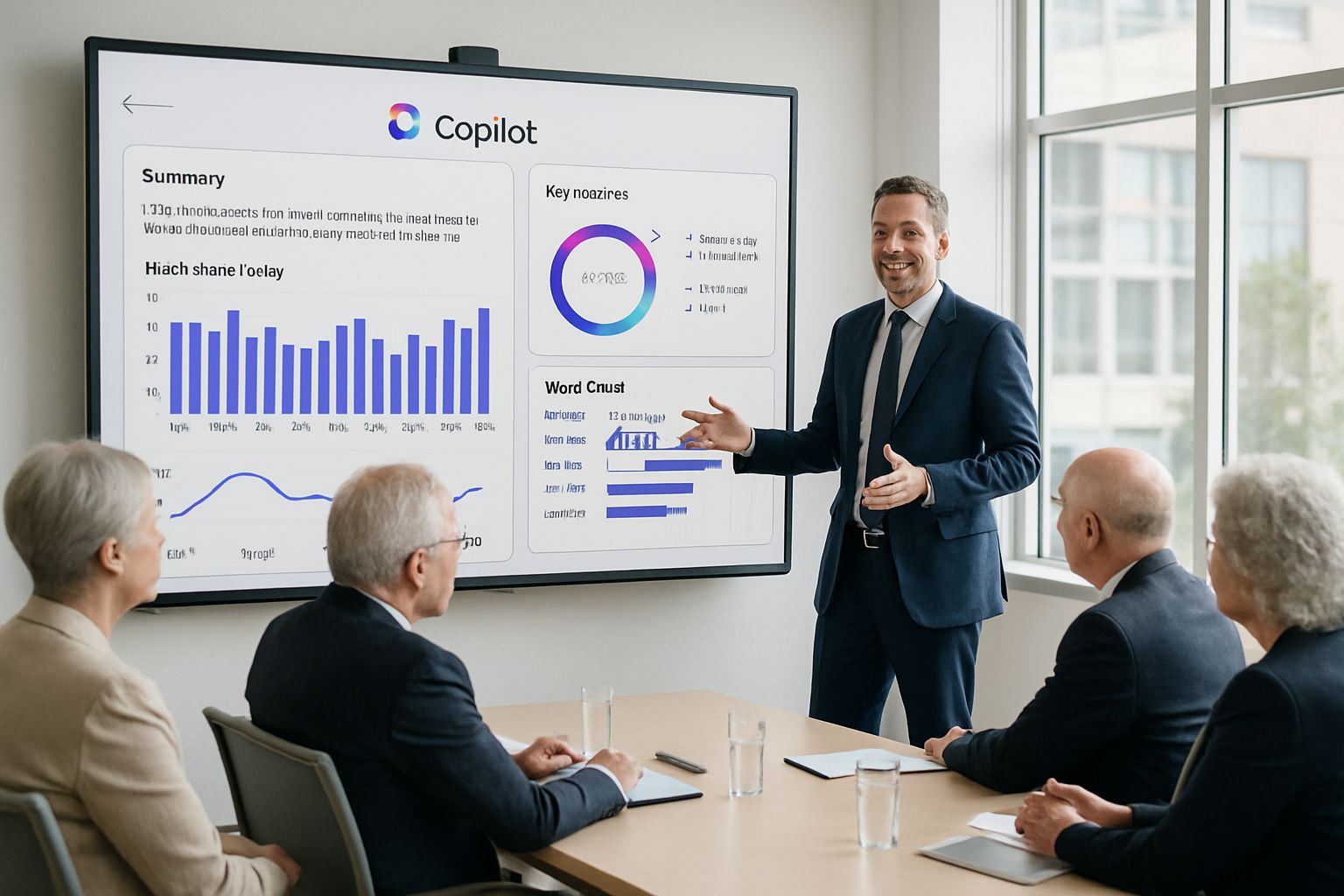
Copilot now operates as a platform, not a single tool. Copilot Studio lets teams publish custom agents. Additionally, Microsoft added unified agent management and new admin roles. These features increase agility. Nevertheless, they introduce governance complexity. Gartner warns that agent sprawl expands data-exposure surfaces. Forrester agrees, highlighting governance costs in ROI models.
Artificial intelligence adoption accelerates because these features unlock niche workflows. Yet, secure scaling hinges on leader oversight. McKinsey states executives underestimate grassroots usage. Consequently, decisions lag behind reality. Robust Microsoft Copilot security configuration knowledge becomes mission-critical.
Key takeaway: Copilot’s platform shift elevates both promise and peril. Next, we explore the capability gap.
Leadership Capability Gap Persist
Leaders often lack hands-on exposure. Surveys show employees experiment daily, while executives observe from afar. Therefore, decisions rely on second-hand reports. Consequently, approvals stall. Furthermore, security teams struggle to enforce policies that leaders never practiced.
Artificial intelligence adoption succeeds when executives model usage. LinkedIn data shows a three-fold rise in C-suite AI skill listings. Nevertheless, most leaders remain on the basics. Dedicated Microsoft Copilot Training fills that void with role-specific exercises.
Summary: The gap slows transformation and inflates risk. The next section details how focused training closes it.
Microsoft Copilot Training Impact
Targeted workshops immerse leaders in daily scenarios. First, they rewrite board decks using Copilot prompts. Next, they analyze KPI dashboards with AI-generated insights. Additionally, they simulate Purview policies to understand data boundaries. Each exercise links governance with value creation.
Forrester’s 2025 TEI study modeled 106%–314% ROI when training accompanied agent deployments. Meanwhile, SMB studies showed onboarding acceleration up to 25%. These outcomes depend on disciplined Microsoft Copilot security configuration at every step.
- Hands-on sessions with live tenant data
- Governance briefings covering DLP and model routing
- Telemetry dashboards tying actions to dollars
- Executive gates before large-scale expansion
Key point: Training blends usage, security, and measurement. Next, we examine risk controls in detail.
Governance And Risk Controls
Copilot introduces new threat models. Prompt injection, oversharing, and hallucinations sit at the top. Moreover, agent sprawl duplicates sensitive logic. Gartner prescribes AI Trust frameworks and TRiSM controls. Adoptify AI’s playbooks answer that call with Purview simulations and role-based gates.
Microsoft Copilot security configuration knowledge empowers leaders to sign off confidently. They test DLP rules, review model cards, and validate “No-Training-Without-Consent” policies. Consequently, legal and compliance teams align faster.
Takeaway: Governance becomes a shared executive sport. Subsequently, leaders must quantify the payoff.
ROI Driven Adoption Playbook
Executives care about numbers. Therefore, pilots must translate minutes saved into dollars earned. Forrester’s composite enterprise projected NPV up to $76.4M over three years. However, those gains required investments in training, governance, and operating cadence.
Adoptify AI’s telemetry pipelines capture time saved, revenue impact, and onboarding speed. Additionally, dashboards feed quarterly business reviews. Artificial intelligence adoption stays funded when these metrics stay visible.
Summary: Measurable ROI secures budgets. Next, we map the process that delivers it.
AdaptOps Operational Framework Explained
Adoptify AI’s AdaptOps model guides enterprises from Discover to Govern. First, teams assess readiness and identify quick wins. Then, a controlled pilot proves value within 12 weeks. Subsequently, scale decisions hinge on executive gates informed by data.
Throughout each phase, Microsoft Copilot Training synchronizes with governance tasks. For example, leaders practice agent lifecycle management right before the Scale decision. Therefore, learning aligns with immediate choices. Moreover, continuous cadence updates keep skills current as models evolve.
Key insight: Integrated operations and training sustain progress. Finally, we present an actionable 2026 plan.
Action Plan For 2026
Enterprises can follow seven steps:
- Run a leadership readiness assessment.
- Map workflows ripe for AI.
- Create a small, telemetry-rich pilot.
- Deliver Microsoft Copilot Training to all executives.
- Implement strict Microsoft Copilot security configuration controls.
- Quantify ROI and update dashboards.
- Scale using AdaptOps gates every quarter.
Artificial intelligence adoption thrives under this disciplined sequence. Consequently, risk decreases while value accelerates.
Takeaway: Methodical execution turns promise into profit. Let us conclude with final recommendations.
Conclusion
Every enterprise faces rapid AI shifts. Focused Microsoft Copilot Training empowers leaders to govern risk and capture ROI. Adoptify AI delivers that edge through AI-powered digital adoption, interactive in-app guidance, intelligent analytics, and automated workflows. Consequently, onboarding speeds up, productivity rises, and security scales with the enterprise.
Why Adoptify AI? The platform unifies training, guidance, and telemetry, ensuring secure, measurable transformation. Visit Adoptify.ai to accelerate your journey today.
Frequently Asked Questions
- What is Microsoft Copilot Training and why is it important?
Microsoft Copilot Training offers role-specific, hands-on exercises that empower leaders to navigate AI adoption. It reduces risks and bridges skills gaps using in-app guidance and user analytics for secure, measurable digital transformation. - How does structured Copilot Training enhance governance and risk management?
Structured training integrates practical exercises and security configuration, helping leaders manage agent sprawl and data risks. It leverages automated support and real-time analytics to enforce robust governance efficiently. - How does Microsoft Copilot Training drive measurable ROI?
By accelerating onboarding and streamlining workflows, the training turns saved minutes into measurable ROI. Telemetry dashboards and in-app guidance ensure that each training step contributes to financial performance and digital adoption success. - What role does Adoptify AI play in AI-powered digital adoption?
Adoptify AI seamlessly combines interactive in-app guidance, intelligent user analytics, and automated workflows. This unified platform supports secure transformation, empowers executives, and bridges the AI skills gap across enterprises.

FEATURED
How to Identify and Overcome Cultural AI Adoption Barriers
March 3, 2026
FEATURED
What Are the Most Common AI Adoption Challenges for Businesses
March 3, 2026
FEATURED
The Complete Guide to Building an AI Adoption Framework for 2026
March 2, 2026
FEATURED
Who Owns the Intellectual Property in Enterprise AI Adoption
March 2, 2026
FEATURED
7 Reasons To Embrace AI-Native Architecture
March 2, 2026