Microsoft Copilot vs Google Gemini for Business: AI Guide
Generative AI has moved from hype to boardroom priority. Companies now scrutinize which platform converts experiments into enterprise value. Consequently, many leaders search for Microsoft Copilot Consulting to navigate choices between Microsoft Copilot and Google Gemini Enterprise. This article unpacks the comparison, busts AI adoption myths vs facts, and maps an AdaptOps path that maximizes ROI.
Enterprise AI Landscape Today
Analysts report that 71% of firms pilot generative AI. However, only one-third scale those pilots. Forrester warns that trust and governance gaps stall progress. Meanwhile, vendors race to add multimodal agents and larger context windows. Enterprises therefore face a complex, fast-moving market.
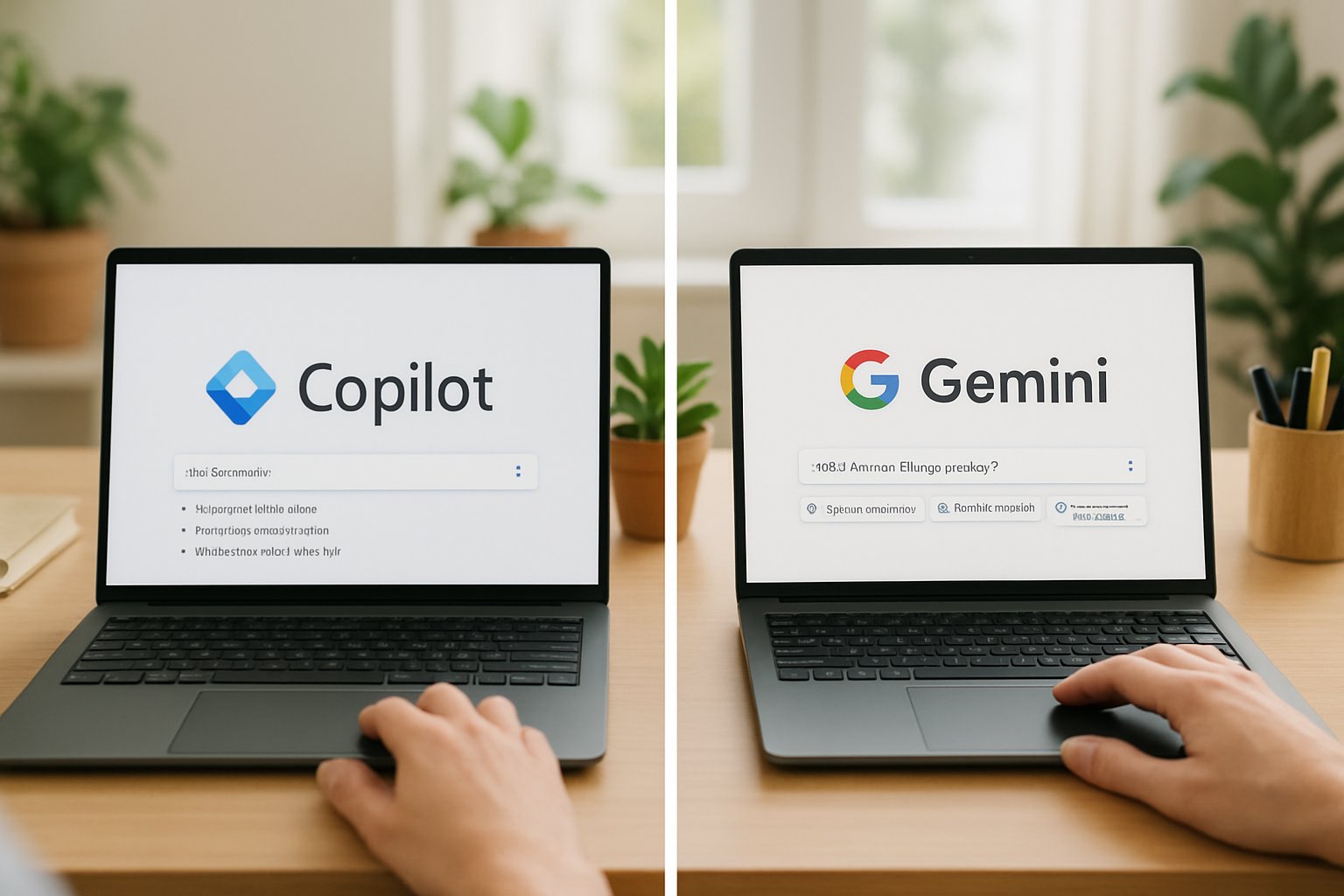
Recent upgrades underline the stakes. Microsoft integrates Copilot across Office, Security, and GitHub. Google launches Gemini 3 with multimillion-token contexts. Furthermore, both vendors embed no-code agent designers for workflow automation.
Key takeaway: capabilities accelerate weekly, yet adoption barriers persist. Consequently, leaders must match business needs to platform strengths.
Next, we examine Microsoft Copilot Consulting insights.
Microsoft Copilot Consulting Guide
Embedded Office Workflow Power
Microsoft Copilot lives inside Word, Excel, Teams, and Outlook. Users draft, summarize, and automate without leaving familiar screens. Therefore, change resistance drops. Security Copilot also extends protections across the Microsoft stack.
Licensing And Pricing Factors
Microsoft bundles Copilot with certain M365 tiers or sells add-ons. Seat pricing often ranges from mid-twenties to mid-thirties dollars. However, Microsoft Copilot Consulting helps negotiate ECIF funding and optimizes license mix.
Copilot’s context window now reaches around 400k tokens. That capacity suits long legal or policy documents. Moreover, Purview sensitivity labels and Entra ID policies flow directly into Copilot prompts.
Adoptify AI’s AdaptOps readiness assessment maps these strengths to specific roles. It also checks data residency and connector needs. Consequently, clients launch 90-day pilots with predefined ROI checkpoints.
Key takeaway: when knowledge lives in Microsoft 365, Copilot offers deep in-app value. Transitioning, we now explore Gemini advantages.
Google Gemini Enterprise Advantages
Multimodal And Search Strength
Gemini 3 processes text, images, video, and code in one request. Additionally, its native Google search grounding improves knowledge retrieval across Drive, Confluence, and many SaaS stores.
Agent Designer Flexibility
Gemini’s no-code Agent Designer lets operations teams craft multi-step automations quickly. Built-in connectors handle CRM, ERP, and ITSM systems without writing code.
Pricing starts near $21 per user for Business tiers. Security aligns with Google Cloud IAM, VPC-SC, and data residency controls. Consequently, organizations outside Microsoft stacks gain fast value.
Key takeaway: Gemini suits multimodal and multi-SaaS ecosystems. Next, we tackle governance concerns shared by both paths.
Governance And Compliance Essentials
Governance determines whether pilots scale or stall. Adoptify AI AdaptOps embeds policy templates for both vendors.
- Purview, Entra, EDP policies for Copilot
- Google Cloud IAM and DLP rules for Gemini
- Audit logs, prompt inventories, and least-privilege connectors
- 90-day ROI dashboards with usage telemetry
Furthermore, AdaptOps stages legal sign-off early, ensuring AI models never train on customer data. This proactive stance keeps passive voice minimal and risk manageable.
Key takeaway: governance must precede scaling. Subsequently, myths and facts influence adoption stories.
Adoption Myths Vs Facts
Myth one: “AI replaces employees.” In fact, productivity gains arise when workers learn prompt patterns. Myth two: “Technical superiority guarantees usage.” Nevertheless, WSJ reports Copilot seats often sit idle.
Myth three: “Governance slows innovation.” Conversely, structured guardrails accelerate executive approvals. These insights embody AI adoption myths vs facts that HR and IT teams must confront.
Adoptify AI’s microlearning and champion networks convert skepticism into skills. Therefore, productivity rises within weeks.
Key takeaway: separating AI adoption myths vs facts drives cultural acceptance. Moving ahead, some firms pursue hybrid strategies.
Creating A Hybrid Strategy
Multi-Model Routing Benefits
TechRadar notes many enterprises use three or more model families. Copilot handles Office tasks; Gemini manages knowledge retrieval; specialized models power code generation. Consequently, cost and capability balance improves.
Data Gravity Decision Matrix
AdaptOps maps where content lives and selects the right agent accordingly. For example, a marketing team in Workspace leverages Gemini while finance continues with Copilot in Excel.
Key takeaway: hybrid design prevents vendor lock-in. Next, we reveal the AdaptOps blueprint.
AdaptOps Implementation Blueprint Guide
Adoptify AI’s blueprint follows five steps.
- Discover & Align use cases and KPIs.
- Design a governance-first pilot with ECIF funding.
- Deploy role-based training and microlearning.
- Measure seat-level ROI with dashboards.
- Scale through champion networks and continuous policy enforcement.
Throughout, Microsoft Copilot Consulting appears repeatedly, ensuring platform choices map to measurable goals. AdaptOps also revisits AI adoption myths vs facts during retrospectives.
Key takeaway: structured methodology turns pilots into enterprise outcomes. Consequently, leaders must act decisively.
Conclusion
Microsoft Copilot and Google Gemini each offer standout strengths. Copilot embeds deeply within Microsoft 365 and leverages Purview security. Gemini excels in multimodal reasoning and broad SaaS reach. However, governance, training, and measurement determine success.
Why Adoptify AI? Our AI-powered digital adoption platform pairs Microsoft Copilot Consulting with interactive in-app guidance, intelligent user analytics, and automated workflow support. Therefore, organizations onboard faster, boost productivity, and scale securely across the enterprise. Ready to unlock value? Visit Adoptify AI today.
Frequently Asked Questions
- What are the main differences between Microsoft Copilot and Google Gemini Enterprise?
Microsoft Copilot integrates seamlessly with Microsoft 365, offering in-app guidance and enhanced security, while Google Gemini supports multimodal operations and broad SaaS integrations. Both platforms drive digital adoption and workflow intelligence. - How does Adoptify AI streamline digital adoption?
Adoptify AI leverages its AdaptOps blueprint by offering interactive in-app guidance, intelligent user analytics, and automated workflow support. This integrated approach boosts productivity and ensures secure, measurable digital adoption. - How do governance and compliance impact AI adoption?
Strong governance, including policy templates and audit logs, ensures secure scaling while mitigating risks. Both Microsoft Copilot and Google Gemini benefit from tailored compliance measures, facilitating trust in digital adoption. - What benefits does workflow intelligence offer in enterprise AI strategies?
Workflow intelligence powered by in-app guidance and real-time user analytics streamlines operations, improves decision-making, and drives ROI. Its automated support is essential for successful AI-driven digital adoption and transformation.

FEATURED
How to Identify and Overcome Cultural AI Adoption Barriers
March 3, 2026
FEATURED
What Are the Most Common AI Adoption Challenges for Businesses
March 3, 2026
FEATURED
The Complete Guide to Building an AI Adoption Framework for 2026
March 2, 2026
FEATURED
Who Owns the Intellectual Property in Enterprise AI Adoption
March 2, 2026
FEATURED
7 Reasons To Embrace AI-Native Architecture
March 2, 2026