Scaling Success: Seven Steps for Enterprise AI Deployment
Boards love AI pilots, yet many never leave the lab. However, pressure mounts to turn experiments into profit. This article maps the journey of enterprise AI deployment across business units.
We draw on Forrester, Gartner, and real AdaptOps engagements. Consequently, the guidance targets HR, L&D, IT, and transformation leaders. You will gain an actionable AI scaling strategy that compresses risk and accelerates value.
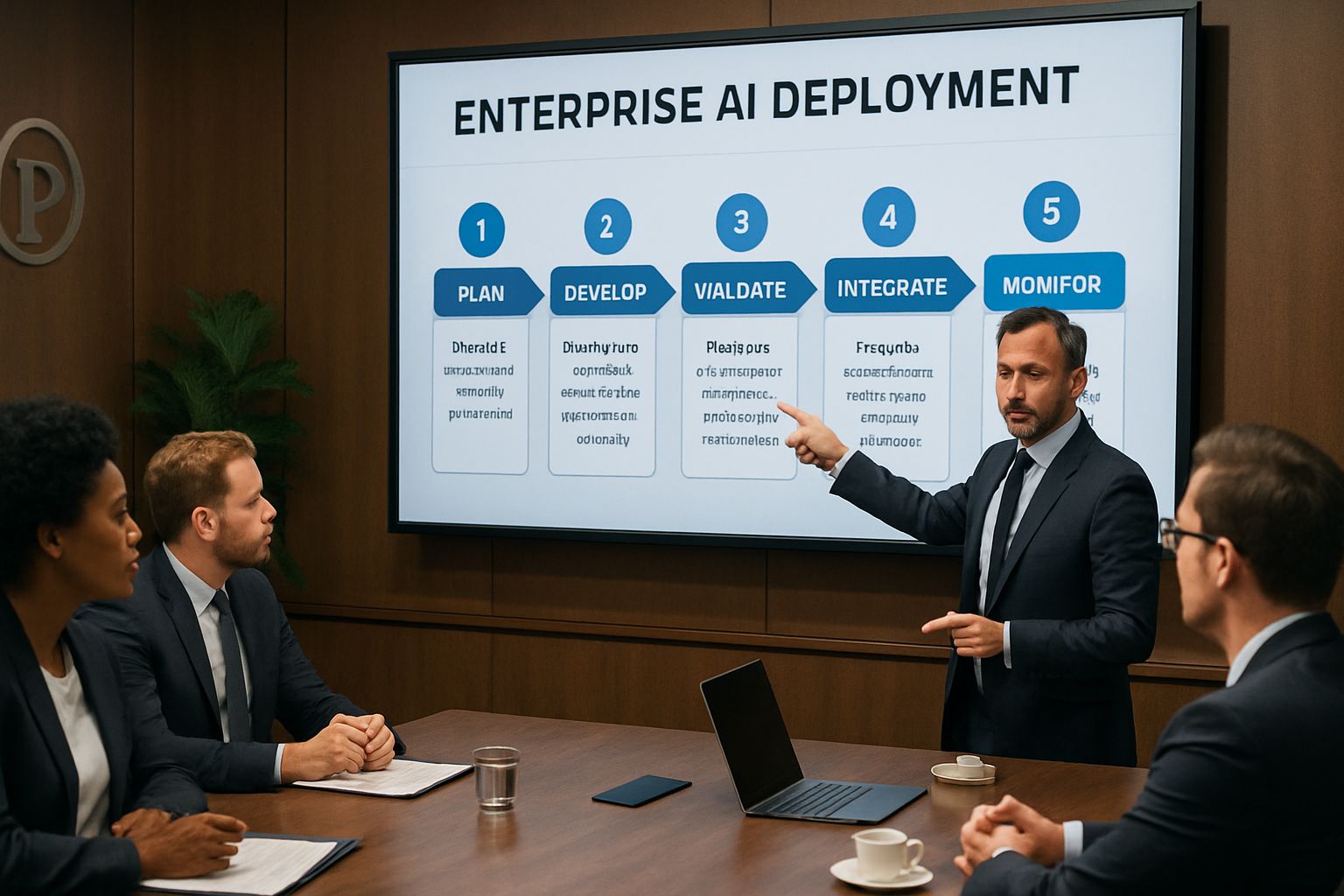
Pilot To Scale Reality
Forrester reports only fifteen percent of pilots reach sustained production. Meanwhile, Concentrix places the success rate near twenty-seven percent. The production gap remains stubborn regardless of sector or region.
Costs spike when usage grows, and governance scrutiny intensifies. Furthermore, time-saved metrics rarely convince CFOs without operational redesign. Therefore, leaders must confront scale realities during pilot design. Successful enterprise AI deployment demands honesty about these statistics early.
Pilots die when leaders ignore real production hurdles. Estimating cost, compliance, and adoption upfront preserves budgets and credibility. Next, we dissect the most common failure patterns.
Common Pilot Failure Patterns
Several patterns recur across stalled projects. First, curated data hides messy, distributed reality. Second, manual fixes during demos vanish in production.
Additionally, ownership gaps leave no one accountable for post-launch support. In contrast, unclear KPIs make value impossible to defend. Consequently, executives hesitate to fund wider rollout. Each issue derails enterprise AI deployment before the second funding gate.
Pilot shortcuts mutate into scale blockers. Recognizing these traps early guides proactive mitigation. Governance gates create that early discipline, as we discuss next.
Governed Enterprise AI Deployment
AdaptOps introduces explicit lifecycle gates from idea to global rollout. Moreover, each gate requires evidence on security, data readiness, ROI, and the chosen AI scaling strategy. Executive steercos review metrics before approving expansion.
- Readiness Gate: data, security, KPI baselines
- Pilot Gate: in-app guidance deployed to target roles
- Scale Gate: budget, adoption, governance evidence
This gatekeeping model aligns with Gartner’s AI engineering recommendations. Subsequently, pilot teams embed telemetry, DLP tests, and cost projections upfront. That rigor prevents surprise budget overruns at double-digit user loads.
Lifecycle gates translate vision into auditable, fundable reality. They assure every enterprise AI deployment aligns with risk appetite. Data readiness forms the first gate, so we explore it now.
Data And Integration Discipline
Many pilots rely on CSV exports or demo APIs. However, production workloads demand resilient pipelines, lineage, and monitoring. Adoptify readiness assessments surface missing connectors, schemas, and access policies early.
Furthermore, the framework catalogs latency budgets and compute costs. Therefore, architects can request realistic cloud reservations before day-one traffic arrives. This practice embodies a sound AI scaling strategy used by high performers. Skipping this work has doomed more than one enterprise AI deployment.
Clean, integrated data keeps models reliable and affordable. Early visibility eliminates rework that delays scale. Yet people, not pipelines, make adoption stick, which we cover next.
Key Workforce Enablement Levers
Models cannot deliver value without informed, confident users. Accenture trains thousands; Adoptify mirrors that approach with AI CERTs. Additionally, in-app guidance accelerates learning within flow of work.
Champion networks answer contextual questions and surface improvement ideas. Meanwhile, role-based certifications cement accountability and safe usage patterns. Such programs form the cultural core of any AI scaling strategy. Without them, even the most tuned enterprise AI deployment fades into disuse.
Upskilled people unlock model potential responsibly. Ongoing coaching sustains adoption momentum across units. Numbers then tell the success story, as the next section explains.
KPI Focused AI Rollouts
Gartner warns time saved rarely equals money saved. Consequently, Adoptify dashboards link user telemetry to throughput, error, and revenue metrics. Executive reviews every quarter decide whether to accelerate, pause, or pivot.
Furthermore, phased expansion enables A/B comparisons against baseline. Therefore, the business case strengthens with each measurable win. Leaders can refine their AI scaling strategy after each gate without sunk-cost panic.
KPIs convert technical achievement into financial credibility. Incremental proof fuels budget approvals for next use cases. Finally, we review how Adoptify unifies all these elements.
Adoptify AdaptOps Advantage Explained
AdaptOps bundles governance gates, in-app guidance, telemetry, and optimization loops. Moreover, 90-day engagements compress pilot timelines without ignoring scale realities. The platform’s ROI dashboards continuously benchmark cost versus outcome across units.
AI Audit Services integrate Purview, DLP simulations, and compliance trails for security approval. Subsequently, role-based enablement converts early champions into certified change agents. Consequently, customers transition to production thirty percent faster on average. That repeatable framework secures every enterprise AI deployment from pilot through scale.
AdaptOps orchestrates people, process, and platform into a single motion. The result is predictable, governed growth across business units. Let us close with final lessons and an invitation.
Conclusion
Scaling AI is never accidental; it demands design, discipline, and measurement. The journey outlined here shows how governance gates, solid data, and workforce enablement drive success. Purposeful KPIs then translate technical wins into financial impact for enterprise AI deployment.
Adoptify AI delivers that blueprint. Its AI-powered digital adoption platform combines interactive in-app guidance, intelligent user analytics, and automated workflow support. Therefore, organizations enjoy faster onboarding, higher productivity, and secure, enterprise scalability. Start your scaled AI journey today at Adoptify.ai.
Frequently Asked Questions
- How can organizations overcome pilot-to-scale challenges in enterprise AI?
Organizations overcome these challenges by enforcing governance gates, defining clear KPIs, and addressing production realities early with in-app guidance and intelligent telemetry, ensuring a smoother transition from pilot to scale. - What role does data integration play in scaling AI deployments?
Robust data integration forms the backbone of scaling AI. It ensures resilient pipelines, accurate data lineage, and early detection of missing connectors, all of which support seamless digital adoption and reduce costly rework. - How does Adoptify AI support workforce enablement in AI initiatives?
Adoptify AI boosts workforce enablement through role-based certifications, in-app guidance, and automated support, ensuring that users gain confidence and skills necessary for successful, scalable AI adoption. - How do governance gates and KPIs ensure successful AI scaling?
Governance gates and KPIs provide structured checkpoints that validate data readiness, security, and ROI. This disciplined approach, supported by automated analytics, translates technical achievements into measurable financial impact.

FEATURED
How to Identify and Overcome Cultural AI Adoption Barriers
March 3, 2026
FEATURED
What Are the Most Common AI Adoption Challenges for Businesses
March 3, 2026
FEATURED
The Complete Guide to Building an AI Adoption Framework for 2026
March 2, 2026
FEATURED
Who Owns the Intellectual Property in Enterprise AI Adoption
March 2, 2026
FEATURED
7 Reasons To Embrace AI-Native Architecture
March 2, 2026