Security Audit for Corporate AI Adoption
Data leaks. Biased AI decisions. Employees using random AI tools without approval. Sensitive company files ending up in public chatbots.
This is the reality many companies are facing during Enterprise AI Adoption.
In 2023, Samsung engineers accidentally leaked confidential source code after using ChatGPT for help with work tasks. The company later restricted generative AI use.
In 2024, the UK data protection authority warned organizations to check how AI tools collect and store personal data.
In 2023, Italy temporarily blocked ChatGPT over privacy concerns.
These events show one clear thing. Corporate AI adoption brings speed and growth. It also brings risk.
Many companies jump into AI because competitors are doing it. Few stop and ask, Is our system secure enough
This is where a structured security audit helps.
If your organization is planning Enterprise AI Adoption or already using AI tools, this 25-point security audit will give you a clear and simple checklist.
Before we begin, if you are exploring structured and secure AI implementation, you can learn more about Adoptify AI here.
Adoptify AI works with enterprises to guide safe and strategic corporate AI adoption without chaos or guesswork.
Now let us go through the audit in simple language.
Data Safety Checks
- Do you know exactly what data your AI system uses
- Is sensitive data like customer records separated from general data
- Are files encrypted while stored and while being transferred
- Do you have clear rules about who can upload data into AI tools
- Are employees trained to avoid sharing confidential data in public AI platforms
Data is like fuel for AI. If the fuel is messy or exposed, the whole system becomes risky.
Access Control
- Does every user have a unique login
- Is multi-factor authentication enabled
- Do managers review access rights every few months
- Can you instantly remove access when someone leaves the company
- Are admin privileges limited to a small trusted group
During enterprise AI adoption, access spreads quickly. Without control, it becomes impossible to track who did what.
Vendor and Tool Evaluation
- Do you know where your AI vendor stores your data
- Does the vendor follow global compliance standards
- Have you signed a clear data processing agreement
- Can you audit the vendor’s security practices
- Does the vendor provide transparency on how the model makes decisions
Corporate AI adoption often involves third-party tools. If the vendor fails, your company reputation suffers.
You can explore how AI strategy and governance services are structured here
This gives insight into how structured AI adoption programs assess risk before scaling.
Bias and Fairness Testing
- Has your AI model been tested for bias
- Does it treat different user groups fairly
- Are results reviewed by humans before major decisions
- Is there a process to fix unfair outputs
- Do you document how the model was trained
AI systems learn from historical data. If the old data had bias, AI may repeat it. A security audit also includes fairness checks.
Monitoring and Incident Response
- Do you monitor AI activity logs regularly
- Do you have alerts for unusual behavior
- Is there a clear plan if AI makes a harmful decision
- Do you test your incident response plan
- Does leadership review AI risks at board level
Security is an ongoing habit. It is not a one-time setup.
Why This Audit Matters for Enterprise AI Adoption
Imagine building a fast car. You want speed. You also want brakes, seatbelts, and airbags.
Corporate AI adoption works the same way.
Companies often focus on productivity gains, automation, and cost savings. Security and governance feel slow. Yet history shows that data breaches cost millions in fines and lost trust.
IBM’s Cost of a Data Breach Report 2023 states that the global average cost of a data breach reached 4.45 million dollars.
When AI systems connect to internal databases, customer records, and operational workflows, the risk surface grows wider.
This is why enterprise AI adoption needs a security framework from day one.
Industry-Specific Risk
Different industries face different AI risks.
- Healthcare deals with patient data.
- Finance handles transaction records.
- Retail manages customer behavior patterns.
- Manufacturing connects AI to operational systems.
You can see how AI strategies vary by sector here
Each industry needs a tailored approach to corporate AI adoption rather than copying what another company is doing.
The Hidden Risk: Shadow AI
Many employees start using AI tools on their own. They want faster emails, better reports, and smarter presentations.
This creates shadow AI. Leadership may have zero visibility into these tools.
A strong audit asks simple questions
- Which tools are being used?
- Who approved them?
- Where does the data go?
Without visibility, enterprise AI adoption becomes chaotic.
Building a Culture of Responsible AI
Security is not only technical. It is cultural.
Employees need simple training
Clear do and avoid rules
Regular reminders
Open communication about AI risks
When people understand the reason behind policies, compliance becomes easier.
Corporate AI adoption works best when IT teams, leadership, legal teams, and business units work together.
Where Adoptify AI Fits In
Many companies feel overwhelmed by AI choices. They hear about generative AI, predictive analytics, automation, and machine learning. They want results yet fear data leaks and compliance issues.
Adoptify AI supports structured enterprise AI adoption with governance, risk assessment, and strategic planning built into the process.
If you want guidance on secure corporate AI adoption, you can connect here.
AI can help companies move faster, serve customers better, and make smarter decisions. Yet growth without guardrails leads to trouble.
A security audit gives you clarity. It turns AI from a risky experiment into a controlled system.
Before scaling your next AI project, ask yourself one simple question.
Are we building speed without safety, or are we building both together

FEATURED
Scaling Retail Operations Through Corporate AI Adoption
February 27, 2026
FEATURED
How Corporate AI Adoption Reduced Operational Costs by 40%
February 27, 2026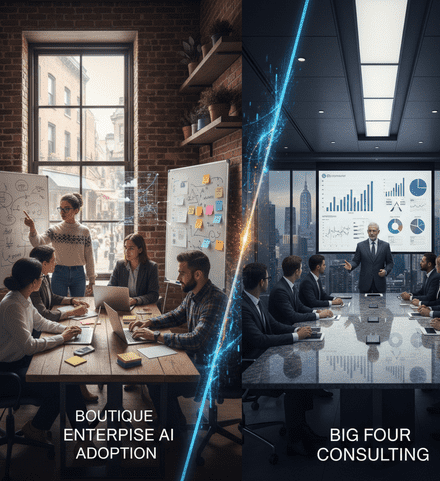
FEATURED
Boutique Enterprise AI Adoption vs Big Four Consulting
February 25, 2026
FEATURED
What is the Average Investment for Enterprise AI Adoption
February 20, 2026
FEATURED
Managed Enterprise AI Adoption Services for Legacy Systems
February 20, 2026