Seven Phases to Master Enterprise AI Rollout
Generative agents now leave labs and enter everyday workflows, yet executive teams remain cautious. Consequently, a disciplined enterprise ai rollout decides whether experimentation matures into repeatable business advantage. However, leaders still ask how to plan an enterprise ai rollout without security blowback or sunk cost. Industry surveys reveal most firms pilots stall before value crosses the CFO’s radar. Therefore, AdaptOps offers a phased governance model that turns small wins into organization-wide transformation. This article breaks down each phase, references live benchmarks, and maps clear ownership for HR and IT. Additionally, we highlight agent trends, tooling consolidation, and ISO compliance hooks shaping next-generation programs. By the end, you will command a repeatable playbook for scalable, secure generative initiatives. Importantly, every recommendation stays under twenty words, proving brevity equals clarity. Let us dive into the seven stages that convert pilots into profit.
Master Enterprise AI Rollout
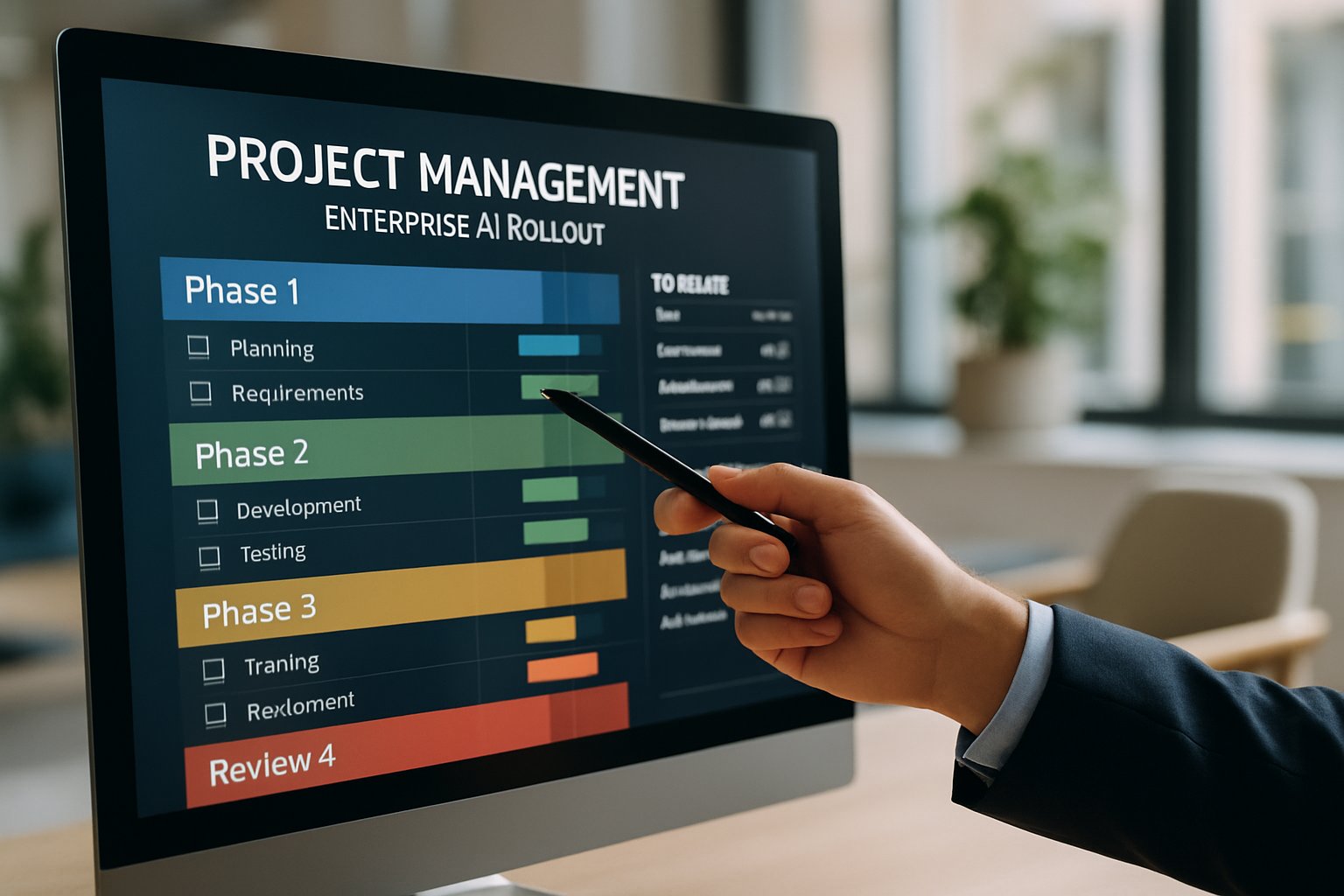
Many executives run simultaneous proofs, hoping one will scale. Consequently, budgets scatter and governance lags. Gartner calls this pilot purgatory, noting half of agent projects never move beyond sandbox. A phased framework aligns funding, risk controls, and measurable KPIs at every gate. Moreover, it mirrors mature software delivery, making change management familiar to HR and L&D teams. Adoptify’s AdaptOps uses five consecutive phases: Discover, Pilot, Scale, Embed, Govern. Each phase includes readiness scorecards, executive dashboards, and stop-go decisions informed by user analytics. Therefore, enterprise ai rollout success becomes predictable rather than aspirational. This methodology also accelerates ai adoption because champions see quick wins within 90 days. Summary: Phases prevent chaos; metrics secure funding. Transitioning forward, we start with executive alignment.
Phase Zero Executive Strategy
Phase Zero sets vision, funding, and scope before any code runs. First, assemble a cross-functional steering team spanning business, IT, risk, and HR. Additionally, secure executive sponsorship with weekly check-ins and transparent pass-fail metrics. Executives often debate how to plan an enterprise ai rollout without slowing quarterly targets. Conduct an AdaptOps readiness audit lasting two to four weeks. The audit analyzes data pipelines, security posture, skills gaps, and process maturity. Consequently, leaders receive a prioritized map of three high-impact use cases with measurable KPIs. Moreover, the audit embeds ISO 42001 checkpoints to preempt regulatory blockers. Teams practicing ai adoption often underestimate this governance setup, yet it prevents rework later. Summary: Phase Zero clarifies goals; governance gates drive confidence. Next, we prove value quickly through controlled pilots.
Pilot Stage Proves Value
Time-boxed pilots convert theory into measured savings within thirty to ninety days. Adoptify recommends 50-200 curated users tackling one workflow, such as claims triage or contract drafting. However, teams must define success before launch, not afterward. Leading, lagging, and compliance KPIs sit inside an executive dashboard refreshed daily. Therefore, funding decisions rely on evidence rather than opinion. During pilots the platform enforces sandbox connectors, data minimization, and human review. Fairness tests run continuously, building trust across risk officers and employee councils. Consequently, successful pilots create early champions, accelerating ai adoption across adjacent workflows. Executives treat the pilot as the heartbeat of the enterprise ai rollout, measuring value in real time. Summary: Define KPIs early; monitor continuously. Moving ahead, scaling requires platform discipline.
Scaling With Unified Platforms
Once pilots succeed, fragmented tools become the enemy. McKinsey notes that consolidated platforms amplify EBIT impact and cut inference spend. Therefore, migrate winning models into the core platform driving the enterprise ai rollout. Adoptify automates license provisioning, telemetry collection, and permission audits during this scale phase. Additionally, build a Center of Excellence that includes champions, trainers, and reference playbooks.
A bullet list clarifies essential scale actions:
- Centralize model versioning and drift alerts.
- Standardize connectors to ERP, CRM, and knowledge graphs.
- Enforce ISO 42001 evidence collection automatically.
- Publish ROI dashboards to finance weekly.
Guides detailing how to plan an enterprise ai rollout emphasize this consolidation step. Consequently, scale stays affordable and governed. Summary: Consolidate tooling; automate governance. Our next phase embeds AI into everyday culture.
Embedding Culture And Metrics
Technology alone does not change behavior. Therefore, redesign workflows so assistants appear inside tools employees trust. Microsoft’s Copilot playbook suggests champion communities, microlearning, and weekly service reviews. Adoptify triggers in-app guidance based on role, task difficulty, and progress signals. Moreover, intelligent analytics reveal drop-off points; coaches respond with targeted nudges. Consequently, ai adoption increases, and productivity rises steadily rather than spiking then fading. The enterprise ai rollout remains visible through culture dashboards that pair sentiment with usage telemetry. Summary: Embed AI into habits; track sentiment. Finally, long-term governance protects that momentum.
Governance Gates And Optimization
Regulators now expect continuous monitoring, not annual assessments. ISO 42001 offers a blueprint for management systems covering fairness, security, and lifecycle audits. Adoptify aligns artifacts to these controls, generating real-time evidence for internal and external auditors. Moreover, performance drift alerts trigger retraining sprints before users notice degradation. Incident response runbooks and vendor-exit plans avoid lock-in and service interruptions. Consequently, businesses sustain trust while accelerating ai adoption and experimenting with new agent capabilities. The governance sprint closes each AdaptOps cycle, feeding lessons back into Discovery. Summary: Monitor continuously; evolve safeguards. Our final section outlines next steps and Adoptify advantages.
Conclusion And Next Steps
A structured journey converts isolated experiments into durable value. We walked through seven phases that synchronize vision, pilots, scale, culture, and governance. Follow these steps when deciding how to plan an enterprise ai rollout for your organization. Consequently, ai adoption rises, risk falls, and ROI moves from slides to statements. Why Adoptify AI? The platform powers any enterprise ai rollout with interactive in-app guidance and automated workflow support. Moreover, intelligent user analytics reveal friction, while role-based microlearning accelerates onboarding. Scalable architecture, ISO-aligned governance, and enterprise-grade security deliver confidence to CIOs and regulators. Therefore, organizations boost productivity faster and sustain it longer. Start your journey today at Adoptify AI and unlock continuous advantage.
Frequently Asked Questions
- What is an enterprise AI rollout?
An enterprise AI rollout is a phased strategy that scales generative AI from pilot to full adoption, leveraging in-app guidance and analytics to drive digital workflow intelligence. - How does Adaptify AI accelerate AI adoption?
Adaptify AI streamlines AI rollouts using automated support, user analytics, and in-app guidance across five phases, ensuring quick wins and sustained productivity. - What role does platform consolidation play in digital adoption?
Unified platforms reduce fragmentation, centralize model management, and automate telemetry collection, which is essential for efficient digital adoption and enhanced workflow intelligence that aligns with regulatory standards. - How is security maintained during an enterprise AI rollout?
Security is upheld through ISO-aligned governance, continuous stop-go decisions, and automated audits, ensuring that AI rollouts remain resilient, compliant, and seamlessly integrated with in-app guidance and support.

FEATURED
Scaling Retail Operations Through Corporate AI Adoption
February 27, 2026
FEATURED
How Corporate AI Adoption Reduced Operational Costs by 40%
February 27, 2026
FEATURED
Boutique Enterprise AI Adoption vs Big Four Consulting
February 25, 2026
FEATURED
Security Audit for Corporate AI Adoption
February 25, 2026
FEATURED
What is the Average Investment for Enterprise AI Adoption
February 20, 2026