Smart Factory AI Adoption Readiness Assessment Guide
Manufacturers race to modernize plants, yet most still stall at proof-of-concept. A Smart Factory AI Adoption Readiness Assessment pinpoints why. The structured audit aligns people, processes, and platforms before large budgets flow. Consequently, factories speed pilots, avoid rework, and unlock measurable value sooner.
Why Readiness Really Matters
Industry data shows 92% of manufacturers view smart initiatives as future competitiveness drivers. However, only 29% have scaled AI beyond pilots. The Smart Factory AI Adoption Readiness Assessment creates a common scorecard. Executives see gaps in data, skills, and governance clearly.
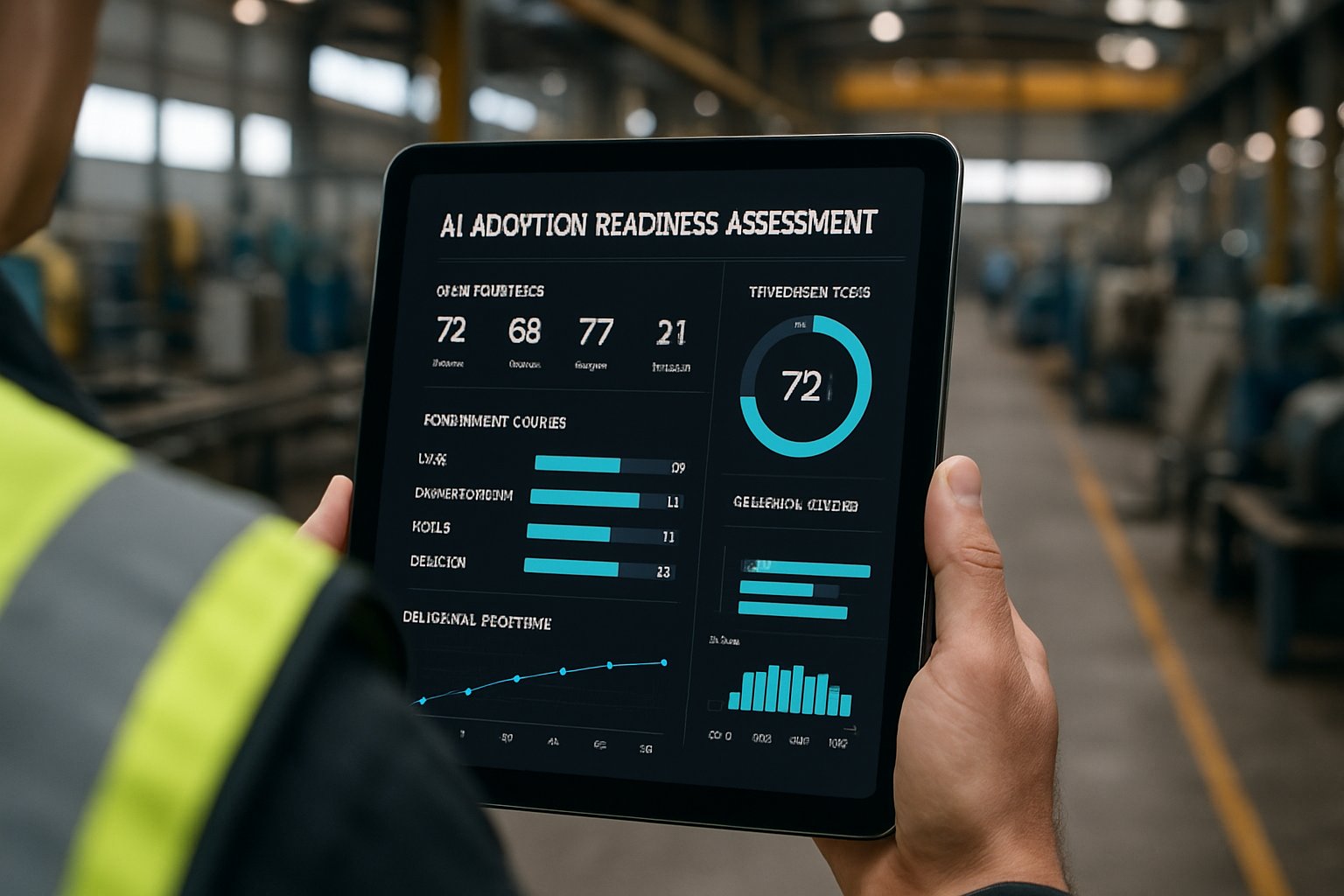
Deloitte reports 10–20% output gains when programs mature. Nevertheless, weak foundations erase upside. Therefore, readiness checkpoints de-risk investment and focus effort where payoff is largest.
Key takeaway: Readiness converts hype into performance. Next, we examine typical blockers.
Common Smart Adoption Barriers
Four pain points derail progress:
- Fragmented sensors and poor data quality.
- Workforce skill shortages and change fatigue.
- Lack of governance, KPIs, and ROI tracking.
- Cybersecurity and operational risk concerns.
BCG finds only 5% of firms capture scaled AI value. Consequently, most waste funding on stalled pilots. A Smart Factory AI Adoption Readiness Assessment flags these obstacles early.
Key takeaway: Removing barriers first accelerates deployment. Now, let’s outline the assessment itself.
Assessment Framework Key Steps
The audit spans eight disciplined steps:
- Stakeholder alignment on strategic objectives and KPIs.
- High-value use-case scoping tied to clear ROI.
- Data and connectivity diagnostics across OT/IT layers.
- Governance policy and operating-model design.
- Role-based workforce readiness mapping.
- Risk, compliance, and cybersecurity controls review.
- Pilot design with 90-day success metrics.
- Maturity benchmarking using indices like AIMRI.
Each step references the Smart Factory AI Adoption Readiness Assessment playbook from Adoptify AI. Moreover, the process delivers a prioritized roadmap within weeks.
Key takeaway: A repeatable checklist simplifies complex decisions. The following sections zoom into critical domains starting with data.
Data And Connectivity Gaps
Sensors feed models; incomplete telemetry starves them. Therefore, the readiness audit measures sensor coverage, latency, lineage, and cloud pipelines. Teams review schema stability and agree on minimal data contracts.
Deloitte’s survey notes companies invest first in IIoT and analytics before large-scale AI. Consequently, factories that pass data readiness scale faster. The Smart Factory AI Adoption Readiness Assessment quantifies maturity using graded rubrics.
Key takeaway: Solid data plumbing prevents costly redesigns. Governance comes next.
Governance And People Readiness
AI thrives when business and IT co-own outcomes. The audit defines clear roles: business owner, data steward, ML engineer, and frontline operator. Additionally, it embeds KPI dashboards for transparent accountability.
Workforce enablement matters equally. Role-based training, certifications, and adoption champions encourage daily use. Deloitte cites human capital as the largest improvement area. Therefore, the Smart Factory AI Adoption Readiness Assessment stresses people metrics beside technical ones.
Key takeaway: Governance plus upskilling build trust and momentum. We now bridge pilots to enterprise scale.
Pilot To Scale Roadmap
Adoptify AI’s Quick Start pilots target 50–200 users and deliver ROI inside 90 days. Each pilot includes gate reviews, value dashboards, and rollback plans. Consequently, leaders spot winning cases early and redirect capital confidently.
After validation, AdaptOps governance kits guide multi-department rollout. Templates cover model monitoring, data drift alerts, and compliance audits. A Smart Factory AI Adoption Readiness Assessment anchors every stage gate with objective evidence.
Key takeaway: Structured pilots reduce risk. Continuous loops sustain gains.
Continuous Improvement Feedback Loop
Factories evolve; models must evolve, too. The readiness assessment recommends quarterly reassessments against maturity indices. Moreover, managed analytics track adoption, accuracy, and financial impact in real time.
When gaps emerge, teams launch micro-sprints to retrain models, refresh data, or reskill employees. Consequently, performance compounds rather than plateaus. The Smart Factory AI Adoption Readiness Assessment thus becomes a living document.
Key takeaway: Continuous checks keep AI relevant. The conclusion wraps the full story.
AI Adoption Readiness Guide
This sub-section reinforces best practices:
| Dimension | Assessment Question | Success Indicator |
|---|---|---|
| Strategy | Are KPIs linked to AI? | Baseline and target values documented |
| Data | Is telemetry complete? | 95% critical signal coverage |
| Governance | Are roles defined? | RACI matrix approved |
| Workforce | Are users trained? | 80% certification completion |
These criteria form the heart of every Smart Factory AI Adoption Readiness Assessment.
Conclusion
A Smart Factory AI Adoption Readiness Assessment aligns strategy, data, governance, and people. It removes common barriers, accelerates pilots, and supports governed scaling. Frequent reassessment sustains competitive advantage.
Why Adoptify AI? Adoptify AI combines AI-powered digital adoption, interactive in-app guidance, intelligent user analytics, and automated workflow support. Consequently, enterprises onboard faster and boost productivity while preserving security at scale. Explore how the Smart Factory AI Adoption Readiness Assessment and Adoptify AI together streamline factory workflows. Visit Adoptify.ai to get started today.
Frequently Asked Questions
- What is a Smart Factory AI Adoption Readiness Assessment?
It’s an audit evaluating data, governance, and workforce skill gaps to de-risk AI pilots and ensure scalable smart factory digital adoption. - How does the assessment accelerate pilot projects?
By identifying data gaps and governance issues, it streamlines AI pilot designs, reduces rework, and supports rapid ROI through structured checkpoints. - How does Adoptify AI enhance digital adoption in smart factories?
Adoptify AI offers in-app guidance, intelligent user analytics, and automated support, enabling seamless workflow integration and faster onboarding to AI solutions. - What common barriers are addressed in the assessment?
The assessment tackles fragmented sensors, poor data quality, skill shortages, and weak governance, providing a clear roadmap for effective and scalable smart factory AI deployments.

FEATURED
How to Identify and Overcome Cultural AI Adoption Barriers
March 3, 2026
FEATURED
What Are the Most Common AI Adoption Challenges for Businesses
March 3, 2026
FEATURED
The Complete Guide to Building an AI Adoption Framework for 2026
March 2, 2026
FEATURED
Who Owns the Intellectual Property in Enterprise AI Adoption
March 2, 2026
FEATURED
7 Reasons To Embrace AI-Native Architecture
March 2, 2026